



There is good reason to phase out plastic. Flexible plastics escape into rivers, oceans and landfills, where they persist for decades, fragment into microplastics and leach chemicals into water and soil, and the harm lands hardest in the places least equipped to collect them.
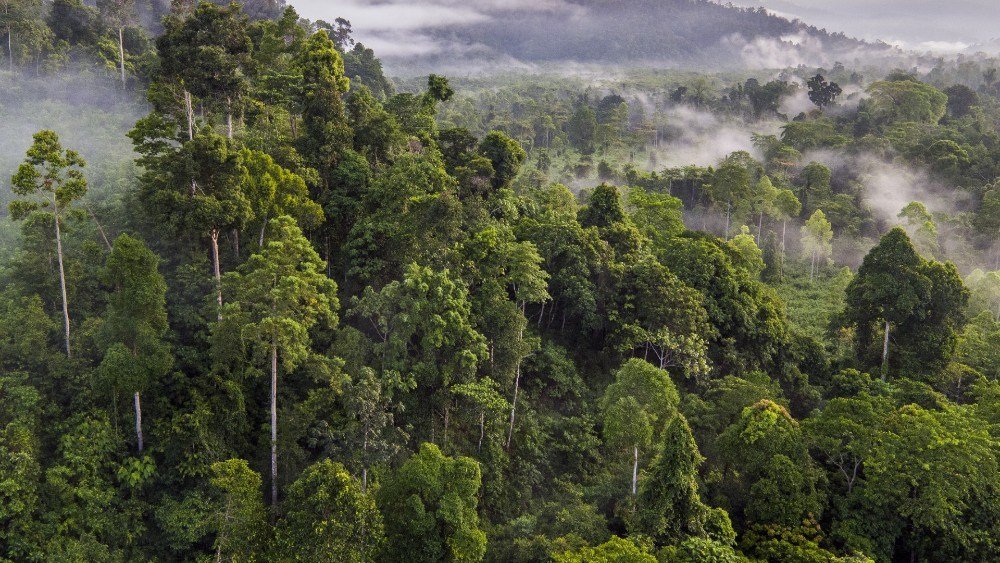
But the transition raises a question: can forests supply its replacement? The world harvests about 4 billion cubic meters of wood each year, and demand is projected to approach 6 billion by 2050, but supply is already constrained. Since 1990, the world has lost 489 million hectares of forest to deforestation, and more than 460 million hectares of what remains stand degraded.
Fires touch another 127 million hectares of forest a year. That is over 1 billion hectares gone or diminished—more than the area of Canada. A packaging decision measured at the factory gate misses most of this because carbon accounting has a blind spot: it treats the biogenic carbon in wood as neutral and puts those uncounted harvest emissions, across all wood uses, at 3.5 to 4.2 billion tons of CO2 a year, more than three times the aviation sector.
Net zero balances two columns: the carbon we release and the carbon nature absorbs. A standing forest sits in the second column. Log it for packaging, and the ledger records a saving for the plastic avoided, but nothing for the lost absorption. That is where the numbers do not add up. A new study in Science, a publication of the American Association for the Advancement of Science, measured the difference.
Primary boreal forests in Sweden hold about 72 percent more carbon than logged and regrown ones, even counting the wood products, and most of that carbon sits in soils that take centuries to recover. For any company serious about net zero, those are not savings, they are costs moved off the corporate balance sheet, onto landscapes, watersheds and the communities that depend on them.
And while certification and recycling remain best practices, neither provides enough fibre.
Certified forests, across FSC and PEFC combined, cover roughly a tenth of global forest area, and 78 percent of that sits in North America and Europe. Those certified lands are mostly working forests supplying around a quarter to a third of the world’s industrial wood. Even so, most of what the market buys is uncertified. And the fix is not simply extending certificates into the intact forests that remain, which do the most for climate and biodiversity. Certification also creates no additional cellulose. A certified eucalyptus plantation in Brazil or an acacia plantation in Indonesia may offer the same certificate as a regenerating native forest, but they provide exponentially inferior ecosystem services.
Recyclability also has its limits, as it only tells us about a package’s next life, not whether the landscape supplying its first life can withstand more demand. The U.S. industry reports that 70-75 percent of cardboard available for recovery was recycled in 2025. There is room to improve collection, sorting and yield, and we should. But recovered cardboard is already a heavily used industrial input, with competing buyers and quality requirements. Mills keep adding recycled capacity faster than used boxes appear, with 2.4 million tons of new recycled containerboard capacity in under two years, so demand for recovered fibre already outstrips supply.
The business question is how to meet new demand without deepening dependence on an increasingly pressured input.
Agricultural residues offer one substantial answer, and supply is available at scale. Wheat straw, barley straw, rice straw and sugarcane bagasse contain cellulose from harvests that already occur. Canopy‘s modeling puts the available potential of four residues alone at roughly 245 million dry tons a year, and that is after leaving half of every straw crop on the field for soil health. Where responsibly available material can be aggregated near production, these feedstocks support shorter supply chains, diversify sourcing and create additional income in farming regions.
The challenges of these alternative feedstocks are surmountable with investment. Straw is seasonal, bulky and variable, and a mill built for wood needs modification to process it. The feedstock also has existing buyers, since straw and bagasse already supply animal bedding and bioenergy. New processing and mill technologies are steadily improving pulp quality and yields. And when regional demand is aggregated into firm volume commitments, capital can flow into collection, storage and mill conversion. Buyers who commit early are not just securing supply, they are financing the transition.
The economics are also promising. Canopy’s modelling shows mills can blend residue pulp at today’s delivered prices of $345 to $380 per ton, and policies already in motion, EPR fee modulation and EU deforestation due diligence, add another $10 to $35 per ton to its value. Straw pulping technology is better than it was five years ago. The barrier now is the system around it: product specifications, supply contracts and procurement processes are all written for wood, which keeps residue fiber niche no matter how well it performs. Specifications follow the buyers who write them, and big buyers can rewrite them.
And this is not a bet on a single product in the packaging portfolio. Residue pulp blends into existing paper grades, which means it can spread across a packaging portfolio. Paperboard is the natural first home, the largest segment of the packaging market and among its fastest growing, where blends of 5-10 percent work in commercial furnishes today and a specification change would enable up to 30 percent. Integrating Next Gen alternatives into existing paper blends can slash greenhouse gas emissions: Canopy’s latest research finds that replacing virgin softwood from old-growth forests with virgin wood from managed forests alongside 10 percent agricultural residues could reduce lifecycle greenhouse gas emissions by 50 percent in some applications.
My call to companies moving away from plastic is to embed fibre diversification from the outset, and to measure it.
The principle is simple. No net new wood. For every tonne of plastic replaced with fibre, at least a tonne of alternative cellulose enters the supply. Paper innovation can help end plastic pollution while building a more resilient material system. Whether it does depends on how far upstream we are willing to redesign.
Kari Stoever is Head of Impact at Canopy, where she works with more than 1,000 global brands to accelerate the transition to low-carbon, circular materials and forest-friendly supply chains. A global leader in policy and sustainable finance, she helps businesses translate nature and materials risk into resilient supply chain and investment strategies.