



PARIS — Ode Parfums intends to revolutionize the fragrance industry.
“We want to be the brand for everybody,” said Grégory Mager, Ode cofounder, alongside Julien Saada, “to make affordable luxury in order to disrupt the market, and make high creativity, high quality accessible to all.”
Their plan is ambitious, but rewind 30 years to understand how it came to be. Mager and Saada cofounded a company now known as Maesa in 1997. That started as the maker of private-label perfumes and cosmetics for specialty fashion retailers, and now also serves as a brand incubator.
The duo sold their majority control of Maesa to Bain Capital seven years ago. They remained operationally involved for a couple of years, and now are board members and minority shareholders.
“This gave us the opportunity to really look deep into what we wanted to do,” Mager said. “Julien and I are still young, and more importantly, we felt that there was still a lot to do in beauty.”
They are passionate about fragrance and hail from the South of France, the birthplace of modern perfumery. The two men met there at age 15.
“We’ve always felt that, especially with perfume, we could do fantastic quality for affordable price points,” Mager said. “This is what we did for Zara, for H&M, for Primark.”

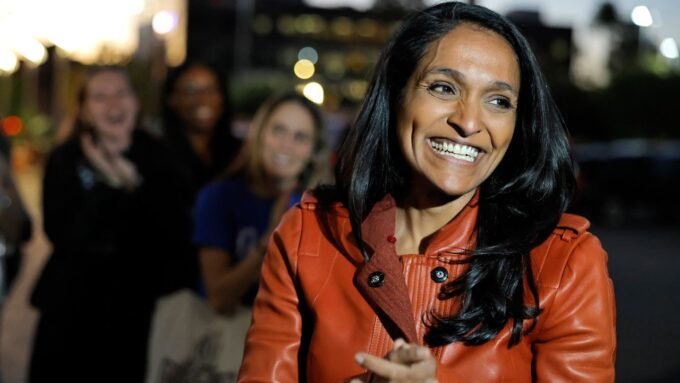
Grégory Mager and Julien Saada
Photo by Anne Combaz/Courtesy of Ode
They have a deep understanding of supply chain and manufacturing processes. “When you strip distribution, marketing and celebrity endorsement, the true actual cost of goods is not very high,” Mager explained. “We’ve always felt that there was a big disconnect between the cost of a product and the retail price point.”
About four years ago they began thinking about what does not work today for the perfume world of tomorrow. “One by one, we’ve started to identify what we felt needed to be reinvented,” Mager said.
First up: retail price points. “We’ve seen the rise of niche perfumery, and now at 250, 300, 400, 500 euros, it’s becoming very, very expensive and harder and harder to access the distribution model, where you have retailers, distributors and a lot of margins stacked up on top of each other,” Mager said.
With direct-to-consumer, it’s possible to sell products at a lower price. So Ode will have a global e-commerce platform, launching in January, and a number of its own stores, beginning at the end of February.
“Then, all the marketing costs and celebrity endorsement, we felt that it wasn’t necessarily resonating anymore with the consumer,” Mager said. “They are looking for something more authentic, especially because the niche perfumery has educated them.”
That’s about ingredients, raw materials, sourcing, creation and sustainability.
“We wanted to rethink how beauty and fragrance can be more sustainable,” Mager said. They envisaged combining reinventing this with an exciting customer experience, where people can educate themselves, learn, discover and have a constant flow of newness and innovation.
“That’s what gave birth to our vision,” Mager said. Neither he nor Saada need to launch a new business, so if they ever did “it has to be revolutionary,” Mager explained.
“We want to reinvent an industry and change the way people are experiencing, purchasing and wearing perfume,” he continued.
The duo, which is investing 30 million euros into the project, wants Ode to be global in the first year.
Many names were reviewed before they conjured up Ode.
“We wanted something short, poetic, artistic, with real meaning and international,” Saada said. “We were lucky enough to find that name and to secure it. We love it, because Ode resonates a lot with a number of worlds.”
It’s the same word in French as in English. “The true definition is a signed and personal composition, which fits absolutely perfectly the world perfume,” Mager said. “Signed because it’s unique, personal and praise — so it’s also a feel-good name. We want the entire brand and experience to make the consumer feel good and enjoy the process, the discovery, the purchasing and the use of the product.”
Each Ode fragrance is a unique, genderless composition, created by Mane perfumer in Grasse, France, with no constraints.

Ode Parfums
Courtesy of Ode Parfums
“The brand’s mission is to reveal the invisible, whether the ingredient, the process, the expertise or the inspiration,” Mager said. “We want Ode to be a brand with open source, open door and really welcome the consumer to discover the back scene of the perfume industry. It’s a nod to creativity.”
Ode is to have a broad selection.
“We will renew frequently, because that is something that we believe the consumers are starving for,” Mager said. “We will always explain the process, tell the truth, explain the ingredient, the sourcing, the material, the composition.”
He believes there to be unlimited possibilities.
“We are going to be the first brand to have the same fragrance for many different products: home, personal care and fine fragrance,” Mager said. “We’ve built this as a real 360-experience. Our mission is to share the art of perfume with the world, and make it accessible, easy to understand.”
Ode is introducing three collections with about 250 stock keeping units in the first year.
Industry sources estimate the brand should generate 5 million euros to 10 million euros in that time frame, with an acceleration in the second or third year.
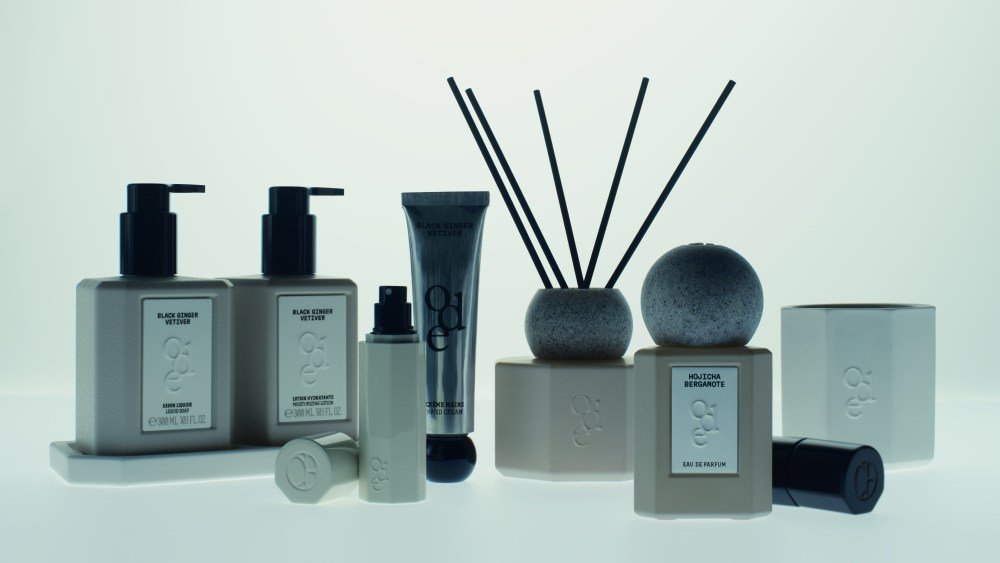
In the first 12 months, Ode will have 30 different eaux de parfums — with each highly concentrated at between 20 and 26 percent — in 15- and 75-ml. sizes. There is also soap, lotion, hand cream, a candle and diffuser. Prices range from 20 euros to 140 euros.

Hand cream from Ode Parfums
Courtesy of Ode Parfums
“Each collection is a very different inspiration and story,” Mager said. “We wanted out of the gate to give this feeling of excitement and discovery.”
The Mixology collection, with the 14 fragrances pairing two unlikely olfactive ingredients — one from the world of fragrance and the other from the world of flavors — launches in January. Hojicha Bergamote has a note of roasted green tea and another of bergamot, for instance. Baguette Tonka is a mélange of sourdough bread and tonka bean notes. Mixology’s lineup, which is illustrated with images on the outer packaging, casts a wide net in terms of tastes, according to Mager.
Each product is made in France with sustainability in mind. Packaging, meant to be kept, is refillable, has aluminum labels, molded stone caps, opaque glass and molded recycled paper-pulp outer containers.
“Our products are very sober and simple, yet high quality,” Mager said. “We want to highlight what’s inside the bottle and not the packaging itself.”
Ode worked with design agency Saint-Lazare on the streamlined, architectural bottles, with atypical, multifaceted shapes, as well as on store architecture.
Starting in May, Ode will launch a second fragrance collection, called Azur. Each of its eight perfume bottles will be in terracotta with ceramic caps. The story behind this line is a fragrance journey throughout a day in the Côte d’Azur. It starts with the floral Jardin Neroli, envisioning a perfumer’s house as the sun rises. A hike is channeled into the Maquis scent, which is very green, and Sunset Gelato, a gourmand fragrance, encapsulates an end-of-day.
The Alchemy collection, with eight fragrances, is due out in September. “This one is more about feelings and emotions,” Saada said.
Because he and Mager want to reinvent the relationship between consumers and products, their focus is on direct-to-consumer retail.
The brand’s first flagship, measuring 2,150 square feet, is due to open in Paris, on Rue de Richelieu, in March. A lab will be in its window, as well as a giant fragrance bottle.
“The shop will be incredibly immersive,” Mager said, adding there are to be screens everywhere, assets explaining and illustrating each perfume, plus an olfactive organ and fragrance discovery cabin, with video, sound and fragrance.
People can refill their bottles in-store at half the price of an original product. Olfactive ingredients will take pride of place in Ode’s store, which will host many workshops weekly.
“You are going to be able to touch and experience raw materials, and to really learn about them,” Mager said.
Two Ode stores are planned for London at the end of 2027 and one in New York in 2028. The goal is to have 20 freestanding stores in three years and 200 freestanding stores in 10 years. E-commerce should ramp up concurrently.
“Our job will be to spread this savoir-faire and this experience globally,” Mager said. “We are here to disrupt the market positively in order to make a contribution with a perfumery that’s more open and exciting, to explore the infinite possibilities.”
He added: “We want Ode to be the brand of the new generation.”
“We want them to think about Ode as the new Apple store of perfume, in a way,” Saada said.