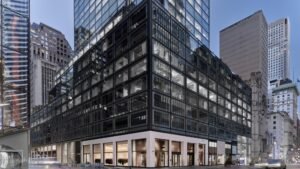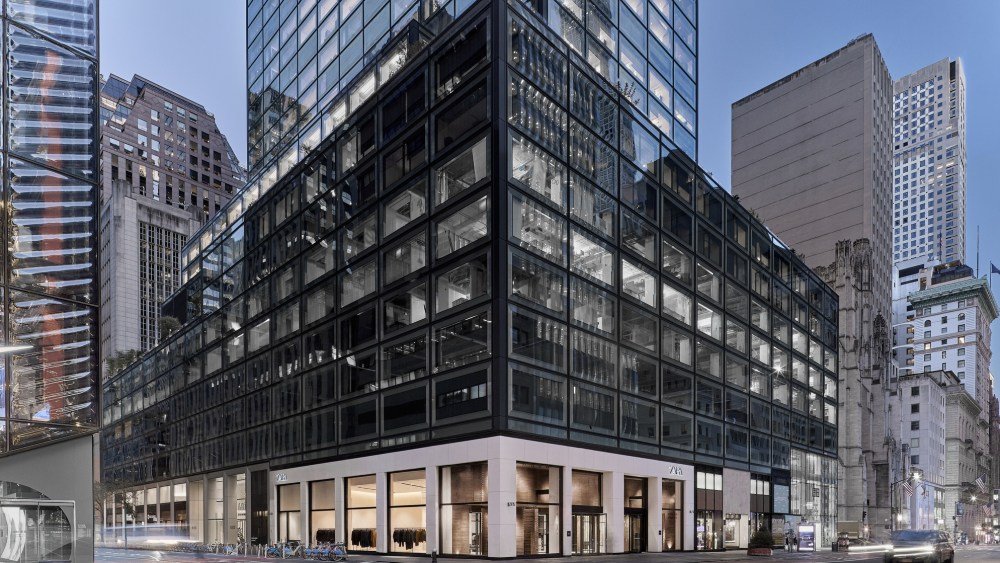




Zara, the giant Spanish fashion retailer, has completed its seven-month, top-to-bottom overhaul of its 15-year-old Fifth Avenue flagship — in a New York kind of way.
The 42,000-square-foot, three-level store, with 32,000 square feet of selling, has been modernized with Zara’s latest technology for customer service and merchandise handling, and redesigned with an open, brighter environment and interior details evoking the city’s architectural heritage. Located at 660 Fifth Avenue by 52nd Street, the site is considered Zara’s U.S. flagship. It reopened Thursday.
Developed by Zara’s in-house Architecture Studio, the store stands unique within the retailer’s network of stores around the world, which generally are designed with elements referencing the local architecture.
“When we think about the Zara client, this store is very specific, meaning we try here to pay our homage to our New York customers, which is important for us,” Dilip Patel, president of Zara USA, told WWD. “When we think about Fifth Avenue, given the amount of traffic it gets, we’ve decided to invest heavily.

The old-style freight elevator doors in the men’s active area.
domo fotografia sl
“When we took over the space in March 2012, for our founders and owners that was something quite spectacular because we were able to show our collections to everyone, and not only New Yorkers, because New York is really the world. It’s a blend of every nationality, all in one melting pot. So I think we were able to show them something very, very special.”
After almost 15 years on the site, “What we have now is a refreshed version,” Patel said. “And taking into account things like these New York ceilings we have here now, the kind you see in Grand Central Terminal, the things that are so specific in this store, it’s how we really want to connect with the community of New York. Things like that make a big difference.” But the New York trappings, are subtle, and “not in your face. What we wanted to do is sneak in things like this. It’s very important.”

Black iron columns evoke New York’s heritage architecture, while track lighting and a neutral palette set a contemporary tone.
domo fotografia sl
Most noticeable at the flagship are the tall, black original cast-iron, industrial-like columns which were previously covered up and seemed ordinary before. Also noticeable are the ornamental pressed-tin ceilings as well as the smooth, undulating curved ceilings, and the old-style freight elevator doors at the entrance to Zara’s Athleticz athletic line on the men’s floor. All told, there’s a subtle retro feel repeating through different areas, warmly offset by the overall soft grayish palette and brushed concrete floors for a contemporary ambiance.

Linen scrims segment the merchandise.
domo fotografia sl
Some walls have been removed, eliminating small areas or which officials regarded as rooms that housed collections, and those outside the store can now see inside. There’s also much more natural light to brighten the setting. Linen scrims segment the assortments where there were once walls.
There’s an easy flow shopping the store, with plenty of elbow room, and a spacious “entrance hall” by the front doors. It will be used to showcase art and sculpture exhibitions, and new collections, where there was once selling space.
Select pieces from the Zara Man collection are currently displayed on the landing, offering visitors a preview of the entire collection on the upper floor housing menswear.
The flagship receives shipments of merchandise twice a week. Asked if the shipments are significant, Patel replied, “We’re talking big refreshes…Sometimes we like to explain to our customers, if you see it today, buy it, because in two days or three days it’s not going to be there. It’s going to be almost gone.”
But Patel stressed Zara’s rapid turnover of product is not about pushing more garments out there. It’s more about regularly introducing new garments and styles, and in short runs, Patel said. Zara does maintain large inventories of basic, perennial-type items, but is constantly evolving with fashion-forward or trendier items presented with limited units.
To celebrate the opening, the vertically integrated Zara developed pieces exclusively for 660 Fifth Avenue. The Zara Woman collection features 100 percent leather designs in black, and a range of blue tones, while the Zara Man selection brings together an all-black edit of 100 percent leather pieces. The pieces feature a special “660 Fifth Avenue” label. The kids’ collection includes T-shirts and a mini bag with playful references to New York City. Completing the selection are three fragrances created as “a tribute” to the city.
Among the more impressive tech advancements is a concealed automated clothing sorting system. Associates feed new arrivals, returns and items from the fitting rooms onto the system, which reads and sorts the items moving along a rail to rolling racks that are numbered to correlate to locations in the store. Associates then wheel the racks to the appropriate spot on the selling floor, for re-merchandising, or the garments could end up in storage. The system is reminiscent of how a warehouse distribution center would operate, and streamlines tasks for store employees, giving them more time to assist customers and keep the sales floors orderly and sufficiently stocked.
There is also sophisticated checkout and return technology that’s user-friendly and fast. Customers place their items on a black bin in a pile, either folded or unfolded. Items are read simultaneously in seconds, through RFID tags, and appear on a screen with the prices. You enter your personal information, and choose whether or not to get a shopping bag, pay via a Zara or credit card or cash. With returns, the technology will provide a credit to your bank account or cash on the spot. Associates are stationed nearby to help with any issues. A customer-service area provides support for online returns and serves as an automated returns point and dedicated collection area for online orders.
Officials also point out the new high-performance heating and cooling installations, LED track lighting, and materials selected to reduce environmental impact. Also, if an online order is placed and the item is available at the store, in two hours it will be packed and ready to be picked up by the shopper.
The fitting room area has a board up front with green lights indicating the rooms that are vacant, and gray lights indicating those that are occupied, so no one gets disturbed.
The flagship also connects the in-store and online shopping experience through the Zara app, allowing customers to check real-time product availability, both in store and online, as well as locate specific items within the flagship.

Zara’s remodeled flagship.
domo fotografia sl
“There is a lot going on here, be it the music, the technology, the finishings, the materials, and as you look in from Fifth Avenue to inside the store, you’re seeing different aspects of this,” Patel observed.
“It’s all about the experience, making life easier and removing friction. That’s very important because we’re on Fifth Avenue and there’s a lot of traffic that comes in. We receive a lot of customers, and for us, removing that shopping friction and making navigation easier inside the store is really important. From a tech perspective, it’s really important for the team. It makes life easier for them as well, and this collaboration between the customer and us becomes nicer.” The flagship employs a total of about 200 people, including the different shifts.
“Experience is super important for our customer, and perhaps I haven’t seen these kind of things we have here in other retailers yet. So these things certainly help remove friction and move traffic and make sales through the season.”
The store seems heavily merchandised though not suffocatingly so. While Patel acknowledged that the store is stocked with many units of clothes and accessories, he did add, “It’s more than [stock keeping units]. There’s a lot of different looks, and it’s almost like you can happily walk very easily around the store, spend a lot of time and get inspired. That’s what it’s also about. It’s about being inspired about the product and the way it’s laid out.” Zara is often associated with “fast fashion,” a term its executives reject.

A spacious men’s area.
domo fotografia sl
Patel then pointed to a vegan leather cropped jacket paired with a leopard-print pant in a polyester-cotton blend, and a wool-blend yellow coat paired with a velvet lingerie-inspired dress with lace. In the men’s, a wide-leg leather pant is matched with a four-pocket sports jacket with cuffed sleeves. The flagship is Zara’s only store in New York selling the brand’s Athleticz activewear line.
Outfits on the selling floors are shown without the use of mannequins though there are mannequins in the windows. Asked why not have more mannequins in such a large store, Patel replied, “The experience inside here is really trying to showcase in a more informal way.”

Shoes and accessories.
domo fotografia sl
Asked for his outlook on the holiday season, Patel replied, “There’s a lot of things that are going on in the world right now. But I think we’re very well set up for receiving what happens in the economy. The key thing is our product looks really good. We’ve invested heavily in the product,” including making it more relevant to what customers want, he said. “Look at the leather collection, it’s so New York, it’s so beautiful,” he said. “We’re trying to make sure that we represent the product with what’s happening in the world today.” Zara actually emphasizes faux leather, though to a lesser extent real leather and suede are carried.
Zara opened its first U.S. store on Lexington Avenue in New York in 1989, but opened 660 Fifth Avenue in 2012, when there were 40 stores in the country. That was a pivotal moment in Zara’s approach to the U.S. when the team first started believing they could put together a significant expansion in the country.
Currently there are more than 107 Zara stores in the U.S. For 2027 in the U.S., at least 20 projects are planned at this point, involving either new locations, refurbishments or relocations.
The parent Inditex is selectively opening Bershka and Massimo Dutti stores in Miami and New York, respectively. Inditex continued its sales growth run, with revenues up 9.1 percent at constant currency to 11 billion euros in the three months ending July 30, even as the Spanish behemoth faced difficult consumer and macroeconomic headwinds.
It marked an acceleration from the first quarter of the year, when sales grew 5.8 percent, and showed continued momentum going into the fall season with sales in constant currency up 9 percent year-over-year in the five weeks from Aug. 1 to Sept. 7.
“We just recently opened a beautiful Massimo Dutti store in SoHo. And again, we’re very proud of that particular store because it feels like it’s landed in the right place in SoHo,” with the right look for the community, he said.
Inditex also operates the Pull&Bear, Stradivarius, Oysho, Zara Home and Lefties brands. All told, the company operates more than 5,400 stores in 76 markets around the world, and each is designed to reference the city in which it’s based.

Zara Kids at the flagship.
domo fotografia sl