



The title of Wednesday morning’s press conference was like a siren’s blare: “EMERGENCY BRIEFING: Bangladesh Wage Protests, Workers’ Demands.”
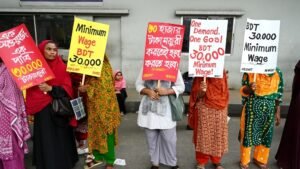
Organized by the Clean Clothes Campaign, the garment industry’s largest consortium of trade unions and civil society organizations, the hour-long webinar had reason to sound the alarm: On Monday, only days away, Bangladesh’s minimum wage board will meet to review employers’ counterproposals to workers’ demands for higher pay. How close the proposed wage comes to the 32,000 Bangladeshi taka ($257) workers are seeking could shape both the protests roiling the country and workers’ livelihoods in one of the world’s lowest-paying manufacturing centers.
Opportunities for a wage adjustment don’t come around very often, said Anna Bryher, policy lead at Labour Behind the Label, the Clean Clothes Campaign’s U.K. affiliate. Historically, Bangladesh reviewed wages every five years, most recently in 2023, when similar wage demonstrations played out. A 2026 amendment to the Bangladesh Labour Act shortened that interval to three, though the country’s manufacturers pushed to delay the next review until 2028, citing intense economic pressure from high inflation, an ongoing energy crisis and additional U.S. tariffs on their exports. Against this backdrop, manufacturers have said that even the earlier demand for 30,000 taka ($241)—a 140 percent hike—would be impossible to meet.
To achieve wage progress, Bryher said, Bangladesh’s top apparel buyers, including Bestseller, C&A, H&M Group, Marks & Spencer, Primark, Uniqlo parent Fast Retailing and Zara owner Inditex, need to speak out before employers make their counterbid next week. Specifically, they must publicly support the 32,000 taka demand and urge their suppliers to do the same, commit to continued sourcing from Bangladesh after the minimum wage increase and “fully absorb” the higher labor costs in their purchasing prices.
“They can’t stand on the sidelines, given their vital economic role,” she said. “They’ve got a responsibility under human rights guiding principles to use their influence now to support the workers’ wage demand, to ensure that we achieve a wage that people can live on and to ensure that workers can organize and negotiate without fear of repression.”
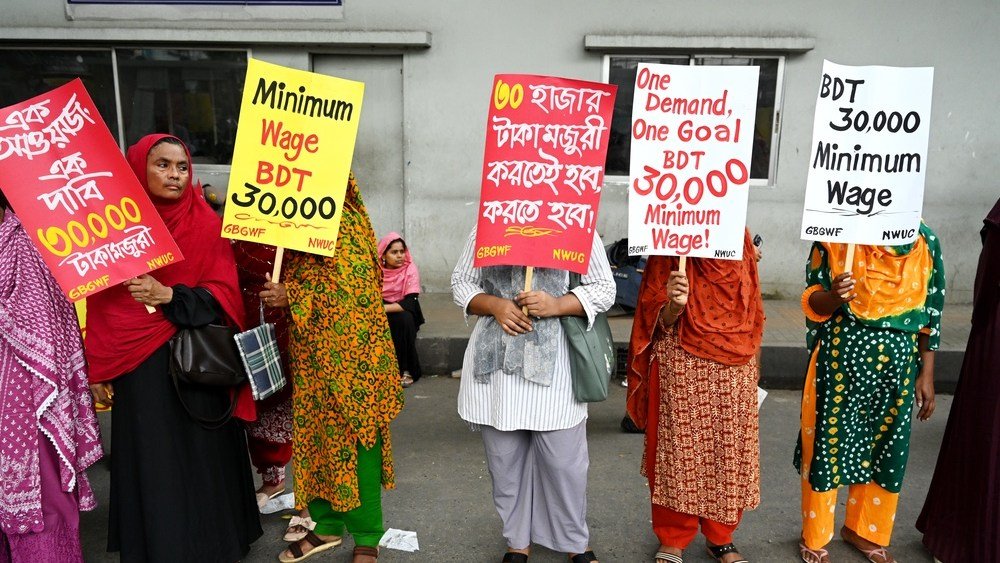
The current monthly minimum of 12,500 taka ($100) is no longer enough to live on, said Kalpona Akter, founder and executive director of the Bangladesh Center for Workers Solidarity. In a recent Clean Clothes Campaign survey of more than 1,000 workers in Bangladesh, 89 percent of respondents said their wages were insufficient to cover their families’ basic expenses, such as food, rent, transportation and healthcare. When workers felt like they weren’t being heard, they took to the streets in droves, first to call for the formation of a review board, then to press for a wage that could cover basic living costs.
Police responded with batons, tear gas and water cannons to disperse crowds blocking highways. Authorities also sent in the Border Guard. Amid the clashes, dozens of workers were arrested and hundreds injured, she said. Hundreds of factories have shuttered due to the disruptions, though the number of closures fluctuates daily.
Politically motivated agitators have also complicated matters, Akter said. At least one garment worker, 21-year-old Toufiq Sheikh, died from injuries sustained when he was beaten by protesters while attempting to film an act of vandalism, according to local media reports. Akter also blamed rabble-rousers from “the last regime,” referring to the ousted Awami League, for setting vehicles on fire, setting off crude bombs at warehouses and spreading false reports of additional deaths.
“Our workers are not involved in those,” she said. “Our workers are protesting with bare hands.”
A few dollars more every month won’t ease workers’ increasingly dire circumstances, particularly if far larger pay raises for government officials drive up commodity prices, Akter said. Big brands voicing their support, however, could give employers the confidence to propose a higher wage and help workers secure a more meaningful increase.
So far, buyers have demurred. Of the nearly 30 brands Sourcing Journal reached out to, few responded, and even those said little beyond the usual boilerplate commitments to respect workers’ right to collective bargaining and assurances that they were closely monitoring developments.
H&M Group, Bangladesh’s largest apparel purchaser, offered more detail. The retailer said it does not directly determine garment workers’ wages because it does not own the factories that make its products. It nevertheless supports a “timely minimum wage revision that results in meaningful wage increases for workers across all grades and makes a real difference to workers and their families.” Once a new minimum wage is set, it said, the labor-cost component of its costing tool is automatically updated to reflect the revised wage level for all future orders.
“We take our responsibility to ensure that our purchasing practices support improved wage levels very seriously,” a spokesperson said. “This includes better planning and forecasting of our production orders and fair payment terms for all our suppliers, while workers’ wages, which are paid by our suppliers, are ring-fenced and excluded from our price negotiations.”
The Fair Labor Association, a multi-stakeholder organization whose members include Adidas, Puma and Nike, called on the minimum wage board to deliver a “transparent, evidence-based increase that reflects a living wage.” It pointed out that since the 12,500 taka minimum wage took effect in 2023, consumer prices have risen by roughly 29 percent, meaning that a new minimum wage would need to be around 16,125 taka just to preserve the original purchasing power. Yet the group added that a wage sufficient to cover a decent standard of living would need to be higher still. It cited the Anker Research Institute, which calculated the monthly living wage at approximately 25,166 taka ($202) in Dhaka’s satellite cities and 30,459 taka ($245) in Dhaka proper.
The Fair Wear Foundation, which counts Filippa K, S.Oliver and Vaude on its roster, said that while raising the minimum wage is an important step toward living wages, the impact of the increase hinges on what happens “beyond the wage-setting process.”
“Wage increases result in higher labor costs, and suppliers need to be able to pay this,” it said. “Brands have a critical role in making that possible through responsible purchasing practices. When labor costs rise, those increases need to be reflected in fair and transparent price negotiations. Proactively engaging in these can ensure that extra costs are accounted for through higher prices, rather than leaving suppliers to absorb these costs.”
What’s crucial at this juncture, the organization said, is for brands and suppliers to work together to “ensure that risks, responsibilities and accountability are shared, and higher wages translate into lasting improvements for workers.”
Nate Herman, executive vice president of the American Apparel & Footwear Association, said the trade group shares many of the concerns about Bangladesh’s minimum wage process. While its members are committed to responsible purchasing practices, he said, the association could not speak for individual members on whether they would support the Clean Clothes Campaign’s specific calls for action. As it did in 2013, the AAFA urged the government to protect workers’ rights to organize.
“We support the demands that wages and benefits meet workers’ basic needs, provide some discretionary income and account for inflationary pressures,” Herman said. “We also believe workers must be able to participate in the process without fear of retaliation, violence, or arrest for peaceful activity, and that the process must foster open, inclusive dialogue throughout the negotiations and beyond. All parts of the supply chain have a role in achieving these outcomes.”
At the briefing, Anne Bienias, living wage coordinator at the Clean Clothes Campaign, said the easiest way to calm the protests was to take workers’ and trade unions’ demands seriously. The fact that workers are protesting in such high numbers, she said, is a “very clear sign” that they’re willing to risk their health and safety in the streets because the alternative—continuing to live on the current minimum wage—is even less appealing.
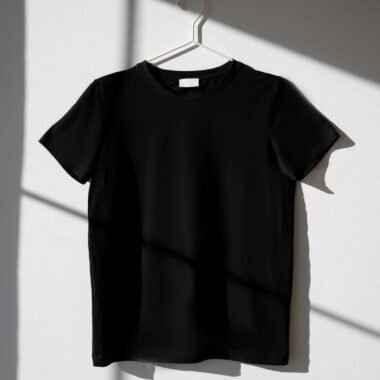
Brands’ purchasing prices, she said, have much to do with why wages have risen so little. A March report from the Clean Clothes Campaign and Public Eye, its Swiss affiliate, found that while nominal purchasing prices have inched up in Bangladesh, brands are paying 30 percent less for a cotton T-shirt than they did 25 years ago, after adjusting for European inflation.
“Nothing today costs the same as it did 25 years ago,” Bienias said. “So it’s quite horrific to imagine that brands have been paying exactly the same price, which is now also lower in real terms for the same piece of clothing.”
Bangladesh’s buyers face headwinds of their own: The Children’s Place recently filed for Chapter 11 bankruptcy, and Calvin Klein owner PVH Corp. just announced cuts of about 4 percent of its global workforce. But Bienias said it was a “disgrace” that “so much money is paid every year to shareholders and CEOs.”
And what if workers don’t get what they’re asking for? Akter was blunt.
“There will be malnutrition,” she said. “They will be less productive. Their children will not be able to go to school. The workers will not be able to take care of their medical costs, and they will not have any savings.”