


 rahulNovember 25, 202610 Mins read0
I was 12 when I first came across the story of Mileva Marić, Albert Einstein’s first wife. The anecdote I remember being told was that she had contributed to some of his most significant scientific work, only for her intellectual labour to disappear behind her husband’s name. Historians continue to debate the extent of her contribution, but what stayed with me was a much bigger question: how many brilliant women have had their work diminished, their ideas absorbed, and their achievements quietly attributed to someone else?
I think that was also around the time I developed a particular kind of rage towards men who seem convinced that being at the top is proof of their superior intelligence, ethics, or ability to lead. You know the type: the finance bro who mistakes aggression for ambition, the tech founder who thinks disrupting an industry excuses treating people terribly, the CEO whose confidence seems to arrive long before any evidence of competence.
And perhaps that’s why I have a slightly controversial opinion: women actually make better leaders. Not because every woman is automatically good at her job or because men are incapable of leading, but because we’ve spent far too long celebrating a very narrow idea of what leadership should look like.
A woman with a rape conviction, affairs or a record of abandoning her family would never get the same redemption. Yet men get presidencies, CEO reinstatements and prime-ministerial worship. Patriarchy is literally a pyramid scheme protecting mediocre, morally bankrupt men.
— komolika (@Ichanpyaari) November 24, 2026
Somewhere along the way, being decisive became synonymous with being domineering. Having authority meant being intimidating. Success was measured by how much a company could make, how quickly it could grow, and how many people answered to one person. But what about the people doing the work? The culture being built? The decisions that will matter five years from now, not just at the next earnings call?
Perhaps we’ve been so busy looking for leaders who can command a room that we’ve overlooked the ones who know how to build one.
And this isn’t just my personal theory. A 2024 meta-analysis examining 50 years of research found that women were rated more highly on several leadership behaviours associated with effectiveness, including those centred on interpersonal relationships and those associated with assertiveness and taking initiative. In other words, the qualities we often treat as opposites, being people-focused and being assertive, can exist in the same leader.
So, what does leadership look like when we stop measuring it by the size of someone’s ego? Consider the women who are already challenging that definition.

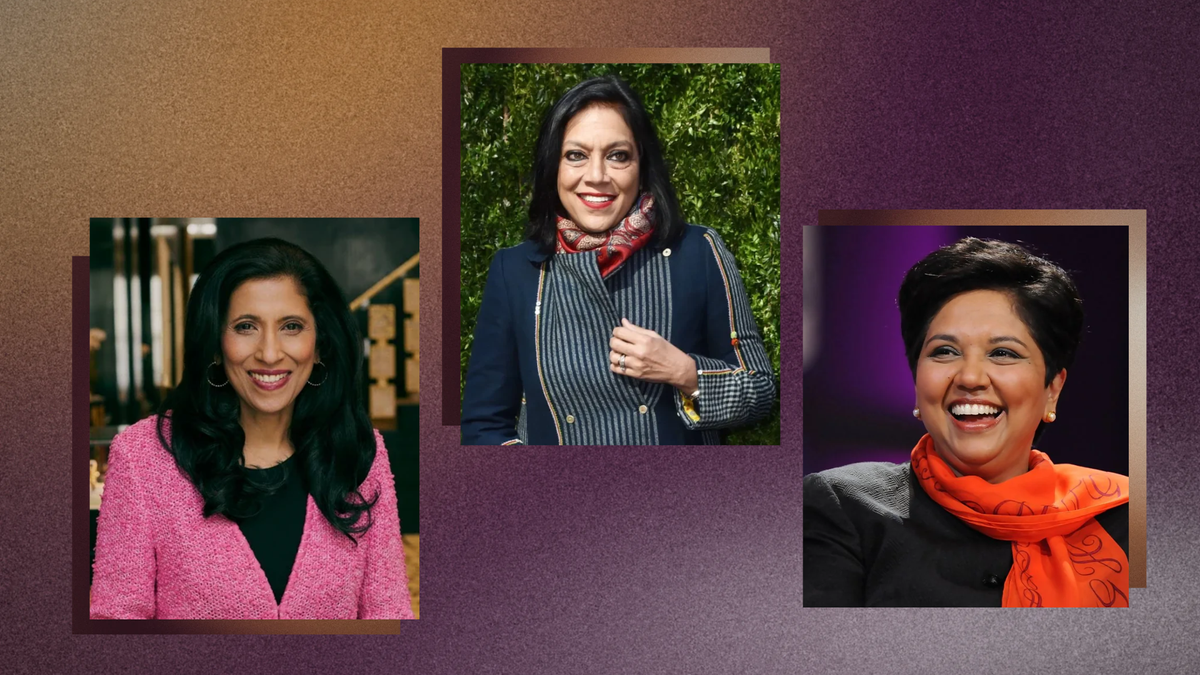
When Leena Nair took over as Chanel’s global CEO in January 2022, following the announcement of her appointment in December 2021, she became the first person of Indian origin to lead the French luxury house. Before that, she spent three decades at Unilever, eventually becoming its chief human resources officer.
What makes Nair’s approach worth examining is her emphasis on people and organisational culture. At the helm of a house as storied as Chanel, she has to balance commercial expectations with the responsibility of leading a vast, global workforce. Her career is a reminder that understanding people isn’t a distraction from running a successful business. It is part of the job.

Indra Nooyi took that thinking into one of the world’s biggest food and beverage companies. During her 12 years as PepsiCo’s CEO, she championed ‘Performance with Purpose’, a business philosophy that placed long-term sustainability, healthier products, and social responsibility alongside financial growth.
And the numbers didn’t exactly suffer for it. PepsiCo’s annual net revenue grew from approximately $35 billion in 2006 to $63.5 billion in 2017.
Nooyi understood something that seems to escape the traditional profit-at-all-costs mindset: a business doesn’t operate in a vacuum. Its decisions affect its employees, consumers, communities, and the environment around it. Thinking beyond the next quarter isn’t idealism. It’s good business.

Empathy and long-term thinking aside, effective leadership also demands the ability to recognise an opportunity and act on it. Melanie Perkins did exactly that with Canva.
She co-founded the platform with a deceptively simple idea: design should be accessible to everyone, not just those who knew how to navigate complicated software. Today, Canva is one of the world’s most widely used design platforms, changing how people create and communicate.
There’s something to be said about a leader who can identify a problem that an entire industry has accepted as normal, imagine a different way of doing things, and build a business around it. That kind of vision isn’t about being the most disruptive person in the room. It’s about making something genuinely useful.

And if anyone still thinks this approach to leadership is all about empathy and the so-called softer skills, meet Lisa Su. An electrical engineer with a doctorate from MIT, Su has led AMD’s transformation into a major force in semiconductors and high-performance computing.
Her leadership is rooted in technical expertise, calculated risks, and a clear understanding of where the industry is headed. Her success challenges the tendency to view women in leadership exclusively through the lens of traditionally feminine qualities. She’s succeeding because she knows her business, understands the technology, and has the conviction to make difficult strategic decisions.
Perhaps that’s another thing worth remembering: women don’t need to be good at one particular kind of leadership. They can be the people running the technology, making the numbers work, and deciding what the future of an industry looks like.

Falguni Nayar is another example of what happens when a woman decides that it isn’t too late to start over. After spending nearly two decades in investment banking, she founded Nykaa at 49, building a digital-first beauty retail business around discovery, accessibility, and consumer education.
Nykaa went on to transform India’s beauty retail landscape, expanding into physical stores, fashion, and its own beauty brands.
Nayar’s story is particularly interesting because she didn’t simply identify a gap in the market. She understood that the Indian beauty consumer was changing and built a business that could grow alongside her. There was no prescribed timeline for her ambition, no expectation that she should have made her biggest move earlier. She saw an opportunity and backed herself.

The ability to understand an evolving beauty consumer is also central to Katrina Kaif’s entrepreneurial journey with Kay Beauty. Launched in partnership with Nykaa in 2019, the brand was built around combining makeup performance with skincare-conscious formulations.
Kaif’s involvement has extended beyond lending her face to a campaign, with her speaking about her role in product development and the brand’s direction. In a market where celebrity beauty launches are hardly uncommon, building a brand with its own identity and consumer following requires more than name recognition.
What makes businesses such as these interesting is the ability of their founders to turn an understanding of consumers’ everyday needs into commercially viable ideas.

If there’s one woman who understands the value of knowing your audience, owning your work, and playing the long game, it’s Taylor Swift.
Two decades into her career, Swift has built one of the most recognisable personal brands in popular culture. From her album rollouts and carefully constructed visual identities to the re-recording of her masters, she has demonstrated an extraordinary understanding of intellectual property, audience loyalty, and reinvention.
Yet the same qualities that make her an astute businesswoman are often used to describe her as a ‘mastermind’, as though having a strategy is inherently suspicious when a woman is the one executing it.
A man who understands his market is a visionary. A woman who understands hers is calculating. A man who plans his next move is ambitious. A woman who does the same is manipulative.
Swift’s career is a lesson in knowing the value of what you own and refusing to let someone else decide it for you. If that makes her a mastermind, perhaps we should start using the word with a little more respect.

Of course, not every leader is building a company or chasing a valuation. Some are changing the industries they work in by deciding whose voices get heard.
Mira Nair has spent decades building a distinct cinematic language through films such as Salaam Bombay!, Mississippi Masala, and Monsoon Wedding, creating room for stories that mainstream cinema has often overlooked. She also founded Maisha Film Lab, a training initiative that creates opportunities for emerging filmmakers in East Africa, and has supported the work of the Salaam Baalak Trust.
Her work demonstrates a different kind of influence: the ability to create opportunities for others, bring new voices into an industry, and build something that can continue beyond your own career.

Bela Bajaria exercises that kind of influence on a global scale. As Netflix’s chief content officer, she oversees content across languages and markets, helping shape what millions of people watch around the world.
The Indian-origin media executive has been instrumental in expanding the platform’s international programming, championing stories that travel beyond geographical boundaries. Her position carries a particular kind of power: deciding which stories receive investment, reach audiences and become part of the cultural conversation.
Because leadership isn’t always about being the person with the most visible platform. Sometimes it’s about having the power to open that platform up to people who might otherwise never get the opportunity.

That question of opportunity becomes even more significant in industries where women have historically been underrepresented. Roshni Nadar Malhotra became the first woman to lead a listed Indian IT company when she took over as chairperson of HCL Technologies in 2020. She also leads HCL Group and has been involved in the Shiv Nadar Foundation and The Habitats Trust.
At a time when conversations about the future of technology are dominated by a familiar roster of male founders and executives, Nadar Malhotra is helping steer one of India’s largest global technology companies. Her work across education and conservation also reflects an understanding of influence that extends beyond the business itself.

In August 2025, Priya Nair became the first woman to serve as CEO and managing director of Hindustan Unilever in its 92-year history. Having joined the company in 1995, she worked her way through various sales, marketing and leadership positions before heading Unilever’s global Beauty and Wellbeing business.
There’s something significant about a woman spending decades building her expertise within an organisation and eventually getting to lead it. Nair’s appointment is a reminder of how long women have been contributing to the very organisations that took decades to put them in charge.

And then there’s Kiran Mazumdar-Shaw, who built a biotechnology business at a time when women entrepreneurs were hardly taken seriously, let alone expected to establish globally recognised companies.
Starting Biocon in 1978 as a small enzyme manufacturing venture, she went on to build one of India’s leading biotechnology and biopharmaceutical businesses. Her work in affordable healthcare and accessible medicines has helped shape an industry that demands scientific expertise, long-term investment and enormous conviction.
Mazumdar-Shaw’s journey is a reminder that leadership is sometimes about creating opportunities where none previously existed.
And the list goes on. Arundhati Bhattacharya at Salesforce, Jyoti Deshpande at Reliance, Ameera Shah at Metropolis Healthcare, Vinita Gupta at Lupin, Mallika Srinivasan at TAFE and the Reddy sisters at Apollo Hospitals are only a few more examples of women shaping India’s corporate landscape.
I work in a largely female-dominated space, and being surrounded by women has genuinely been one of the things I’ve looked forward to most about my professional life. In many ways, it was the dream: a space where women are creating, collaborating, disagreeing, making decisions and figuring things out together.
Is it always harmonious? Absolutely not. It isn’t always sane, either. There are deadlines, disagreements, difficult days and the occasional collective meltdown. But there is something deeply reassuring about being in an environment where women aren’t just occupying positions of authority but actively shaping the culture around them.
It has changed how I understand leadership beyond a designation. Sometimes, it is the colleague who makes sure you’re not drowning in work, the person who gives you credit for an idea, the editor who lets you take ownership of something you’re passionate about or the manager who understands that being a person doesn’t stop the moment you walk into an office.
These things might not make headlines or appear in quarterly earnings reports, but they determine how people experience their workplaces. And that matters.
I think that’s what gets lost when we reduce leadership to confidence, authority and the ability to make the biggest decisions. A good leader doesn’t just know how to build something. They know how to bring people along with them. They understand that a team isn’t a resource to be used up, that listening isn’t a sign of weakness and that making people feel valued doesn’t make you any less ambitious.
And no, I don’t think women have some magical monopoly on empathy. Nor do I think every woman is automatically a better leader. Women can be terrible bosses, make disastrous decisions and run workplaces that people cannot wait to leave. But perhaps the point is that we’ve spent so long dismissing people-first leadership as soft that we’ve failed to recognise just how much it takes to do it well.
What these women demonstrate is that commercial ambition and an understanding of people needn’t be mutually exclusive. You can be strategic without being manipulative, technically brilliant without needing to dominate a room and powerful without making everyone around you feel small.
Perhaps the real problem with the finance bro version of leadership is that it has convinced us that being feared is the same as being respected, that making money is the only measure of success and that the person at the top deserves all the credit.
It’s funny how “competence” only enters the chat when women are being discussed. When it’s men, mediocrity is tolerated, even glorified. Senile men are even presidents. But mention women in leadership, and suddenly everyone turns into an HR manager demanding proof of merit🙄
— Lydia Owuor (@itslydiaowuor) October 30, 2025
I’d rather have a leader who knows how to listen, knows when to take a risk, gives people room to grow and understands that success is bigger than their own name on the door.
The women who are challenging conventional ideas of leadership aren’t succeeding because they lack ambition, competitiveness, or the ability to make difficult decisions. They’re showing us that these qualities can coexist with empathy, accountability, and a sense of collective purpose.
So, the next time someone tells me that behind every successful man is a woman, I’d like to ask why we’re still so comfortable placing women behind the scenes when they’ve been doing the work of leading all along.
Give us the boardroom. Give us the microphone. Give us the money, the resources, the authority and, most importantly, the room to get things wrong without having to justify our entire existence afterwards.
Because women aren’t waiting to be invited into leadership anymore. They’re already building the tables, deciding who gets a seat and, increasingly, calling the shots.
And it’s about time.