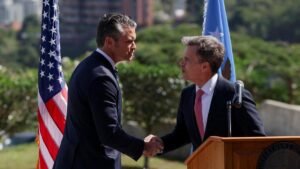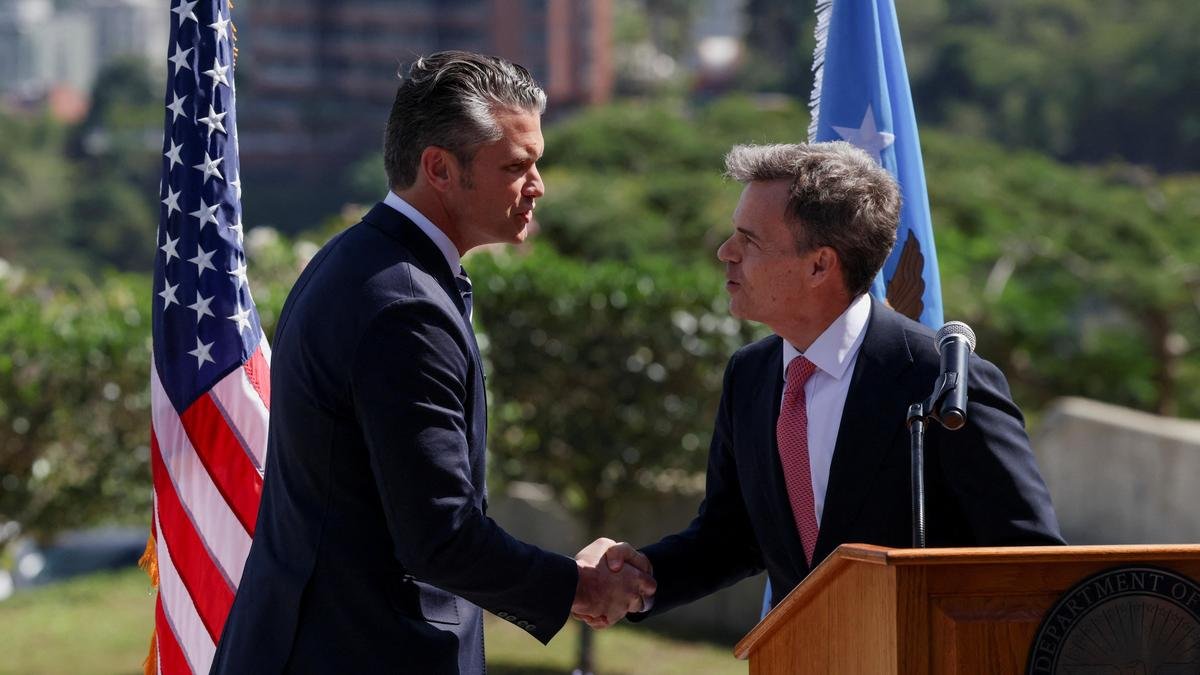



Defence Secretary Pete Hegseth, speaking in Venezuela, said the two countries have signed an agreement to re-establish military ties, from training to intelligence sharing.
Mr. Hegseth said that following the January capture of Venezuelan President Nicolas Maduro by the U.S. military, the country “has gone from our most aggressive regional threat to a compliant security partner.”

Mr. Hegseth also praised the “close cooperation” with interim President Delcy Rodriguez that allowed officials “to stabilise Venezuela and rid it of narco-terrorists once and for all.”
The Pentagon did not immediately offer further details on the new partnership.
Ms. Rodríguez separately lauded the opportunity to strengthen the military partnership. “I hope that this technical-military cooperation … can be brought to its highest possible level so that … we may address common threats,” she said.
Mr. Hegseth’s visit underscores efforts by President Donald Trump’s administration to deepen its influence in the South American country since U.S. forces ousted Maduro in January.
Mr. Hegseth is the latest member of Mr. Trump’s Cabinet to travel to Venezuela following visits this year by the Interior and Energy secretaries, who have focused on efforts to tap its oil reserves and critical minerals. Mr. Trump said in August that Mr. Hegseth helped broker a sweeping deal for the U.S. to take control of some Venezuelan oil reserves.
The head of U.S. military operations in Latin America, Gen. Francis Donovan of U.S. Southern Command, also has met interim authorities in Venezuela at least twice this year.
The U.S. military has been expanding its attention on the region since Mr. Trump returned to the White House last year, with the Republican president promising to focus more on the Western Hemisphere and battle Latin American drug cartels.
To try to stem the flow of narcotics into the U.S. and the scourge of fatal overdoses, American forces have been attacking what the Trump administration says are boats smuggling drugs in the Caribbean Sea and the eastern Pacific Ocean. At least 240 people have been killed since the administration began targeting those it calls “narcoterrorists” in September 2025, although U.S. officials have released little evidence publicly to support claims the vessels were carrying drugs.
Mr. Hegseth’s visit comes at a time of uncertainty for Venezuelans regarding who will lead the nation in the coming months and years. Ms. Rodríguez, a Maduro ally, took over in Venezuela after Mr. Maduro’s capture. Ms. Rodríguez’s court-allowed term expired in July, but she continues to function as Venezuela’s head of state.
Opposition leader María Corina Machado recently returned to Venezuela from exile following seven failed attempts that opposition activists claimed were thwarted by the government.
U.S. Secretary of State Marco Rubio has said the “safe” return of the politician was the result of “reconciliation talks” supported by his country, which he considered “the best opportunity” Venezuela has had in three decades to achieve free and fair elections and a lasting democracy.
The lack of a date for the next presidential election has left many Venezuelans conflicted on their sentiment toward Mr. Trump. While relieved that Mr. Maduro is no longer president, many believe that the White House’s decision to prioritise reviving Venezuela’s oil industry over pro-democracy steps was the wrong approach for meaningful changes in their country.
The Trump administration says it has returned more than $12 billion, or almost 99%, of the revenue obtained from the sales of Venezuelan oil back to the country under the terms of the energy deal reached with Ms. Rodríguez’s government, according to a report released this month.
Published – November 19, 2026 02:00 am IST