“I’ve been criticized for objectifying women,” Tom Ford ventured to The Guardian in 2015: “But I’m an equal opportunity objectifier—I’m just as happy to objectify men. The thing is, you can’t show male nudity in our culture in the way you can show female nudity. We’re very comfortable as a culture exploiting women, but not men. But I don’t think of it as exploitation [either way].”
Two years later, Ford returned to the point in New York Magazine, observing: “I’ve objectified men just as much in my career, but you just cannot run those images. I put that perfume bottle between a woman’s breasts, but I also put it between a guy’s butt cheeks, but [few] would accept that.”
A decade later, Ford’s successor, Haider Ackermann, is still flicking away at the same, still-sensitive cultural double standard, apparently also to advocate for equal-opportunity objectification. Following a runway show featuring what the designer termed “ass out” menswear looks, Nicole Phelps observed in her Vogue Runway review: “Ackermann just about out-Forded Tom Ford with this one.”
In this pre-spring lookbook-delivered collection for men—and its simultaneously released sister lookbook for women—Ackermann went all in on symmetry. Through both pose and clothes he placed a mirror between the genders that broadly reflected similarity, while playing with the nuance of difference. As he observed in one of his prepared statements about these collections: “The deeper I delve into the signs, the more I find freedom in interpreting them.”
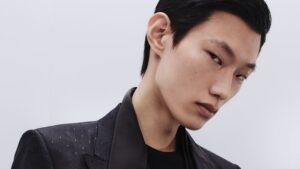
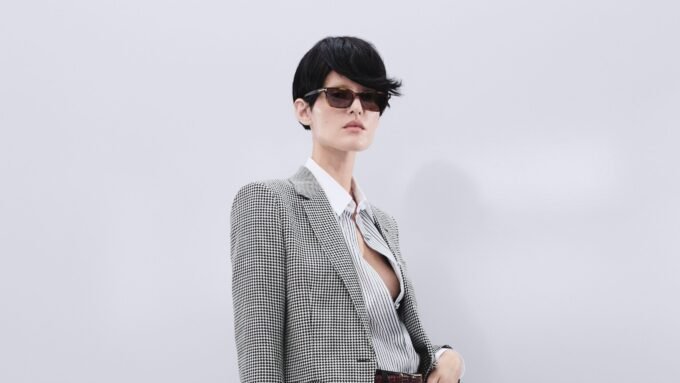
That interpretation began with Fordian tailoring that appeared especially “correct” in its severity. Double-breasted jackets were cut with strong shoulders, wiry waists, and slimmish sometimes slightly-kicked pants. Skinny scarves fronded around necklines. There were tuxedos and jacquard cocktail jackets, sometimes with eveningwear sparkle. An amazing tufted scarlet rococo jacquard jacket was layered over a monochrome silk snakeprint shirt. In another look a dogtooth jacket was worn over puppytooth pants. Tailoring was similarly commanding in womenswear, punctuated by a more overtly fluid sensibility. Ackermann seemed to be toying delicately with the tensions of tailoring’s masculine convention to redistribute its power.
Away from tailoring Ackermann returned to American sportswear and louche, casually-precise dressing. Cropped leather jackets in green and turquoise suede, checked Western shirts, and very straight-cut denim all came with an inherent ruggedness that was highly refined through fabrication and fit. There was top-to-toe leather and all-corduroy prep. In the accompanying women’s collection, similar ingredients were rearranged to related effect: the two closely adjacent wardrobes were presented as variations of two closely adjacent personalities whose greatest point of difference was gender.
In both lookbooks, tailored jackets were also worn over boxer shorts, with the models shot in parallel poses. The between-knee perspective of multiple, house-specialty crotch shots of similar looks across the two lookbooks made Ackermann’s fealty to Ford’s equal-opportunity approach eminently clear. In his menswear statement, Ackermann said: “I like the idea that a man does not need to choose between different expressions of himself. I keep following this intuition, wherever it may lead.”