This bride restored her late mother-in-law’s 36-year-old bridal dupatta for her wedding
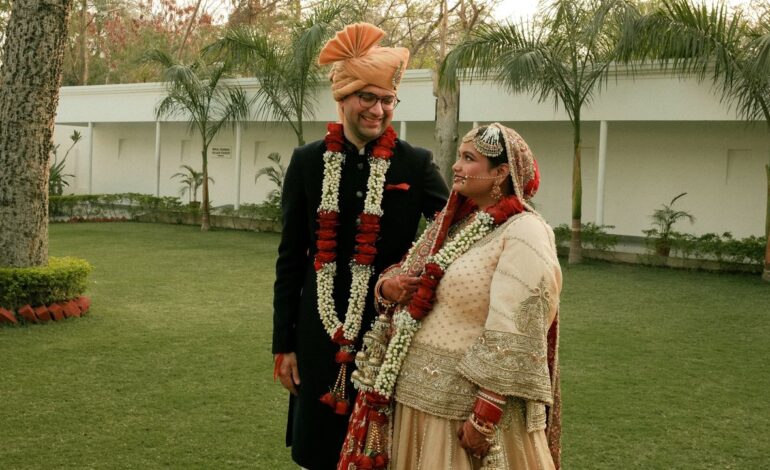

“We chose to give our wedding a staycation vibe where you come, enjoy food, enjoy the property, go for a stroll to the nearby lake and in the middle of all of this attend a wedding,” Saxena says.
After the welcome lunch on February 11, guests could return to their rooms for a siesta, where small spa kits were waiting for them.
Watercolour artist Irshad Ahmad Ansari, based in Ballia district in Uttar Pradesh, painted the save-the-date, invitation, itinerary, welcome notes, thank-you cards, flower cones and event signage by hand. For the save-the-date, he recreated Saxena and Dhawan’s first date outside K Rustom’s, including her car and what they had been wearing; “Aye Hairathe” from Guru, which they had listened to during their Marine Drive outing, became the soundtrack.
At the Senate Hall on February 11, many of Dhawan’s relatives and the couple’s friends were seeing Bhopal for the first time, and lunch allowed Saxena to make an introduction through food. There was dal bafla, gatte ki sabzi, dal kachori, mawa bati, khopra pattis and bhutte ki kees, alongside jamun shots inspired by Indore. Pink, yellow and orange marigolds sat in ceramic pots around the room, and Saxena’s mother and Dhawan’s aunt set up Bhopali batuas filled with suhaag ka samaan for the women.
Saxena’s rust-orange gharara had its beginnings in conversations with Dhawan’s grandmother, who still owns pieces from her wedding trousseau embroidered with real zari, gota patti and mukaish. Wanting to find people continuing comparable handwork, Saxena asked Dhawan’s relatives in Punjab for recommendations and travelled to Patiala after Akriti by Shakun’s name kept coming up.
Her crepe kurta and georgette gharara were covered in aari dori embroidery done by hand, while the organza dupatta carried sequins and broad embroidered borders edged in kiran lace, added at designer Shakun Garg’s suggestion for an “old school Punjabi bride” effect. Green stones and pearls by Anu Merton sat alongside green glass bangles, which women in Saxena’s family wear after bridal mehendi has been applied.
By evening, the Darbar Hall belonged to the small portion of Saxena and Dhawan’s musical tastes that overlap. “It’s like Linkin Park to Satinder Sartaj,” Saxena says of their playlists, but Nusrat Fateh Ali Khan and Jagjit Singh are common territory. They had no interest in asking friends and relatives to spend weeks rehearsing choreography for a sangeet, though Saxena and Dhawan still wanted a performance of their own. Bhopal-based qawwal Sajid Habib and the Rang Band performed instead.
Low diwans, Persian carpets, lamps, shamadans and red roses surrounded the musicians; gajras went around guests’ wrists, and the paan came from a Bhopal shop Saxena says her father and grandfather have visited for four decades. Jehan Numa’s kitchens sent out til-chilgoze kebabs, rajma galawat with ulte tawe ka paratha and their preparation of shahi tukda.
A week earlier, Saxena had changed what she planned to wear that evening. After the couple’s roka, Dhawan’s grandmother had given her the magenta wedding dupatta worn by his mother 36 years earlier, its bottle-green borders worked with copper zari. Ahmedabad-based Anjana Bohra supported the original fabric with organza and repaired damaged or discoloured areas through structural darning and reinforcement, leaving the embroidery itself intact.