



Among fashion’s many famous yellow dresses: one stands out boldly: Rihanna’s spectacular couture cape at the 2015 Met Gala. Its impossibly long train and intricate embroidery details have since been turned into memes, dissected in fashion schools, and celebrated at exhibitions. It was the look that introduced us all to Chinese couturier Guo Pei, even though she had already spent nearly thirty years building an extraordinary world of couture before that evening.

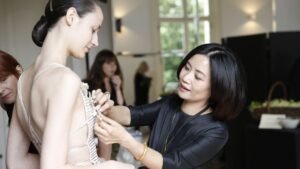
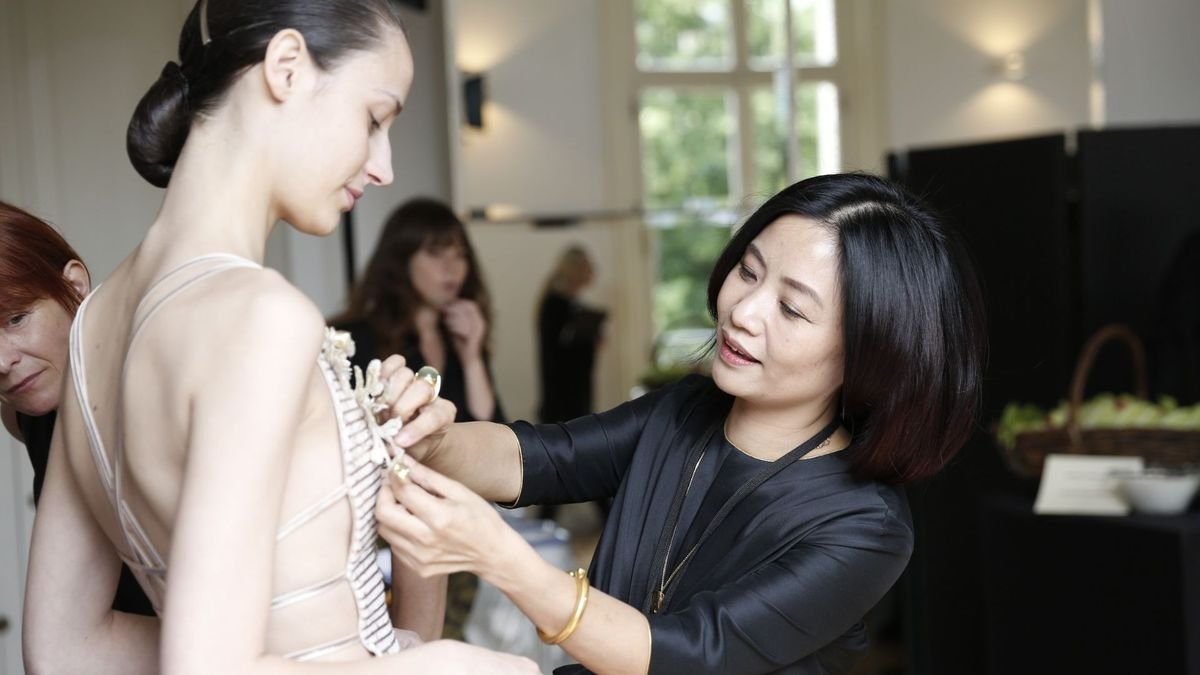
Speaking to Guo Pei, it becomes clear that the woman behind one of fashion’s most iconic creations is warm and patient. She speaks about embroidery, craftsmanship and the stories behind her collections with an excitement undimmed after forty years in the industry.
Born in Beijing in the 1960s, Guo Pei grew up in a China where clothing served a practical purpose. “When I was little, fashion didn’t exist,” she says. Yet, it found its way into her life through the women at home — she helped her visually impaired mother thread needles for sewing, while her grandmother told stories about the flowers and butterflies she’d once embroidered. “I couldn’t picture how a butterfly could be embroidered onto clothes,” she recalls. “But I started imagining it, and that’s how it inspired my later works.” Those childhood motifs – butterflies, birds, blooming florals – remain recurring signatures in her collections today.

When she chose to study fashion design in 1982, few people around her understood what that meant. Still, she never doubted her decision. She graduated in 1986, just as China was opening up and self-expression through clothing was becoming possible. “In China, we have a saying that time creates heroes,” she reflects. “I was very lucky.”
Guo Pei’s early career was spent designing commercially, creating clothes for a rapidly changing China. Business was flourishing, yet creatively she found herself searching for something more. In 1997, she founded Rose Studio in Beijing, giving herself complete creative freedom. It also marked the beginning of the Guo Pei the world recognises today.
Over the next two decades, Rose Studio developed a couture language rooted in Chinese artistry while embracing outside influence — a philosophy she describes as “Eastern learning as root, western learning as application.” Where European couture frequently looks towards royal courts or Christian iconography, Guo Pei turned to Imperial Chinese robes, palace architecture, Buddhist art, folklore, and mythology, translated through old thread, intricate embroidery, featherwork and sculptural silhouettes into garments that feel dreamlike rather than costume-like.

She credits watching John Galliano and Alexander McQueen with expanding how she thought about fashion — not as a direct aesthetic influence, but proof that clothing could become theatre, sculpture and narrative all at once.
Long before the yellow cape, Guo Pei was one of China’s leading couturiers, having designed ceremonial costumes for the Beijing Olympic Games and exhibited in more than twenty-five countries.

Then, in 2015, everything changed. Rihanna’s appearance at the Met Gala turned the cape into one of the defining fashion images of the decade. Within hours, millions were searching for the name behind the dress. “When I first heard about Rihanna, I had no idea who she was,” Guo Pei admits with a laugh. “She absolutely made the garment come alive.”
That same year, Guo Pei became the first and only Chinese couturier invited by the Fédération de la Haute Couture et de la Mode onto the official Couture Week calendar in Paris, where she presented ten consecutive collections from 2015 to 2020. Recognition followed quickly: a spot on the TIME 100 Most Influential People in 2016, a major retrospective at SCAD FASH Museum of Fashion + Film and exhibitions at institutions including the Victoria and Albert Museum, the Metropolitan Museum of Art, the Musée des Arts décoratifs and many more around the world.

Yet she never saw Paris as the final destination. “Chinese fashion has only just begun,” she says. “I would like to contribute to my own country and to the industry.” After her tenth consecutive showcase in Paris, she stepped back from the couture calendar to refocus on Beijing and Rose Studio.
Today, Rose Studio is home to hundreds of artisans working across embroidery, pattern-making and couture techniques. “I don’t want to make a lot of money,” she says. “I just want to be the best designer. I would like to think that my work would become history.

So, what continues to motivate her after four decades in fashion? “My life and my work have been perfectly integrated. There are still so many things that I want to make, but there’s so little time.”
The yellow cape may have made her a global name, but Guo Pei’s legacy was established long before her creation made it to those museum steps in New York.
Also, read:
Siddartha Tytler Celebrates 25 Years In Fashion With ‘Unapologetic’