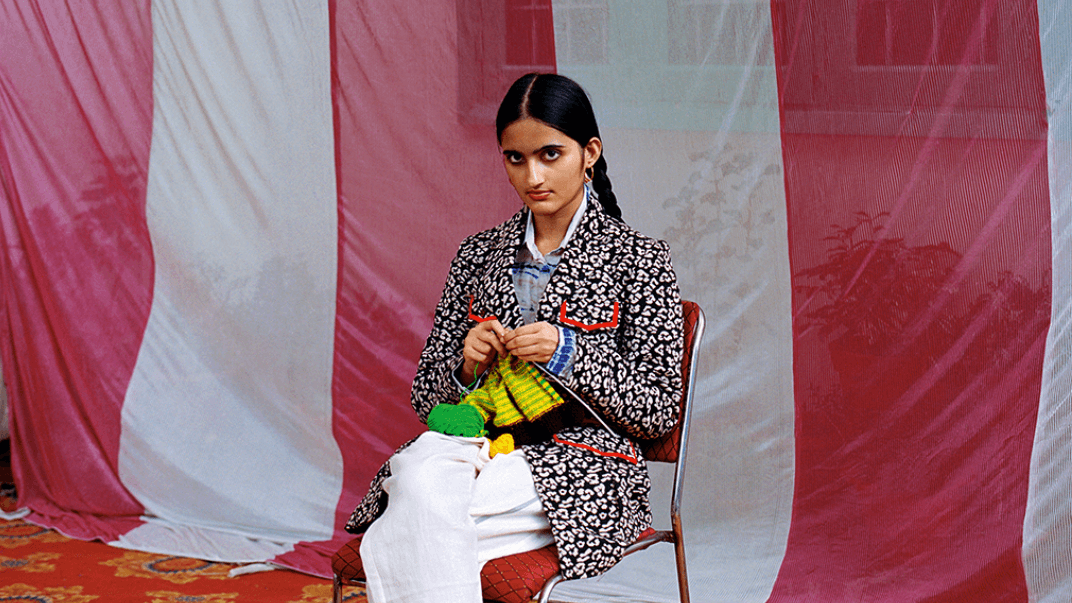
Pillings Tokyo Spring 2027 Collection
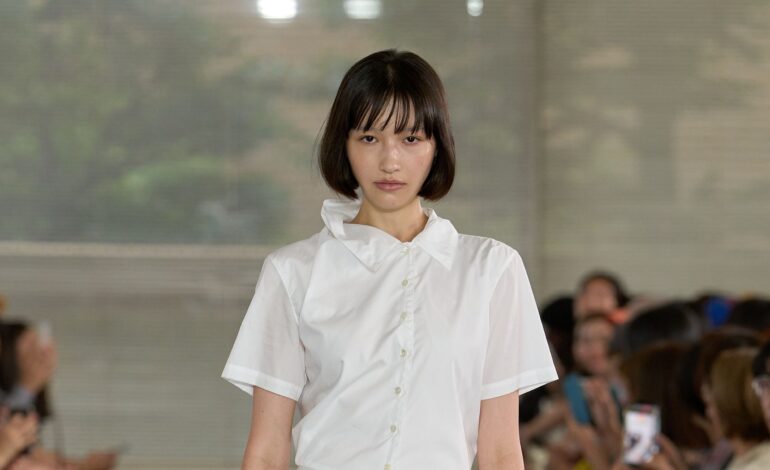

“You can just tell he’s on another level,” said a fellow journalist as we left this Pillings show, shown in a steel-floored hall at the offices of the Asahi Shimbun, one of Japan’s oldest newspapers.
Ryota Murakami is one of the most talented designers of his generation in Japan, able to infuse his lovably off-kilter knitwear with a rare emotional sensitivity. Today, he hinted that this could be one of the final times he shows in Tokyo, as he sets his sights on a more global platform.
Pillings began as a knitwear brand, but as its business expands and it gains more recognition abroad (international stockists have shot up over the past few seasons), Murakami is broadening his oeuvre each season. This time, jackets were reimagined in lighter linen, their satin lining peeking out, alongside softly puffy tailoring, delicate asymmetric shirting, and piqué tops, their warped and draped collars draped at the neck.
There were still plenty of knits in the mix: prim crochet cardigans decorated with little fabric roses, and gradient hues that bled from white into lilac, faint pink, or bluish gray. One white sweater was poked through with a small field of dandelions, while others were decorated with pointelle and scattered with petals. Two seasons ago, Pillings also began experimenting with woven fabrics. “I don’t necessarily agree with the idea that machine-made knits lack a human touch,” said Murakami. “You can still sense a real human quality in the quirks, like the struggles a programmer might have faced or the forced adjustments made to get something to work.”
That sensibility was also clear in the duo of striking flower petal dresses. Wrinkled and twisted like giant lilies of the valley, they were handcrafted from corsage fabric—something not usually used for clothing. “We took a process usually reserved for small-scale floral work and applied it to a human scale, creating this garment that looks like a flower. Or perhaps a flower that looks like a garment.”
As for the venue, it was the first time the newspaper offices had ever hosted a fashion show, and the reason Murakami chose it was characteristically sweet. In the newspaper there’s a section called ‘Voices’, where people from first-graders to centenarians submit everything from senryu poetry to opinions on current events. For Murakami, a regular Asahi reader, it’s how he stays connected. “I’m not the type to physically travel around to see things in person, so that page feels like a vital point of contact with society for me,” he said.
Many models wore floppy white cloche hats, which Murakami said referenced Shiroi Boshi (The White Hat), a Japanese children’s story. The premise is too convoluted to summarize here, but the point Murakami was making was one of beauty in abstraction. “It’s about dissolving the boundaries between the real world and fantasy,” he said. “That’s how I view memory, after all. We might casually look at things like the sky, or a coat hanger”—he gestured to one in the room—“but the images we’ve built up in our minds are often slightly twisted or blurred at the edges. I feel there’s immense value in being able to sense and appreciate those kinds of nuances.”
Another level indeed: when Murakami flies the nest, Tokyo will miss him dearly.