

 rahulNovember 14, 20266 Mins read0
“The Red Bull has… hit,” says Nara Smith, her voice shifting from the mellow monotone we’re used to hearing from her to a light, commanding chirp.
The 25-year-old influencer, model, chef, entrepreneur and soon-to-be actor is functioning on four hours’ sleep after arriving late from New York. She’s in London to promote her new cookbook, Homemade – an apt name, considering the energy drink she sips on set is one of the few things she’s never attempted to make from scratch. In videos with tens of millions of views, Smith has filmed herself making Coca-Cola, sourdough, toothpaste and bubblegum by hand. She once spent seven hours crafting 16 individual Skittles, only for her family to scoff them in seconds. All the while, she dresses in immaculate haute couture – Chanel, Gucci, Schiaparelli – and is a parent to four children under the age of seven. Somewhere along the way, though, things got complicated. The internet did what the internet does best and assigned her a label: tradwife.
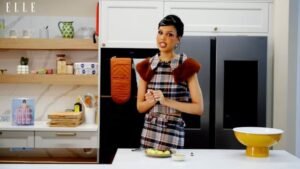
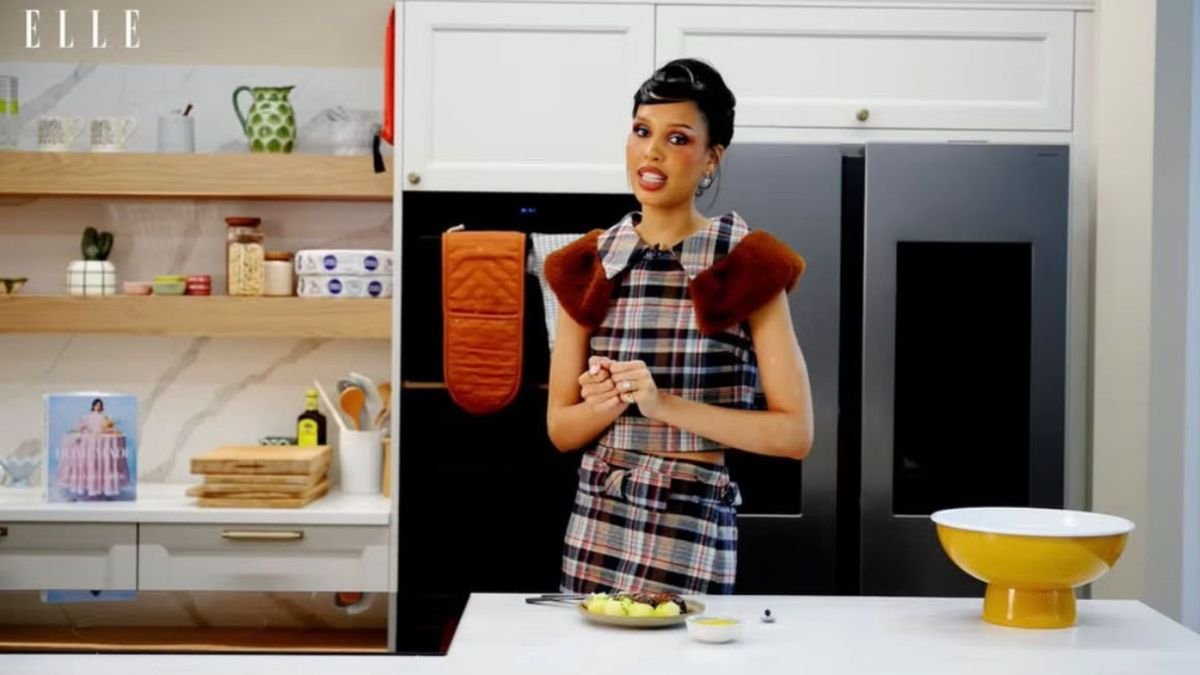
Smith speaks to me after filming a video for ELLE’s YouTube channel, wearing a Clueless-style tartan two-piece with coordinated polychromatic eyeshadow: a vision of polish and poise as she eats mouthfuls of braised beef rouladen while looking straight down the camera. ‘It’s probably the most nostalgic dish in there,’ she says, referencing the 80 recipes that feature in her New York Times-bestselling book. “It was one of the meals my grandma spent a little longer in the kitchen for”.
Born in Bloemfontein, South Africa, Smith grew up in Frankfurt with her grandmother, who taught her how to read, cook and play piano. “Before I started writing Homemade, I’d never owned a cookbook”, Smith says, which is, I think, surprising. “But I feel confident in the kitchen, so I just put things together. Or I would Google something and get the gist of what needs to go in”. When her publisher started asking her about layouts and recipe orders for the project, she was stumped. They were like: “I think you should go to the closest store to get an idea of what a cookbook looks like.”’ The first she picked out was Julius Roberts’s The Farm Table: “The way he approaches food just felt like a warm hug”. After testing and retesting (“it became this irrational fear that I would publish something and it wouldn’t work for people, because of their kitchen, their humidity or the altitude”), Smith’s own collection of heart-warming recipes, largely inspired by her German upbringing and family life in the United States, was finished: a rich goulash with fluffy potato dumplings, a showstopping meringue passionfruit ice cream cake, a ball of fresher-than-fresh mozzarella.
But her career didn’t really start in food; it started in fashion. Smith was scouted through an online programme at 14 years old and went on to work as a model – it was only when she moved to the US to live with her husband, the actor and model Lucky Blue Smith, that she began cooking everything from scratch. Diagnosed with an autoimmune disease and eczema, Smith found that cutting out processed foods helped her to manage her flare-ups. In 2023, she started posting her cooking videos on social media: elaborate dishes and homemade delicacies, prepared with a deadpan expression and narrated with a velvety, almost unmodulated voice-over. Since then, those videos have gained Smith nearly 13 million TikTok followers as well as major brand deals. It’s impressive – especially considering how hands-on she is, working on production from start to finish with minimal assistance.

Yet the elephant in the room is that Nara Smith, at least according to some people, is a ‘tradwife’: loosely defined as a woman who embraces a traditional domestic role in marriage while her husband works as the primary breadwinner. Though it can be dated back to early-noughties blogculture and extreme fundamentalist Christian groups, the tradwife ideal emerged on mainstream social media within the last decade, criticised for its reinforcement of rigid gender roles, rejection of feminist values and, some claim, links to rising right-wing conservatism. Over time, the term has become shorthand for a hyper-feminine, hyper-domesticated aesthetic – one reflected in Smith’s videos and, some argue, in the lifestyle she shares with her Mormon-raised husband.
Smith clearly distanced herself from the label in an interview in Alex Cooper’s Call Her Daddy podcast this summer. “I’m none of that”, she said, adding that women “can’t exist under any terms but the little boxes we put them in” and going on to defend the fact that she’s a working mum and loves cooking as a hobby. All the while, the so-called ‘de-trad’ movement has gathered speed. Former anti-feminist trad-wife creator Bernadine Bluntly divorced her husband and renounced the movement in a video earlier this year, noting it has “become indistinguishable from the current wave of the red-pill manosphere”: her Instagram bio now describes her as a “domestic violence survivor and mother of six”. ‘Ballerina Farm’s’ Hannah Neeleman, regarded as a friend of Smith’s, publicly distanced herself from the label two years ago.
“We should be uplifting each other and supporting each other in whatever we choose”
The public, however, remains obsessed. Caro Claire Burke’s debut novel published in April, Yesteryear, follows a tradwife influencer who wakes up one day in the 19th century; it sold 1.4 million copies within four months. Tradwife hot takes are still surfacing about Sabrina Carpenter’s Man’s Best Friend album cover. On Monday, BBC One is airing Young, British and Tradwife, a documentary exploring the largely US-central trend on home soil. Smith, meanwhile, has done her best to remain, or at least appear, staunchly apolitical, hoping to remove herself from the discourse altogether – despite critics accusing her of glamourising a traditional lifestyle without addressing the financial risks it might pose to everyday women.
Why does she feel the phenomenon is getting so much engagement now? She pauses. “I don’t know”, she says. “I stay away from the internet as much as I can, so I wouldn’t even know how to answer that question. I just believe that women should do whatever they want to do and feel empowered in their choices. Those may look different to a plethora of women. We should be uplifting each other and supporting each other in whatever we choose”.
Perhaps, I offer, it says more about those doing the labelling; the term’s political baggage and aesthetic associations have made it seem as though homemaking and being a feminist are almost incompatible. Does she think women are given less room to enjoy their domesticity than men – that it has to be treated as a political statement? “I’ve never really… I don’t really sit with that, to be fair”, Smith says. “For me, I film my videos. They’re an expression of myself and I put them online. I always say the people that understand, understand, and see it for the art form that it is. The people that don’t, don’t. That’s totally fine”. She adds: “Not all art is meant to be enjoyed by everyone”.
Could it be, perhaps, that Smith’s choice to marry and have four children by the age of 24 – while enjoying cooking, dressed in designer frocks – just isn’t all that deep? “I can only speak for myself”, she says.
“I’ll never speak for any other woman. Some people enjoy going to galleries. Some people enjoy painting. Some people enjoy singing, acting, whatever it may be. To me, fashion is expressing yourself; you get to tap into different characters, because an outfit can make you feel a certain way. You can put on a really cool leather outfit, and I promise you’re going to feel different than if you put on a ballgown”. It’s apt, then, that Smith’s next plan is to transition into acting: “essentially a version of what I do at home, just in a completely different way”. She has two films in post-production; one, Tyrant, is set in New York City’s culinary world, with a cast that includes Julia Garner and Demi Moore. When I ask if there’s anyone she’s desperate to work with, she asks me to check in again in a couple of years: “I feel like even saying it now feels silly, because I’m nowhere close to doing anything with my dream directors”.
Which brings us back to the question that shadows her social videos: where does Nara end and the persona begin? “People online always think I play this character, and it’s not”, she says. “It’s just me, a heightened version of myself. It’s not like I’m acting or playing someone else. Sometimes I’m calm. Sometimes I’m bubbly. Sometimes I use my normal voice. Sometimes I talk really mellow. It really depends”. That distinction may, of course, be difficult for viewers to make. Yet for all of the terms attached to her, Smith’s story is also one of a woman who followed her passions and found great success doing so. And, as we know, people hate to see women doing well.
Looking back at it all, one lesson Smith has gleaned from her career is less about labels and more about letting go when the time is right. “I always had to do everything perfectly and make it look a certain way”, Smith says, about the beginning. “I was overthinking everything and I feel like I wasted a lot of my time and brain power, when I could have just put things out and reaped the benefits”. This year, she’s found strength in relinquishing that control. “Just because something looks a certain way to us, doesn’t mean that other people will perceive it that way. I want to just try to do things even if they’re not perfect, and to learn and grow through that”.
Would she have had the success she’s had, though, if she hadn’t been such a perfectionist? Smith’s voice slips into a mellow tone once more. “Who knows?”
‘Homemade’ by Nara Smith is available to buy now.