


 rahulNovember 21, 20263 Mins read0
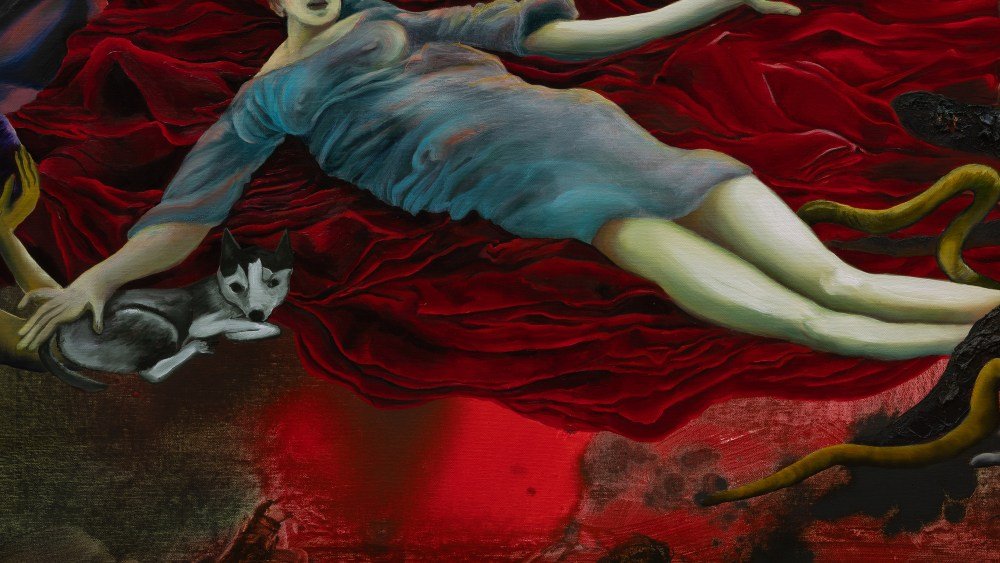
Maggie Ellis is painting beautifully grotesque scenes, but freedom, not aesthetic purity, is her primary ambition.
“Painting can be a rebellious thing,” the artist says, walking through her show, “Chaos Bewitched,” at Charles Moffett in TriBeCa. “I’m trying at every turn to sort of shatter my own expectations of what I see myself doing.
“Beauty is never intentional for me,” she adds. “I think it’s just something that kind of happens. I don’t go after beauty. I go after a feeling.”
The artists solo show presents a sweeping body of uncanny and cheekily comedic work, with a title drawn from Herman Melville’s novel “Moby-Dick,” one of her many cultural references. The painter, who was born and raised in Georgia, currently resides in Chinatown, New York where, when not secluding herself to the studio, she enjoys walks through the bustling streets and watching films that serve as provisions for her eclectic visual repertoire.

Maggie Ellis
Daniel Greer/Courtesy of Maggie Ellis
With each glance into her mystifying and unsettling scenes, Ellis presents characters that are both familiar and foreign. You may have seen them at the grocery store, in a previous life, or on a screen sometime in the last century, now reimagined in a fashion that challenge the logics of what’s real and what is not.
“It’s interesting because, even if I start out at an unfamiliar site, there’s always something that draws me back to a place that I do know,” Ellis says of her creative process.
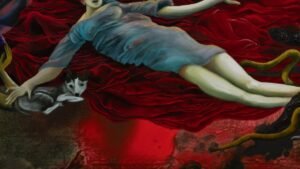
Drawing on film, literature, and her mundanity of her own everyday experiences, Ellis paints enigmatic and psychologically perplexing surrealist scenes that each feel like their own supernatural world. At once subtly horrifying and mesmerizing, her works oppose all confines of syllogistic reckoning and make it difficult to look away.
“I don’t discriminate,” Ellis says. “Maybe it’s an instinct when I see something, or read something, or even hear something. If a reference is getting close to the thing that I’m interested in, or even close to touching it, then I’m drawn to it, drawn to using it. I always think about taking references and then how can I expand on it and make it my own.”

Maggie Ellis
Daniel Greer/Courtesy of Maggie Ellis
Reading from her notebook filled with sketches, research musings, and her highly regimented wellness and creative schedule, Ellis shares a reflection that’s stayed with her throughout preparation for the show: “I’m deeply curious about the supernatural, because there are no direct answers,” she says. “The supernatural and death. And I see water as a metaphor for otherworldliness and death.”
Even though her inspiration is highly referential, Ellis is intentional in distinguishing between periods of consumption and creation to preserve what she calls her capacity for “visual corruption.” She takes a reference, be it a character, setting, or mythos, with its set connotative and denotative associations, and warps its presentation to create something entirely new, yet still reminiscent of its original form.

Perpetuity
Courtesy Photo
For Ellis, opposing the logics of order and expectation are what she finds most fascinating. Entering one of her scenes, whether it is a Spanish moss and willow tree-canopied cemetery assembly of fantastical figures, or a shipwreck turned site of repose split between two views, there’s an impetus to imagine more deeply, because what you expect is never what she presents to you.
“After spending so much time forcing myself to paint in a certain way or trying be perfect or reach perfection and realism, now I want freedom,” she says. “I value freedom and I give myself as much allowance as I can.”
As a viewer, part of the intrigue lays in surrendering to Ellis’ abandonment of steadfast reason. It’s in that tension between optical delight and obscenity that her mysticism finds its power. Taking in her work is an act of mutual discovery, as Ellis explores parts unknown within herself and invites viewers to do the same.
“Sometimes it’s kind of me, and sometimes only I know that…some kind of parallel dimension of myself. Which is what makes it fun,” Ellis says. “I don’t think you should reveal everything.”