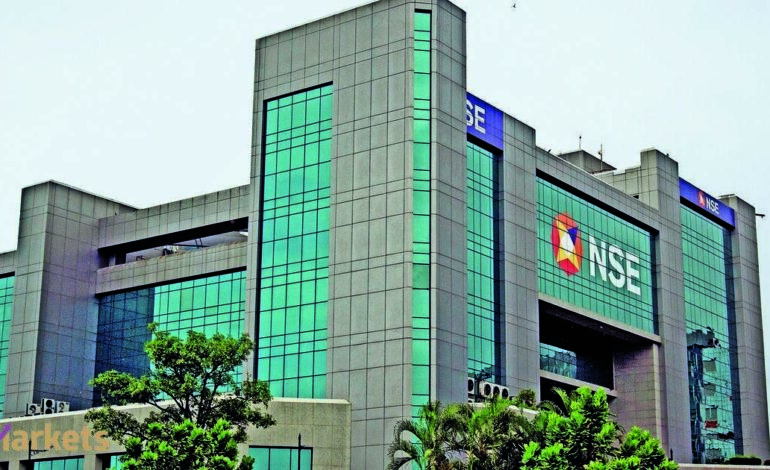
NSE debut may not set street on fire, sparks to come later

Traders in the unlisted market are quoting a grey market premium (GMP) -the amount investors are willing to pay over the expected IPO issue price before listing – of around ₹83 a share, or about 4.8%, over the IPO price of ₹1,785, compared with ₹250-310, or around 14-17%, earlier. The sharp contraction points to expectations of modest listing gains.
 ET Bureau
“While investors have been waiting for the NSE listing for long, the enthusiasm has moderated because of the large issue size and expected supply,” said Abhay Doshi, co-founder of UnlistedArena.com.
NSE’s ₹22,561-crore IPO, the largest so far in 2026, was subscribed 5.71 times, riding a bullish primary market wave over the past three months. The issue received bids for 505.81 million shares against 88.6 million shares on offer, led by demand from institutional and high net-worth investors.
At the IPO price of ₹1,785 a share, NSE commands a valuation of ₹4.42 lakh crore. Rival BSE’s market cap is at ₹1.33 lakh crore. Some market participants said the demand-supply dynamics could have a significant bearing on NSE’s share price in the initial days after listing.

Read more: Gautam Adani reclaims top spot as India’s richest, edges out Mukesh Ambani: Hurun Rich List
“At a valuation of ₹4.42 lakh crore, the NSE IPO would immediately position it among India’s top companies by market capitalisation,” said Manish Bhandari, founder, CEO and portfolio manager at Vallum Capital Advisors. “While GMP indicators hint at a muted 2-5% premium, the real story lies in its tight initial supply.” Experts said that while the grey market could be pointing to a more modest listing pop, the current limited supply of shares makes the grey market prices more unpredictable.According to unofficial estimates, of NSE’s 2,475 million outstanding shares, 2,348.6 million, or 94.9%, constitute pre-issue capital.
Rules Limit Stock Supply
Under Sebi rules, pre-issue shares held by non-promoter shareholders, barring some categories of Alternative Investment Funds (AIFs), are locked in for six months from the IPO allotment date.
Read more: NSE IPO shares all set to list: GMP signals 2% listing gain ahead of market debut
To be sure, although the Life Insurance Corp is the biggest owner of stock in the bourse, the NSE has no identifiable promoter.
While the IPO involved the sale of 126.4 million shares, equivalent to about 5.1% of NSE’s total equity, 37.8 million of the IPO shares went to anchor investors. These shares are also locked in after listing. That leaves only about 88.6 million shares immediately available for trading when NSE lists on Thursday. NSE’s book-built issue was entirely an offer for sale (OFS) of up to 126.4 million equity shares by 10 existing shareholders, including state-owned insurers and banks.
In the absence of large supply on account of selling soon after listing day, any fresh purchases from institutional or deep-pocketed investors could drive up the stock sooner than what the grey market expects, said brokers.
As of the June quarter, foreign institutional investors (FIIs) held 26.41% of NSE, while individual shareholders with holdings of up to ₹2 lakh accounted for 12.71%. Individuals with holdings above ₹2 lakh held another 9.58%. Alternative investment funds (AIFs) held 5.31% and insurance companies 0.13%.
Among NSE’s major shareholders, LIC held 10.7%, followed by SBI Capital Markets with 4.33% and State Bank of India with 3.23%. PI Opportunities held 2.4%, while investor Radhakishan Damani owned 1.58%. Sunil Kant Munjal held 0.41%, S Gopalkrishnan 0.38% and Indian Bank 0.34%.