

 rahulNovember 18, 20263 Mins read0
Historically, South Asian poetry has been closely associated with themes of romance, longing, devotion, displacement and memory. These motifs continue to shape some of the region’s most celebrated literary works.
But contemporary South Asian poetry has never been confined to these themes, and a new generation of writers is finding fresh ways to explore them.
Modern poets are writing about city life and social media, spirituality and celebrity culture, migration and modern identity. They are experimenting across forms, moving beyond the printed page and into galleries, digital spaces and visual art.
They are not abandoning tradition; they are expanding it.

Among the writers contributing to this evolution is New York-based poet and writer Elizabeth Shanaz, whose work blends cultural memory, spirituality, popular culture and contemporary life through poetry, essays and visual art.
Born to Guyanese immigrant parents and raised in New York City, Shanaz first encountered poetry through a spoken-word programme at her public school in Queens. What began as an after-school activity soon became a lifelong pursuit.
“I’ve been writing poetry ever since,” she says. That early introduction in middle school laid the foundation for a body of work that would eventually span poetry, lyric essays and visual art, with an interest in subjects ranging from religious identity to the cultural references of everyday life.
Shanaz’s work reflects the possibilities of a poetic voice shaped by multiple cultural influences. Her writing draws on her Indo-Caribbean heritage, Islamic faith and experiences of growing up in New York, allowing different histories and identities to exist within the same literary space.
One of the most distinctive qualities of Shanaz’s writing is the way it places spirituality within contemporary settings. Her ‘Revelation Series’ explores how themes and teachings from chapters of the Qur’an might resonate in modern-day New York City.
Rather than treating spirituality as something distant or confined to history, the poems explore how faith, memory and everyday life intersect within familiar urban landscapes. The result is a dialogue between inherited beliefs and the realities of contemporary life, without suggesting that one must replace the other.
For Shanaz, cultural identity and spirituality are not fixed ideas. They are living experiences shaped by geography, community and personal history.
While many readers first encounter Shanaz through her spiritually informed work, another significant part of her writing explores contemporary culture.
Her poem ‘Making a Scene’, which references the Netflix series The Perfect Couple, examines the representation of South Asian men in Western popular culture.
Elsewhere, she imagines legendary singer Nusrat Fateh Ali Khan navigating Instagram, bringing together cultural legacy and digital culture in unexpected ways.
For Shanaz, these references are not distractions from poetry’s more familiar concerns. They are part of the world that poetry can document and interpret. “There’s this idea that poetry can only hold portions of a complete world,” Shanaz says, “but poetry can hold anything. Anything that language can hold, poetry can too.”
It is an approach that allows her to move between devotional music, streaming television and the experiences of diaspora communities without treating popular culture as less worthy of literary attention.

The expansion of South Asian poetry is not only happening through subject matter. It is also happening through form.
In recent years, Shanaz has begun presenting her work in visual poetry exhibitions that transform language into physical and visual experiences.
Her work has been presented at Brown Girl Clubhouse in Manhattan and in the Bronx in collaboration with the nonprofit Oyate Group. In Mumbai, she participated in ‘Textiles of Memory’, a visual poetry exhibition at the Kala Ghoda Arts Festival, alongside artist Suchita Senthil Kumar.
Through textiles, maps and other visual elements, these presentations encourage audiences to experience poetry beyond the conventional arrangement of words on a page. Language becomes part of an installation, inviting viewers to consider the relationship between text, memory and physical space.
For a writer whose work frequently explores belonging and cultural inheritance, this movement between literary and visual forms offers another way to examine how identity is experienced and remembered.
What makes Shanaz’s work interesting is the ease with which it moves between seemingly different worlds. Faith and popular culture, family history and city life, personal memory and collective identity all find a place in her writing.
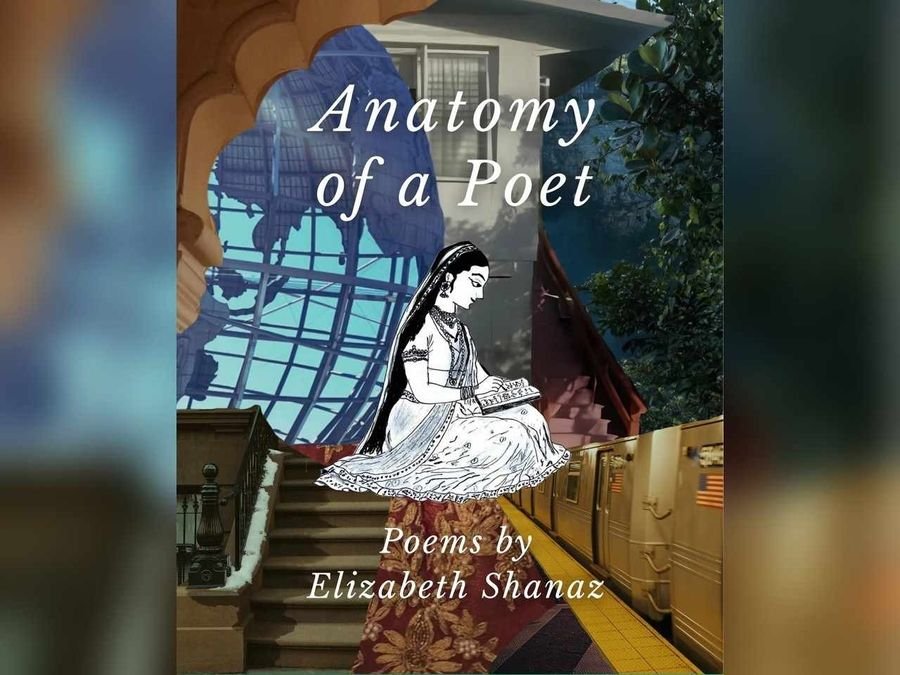
Her forthcoming collection, Anatomy of a Poet, brings these concerns together, exploring Islamic faith, Guyanese roots, the Indo-Caribbean diaspora and the relationships that shape her sense of home.
Rather than positioning her work as a departure from South Asian literary traditions, Shanaz offers an example of how those traditions can accommodate new subjects, forms and perspectives.
In doing so, she makes a case for poetry as a medium that can respond to the world as it is lived, whether that means navigating inherited beliefs, questioning cultural representations or finding meaning in the everyday.
Her collection, Anatomy of a Poet, is scheduled for publication by The Northeast Coast Press on 26 January 2027.
To see more of her work, follow Shanaz on Instagram and explore her published works.