

How ready is the textile industry for 2040? Not particularly, said Zoe Le Grand, managing director, U.K. and Europe, at Forum for the Future. But a better question might be how the industry can prepare, and on that front, she has a fuller answer.
The sustainability nonprofit on Wednesday teamed up with the H&M Foundation to release Textile Futures 2040, a quartet of scenarios designed to help industry leaders stress-test their assumptions about growth, technology, consumption and responsibility and reframe their strategies for everything from a just transition to achieving net zero.
Building on Forum for the Future’s previous Fashion Futures 2030 project, the scenarios depict neither utopias nor dystopias but instead present possible futures neutrally, allowing readers to make their own judgments. Forum for the Future and the H&M Foundation also don’t claim to be prognosticators of any kind.
“They are not predictions of the future,” said Anna Gedda, CEO of the H&M Foundation, the philanthropic organization run by H&M’s founding family. “They’re more a way to help you see what could actually be possible futures, and with that in mind, make better decisions today.”
And why the switch in terminology from fashion to textiles? It all boils down to the industry’s carbon footprint. Textile processing accounts for the largest share of the industry’s greenhouse gas emissions at 55 percent, followed by material production at 22 percent, raw material processing at 15 percent and finished production assembly at 8 percent, according to the Apparel Impact Institute. With the apparel and textile sector’s “moonshot goal” of zeroing out emissions by 2050, Le Grand said, “that’s where you want to focus your attention.” While fashion is part of the picture, how clothes are produced is the focus, she added.
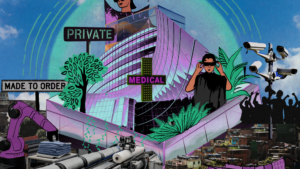
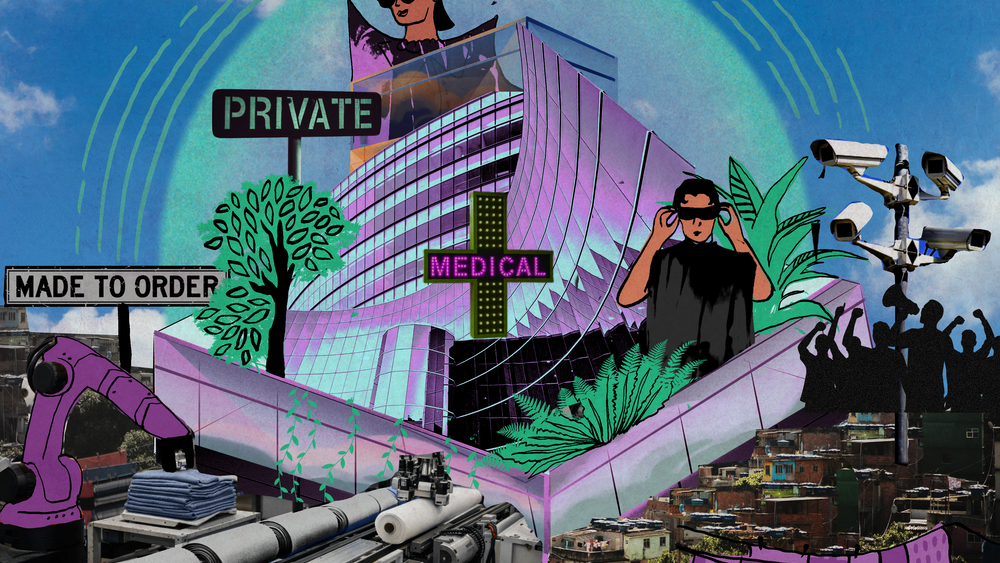
The scenarios are vividly, almost cinematically described. “New Age Corporate Empire” depicts a high-tech, highly efficient world where corporations have become more powerful than governments but inequality persists and decarbonization is deprioritized in favor of profit. “Power Shift” positions Asia as the new center of power and influence, with state-backed innovation, better working conditions and surging consumption resulting in an appreciation for handmade goods and greater product traceability. “Global Storms, Local Shields” sees supply chains breaking down under climate and resource pressures, making local production and circular practices such as repair and reuse imperative for self-sufficiency. And “The New Noosphere” projects an AI-driven world with lower emissions and restored ecosystems, but algorithms decide what gets produced and how people live.
To bring these prospective futures to life, Textile Futures 2040 includes personas: “If you’re a worker in this world, what’s your day like?” Le Grand said. The goal of the project isn’t just to speculate about what lies ahead. Forum for the Future and the H&M Foundation also want companies to use the accompanying toolkit to gamify their future-proofing exercises as they run through prompts like “What’s a move we could make today that we won’t regret?” and “What’s one bet we’re currently making that this scenario calls into question?”
Participants can even design their own “artifact of the future” that reveals how life in a given scenario differs from life today—a SmartFibre-woven kurta that adapts to weather changes in the “New Age Corporate Empire” scenario, perhaps, or a smart card that customers can tap on their clothes to check the garments’ provenance or initiate repair or remake services in “Power Shift.”
Already, organizations have asked Forum for the Future to help them run workshops. The hope, Le Grand said, is to hold sessions at conferences “because it’s always helpful to have somebody to to walk them through with you.”
Textile Futures 2040 didn’t conjure its scenarios out of thin air, instead drawing on expert interviews, focus groups and scenario-testing workshops with more than 60 stakeholders from retail, manufacturing, labor rights, design, philanthropy and academia. Again, Le Grand said they’re not so much prophecies as possibilities based on prevailing trends, even though Forum for the Future has gotten some things right in the past.
She paraphrased Bill Gates: “We always overestimate the change that will occur in the next two years and underestimate the change that will occur in the next 10.”
“The reality is that no one scenario comes to pass in its full in the way we’ve described it,” Le Grand said. “But I’m pretty confident that elements of what we said will come to pass.” Take “The New Noosphere,” for example. “There’s plenty of evidence for all those sorts of technology and that sort of interaction between nature and AI already, scarily enough,” she said. A future in which governments have ceded power to global corporations is also not all that far-fetched.
For Gedda, exploring those possibilities can also be a source of hope amid a turbulent and negative news cycle.
“If you just put that together into one future, it just feels like everything is very much going into the wrong direction, but actually, if you think of that, a future can actually take a lot of different shapes and forms,” she said. “We don’t know exactly how things are going to play out, but by expanding your mind and thinking that more is possible, I think that also enables you to be a bit more optimistic.”