
Crude oil rally nears $100: Will geopolitical risks push prices higher?
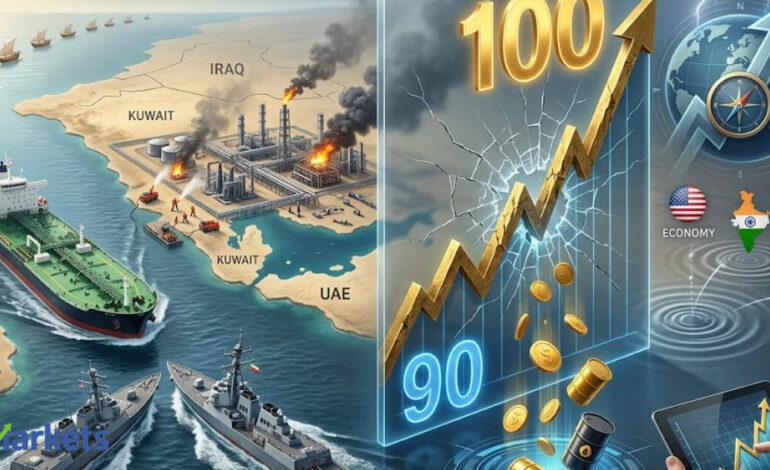

The primary driver behind the rally has been renewed tensions between the United States and Iran, which have revived concerns over global oil supplies and tanker movements through the Strait of Hormuz, a key route for global energy trade. While actual supply losses remain limited, fears of disruptions have led traders to build a sizeable geopolitical risk premium into prices. At the same time, resilient demand from major economies and expectations of stable energy consumption have further supported the market.
US-Iran Tensions Add Risk Premium
The latest leg of the oil rally has been driven by escalating military tensions between Washington and Tehran. Recent exchanges of strikes and threats targeting strategic assets in the Gulf have heightened fears of a broader conflict. Investors worry that prolonged hostilities could affect oil production, export infrastructure, or shipping routes in the region. Although the conflict has not yet significantly disrupted physical supplies, the possibility of escalation has forced traders to price in additional risks. As a result, crude oil prices have surged as markets respond to uncertainty rather than actual shortages.
Impact on Global Supply

Global oil supplies remain largely intact, but concerns about future disruptions continue to dominate market sentiment. The Persian Gulf accounts for a substantial portion of global crude exports, and any threat to shipments from major producers such as Saudi Arabia, Iraq, Kuwait, and the UAE could tighten supplies quickly. While alternative export routes exist, their capacity remains limited compared to traditional Gulf shipping channels.
Strait of Hormuz Remains a Key ConcernThe Strait of Hormuz continues to be the focal point of global oil markets. Tanker traffic has not stopped, but shipping activity remains uneven due to security concerns and isolated attacks on commercial vessels. Reports indicate that operators remain cautious, resulting in occasional disruptions and higher transportation costs. Since nearly one-fifth of global oil trade typically passes through Hormuz, even minor disturbances can create significant price volatility. The market’s biggest concern is that further escalation could restrict vessel movements and disrupt energy flows.
Demand Remains Supportive
Despite concerns over global growth, oil demand remains relatively healthy. The US economy continues to support fuel consumption, while emerging economies, including India and Southeast Asian nations, maintain steady demand growth. China remains a mixed picture, with slower economic activity offset by stimulus measures and infrastructure spending. Overall, global demand has not weakened enough to offset supply-related concerns.
US Economic Data and Fed Outlook
Recent US economic data has reinforced expectations of stable energy demand. However, rising oil prices pose inflation risks and could influence future Federal Reserve decisions. Normally, expectations of tighter monetary policy and a stronger dollar can pressure commodities. Nevertheless, the market is currently placing greater emphasis on geopolitical uncertainties than monetary policy concerns.
Can Brent Cross $100?
Brent crude is now within striking distance of the psychologically important $100-per-barrel mark. Continued escalation between the US and Iran, further tanker attacks, or additional restrictions around Hormuz could easily push prices into triple digits. Conversely, any diplomatic breakthrough or improvement in shipping conditions may trigger profit-taking and a correction. Therefore, the next major move in oil prices will likely depend on geopolitical developments rather than traditional supply-demand fundamentals.
Outlook
The near-term outlook for crude oil remains firm, although price volatility is expected to persist amid ongoing geopolitical uncertainties. Prices are likely to hold above the $90 per barrel level, supported by supply concerns and resilient demand. A decisive breakout above $100, accompanied by strong trading volumes, could trigger further upside momentum and push prices significantly higher. On the downside, $85 is seen as an immediate support level. A sustained break below this threshold could weaken bullish sentiment and lead to a deeper correction in crude oil prices.
(Hareesh V is Head of Commodity Research at Geojit Investments.)
(Disclaimer: Recommendations, suggestions, views and opinions given by the experts are their own. These do not represent the views of The Economic Times)