


 rahulNovember 22, 20263 Mins read0
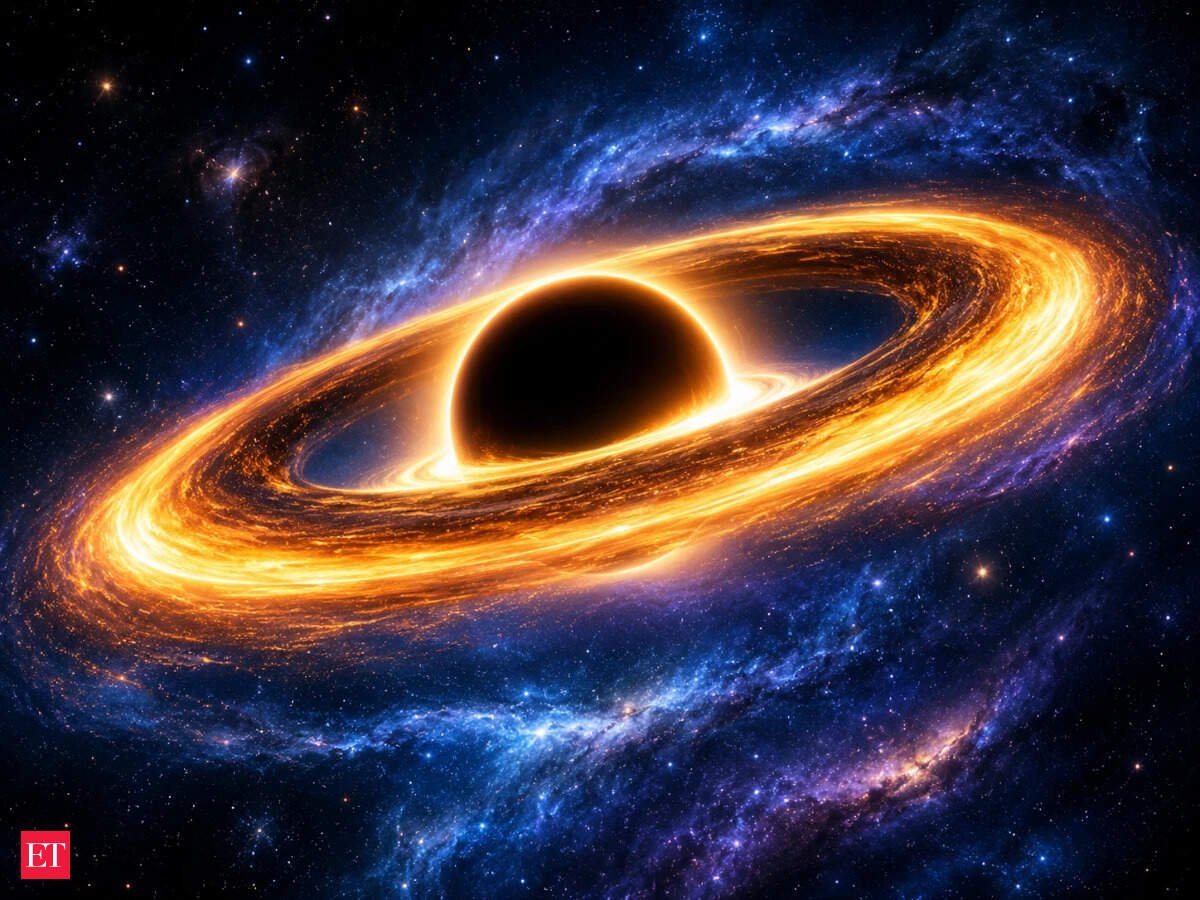
The latest work by physicist Armas takes an earlier theoretical model several steps further. It describes a five-dimensional Black Saturn in which both black holes can rotate independently in two directions. According to ScienceAlert, the solution opens up possibilities that could not be explored using the original mathematical model.
Unlike the familiar picture of a black hole as a spherical object, a Black Saturn has two distinct components. One is a spherical black hole at the centre, while the other is a ring-shaped black hole surrounding it.
Read more – Delhi Metro & traffic jam: 22 weddings, 10,000 guests & 4,500 extra vehicles could turn commute into nightmare; check affected routes & advisories
The ring resembles a doughnut, with an empty space in the middle occupied by the smaller black hole. Each object has its own event horizon, the boundary beyond which nothing, not even light, can escape.
Such a configuration is possible in the mathematics of five-dimensional spacetime. While our observable Universe has three dimensions of space and one of time, adding another spatial dimension changes the kinds of geometries that Einstein’s equations can accommodate.
In this setting, a black hole does not necessarily have to follow the spherical structure familiar from four-dimensional spacetime.Read more – Mumbai woman started business at 18 but struggled to get orders; then came Italian twist, & what began as childhood hobby went on to make Rs 4 lakh in revenue
The original mathematical description of a Black Saturn appeared in 2007. However, it came with a restriction: the two black holes could rotate in only one plane.
Five-dimensional spacetime allows objects to rotate in two independent planes. Accounting for both forms of rotation makes the equations considerably more complicated, but it also provides a way to examine configurations that the earlier model could not describe.
Armas’s new solution removes this restriction by allowing both the central black hole and the surrounding ring to rotate in both planes.
The unusual shape of the outer black hole depends on rotation. Its gravitational pull would otherwise cause the ring to collapse under its own weight. Sufficient angular momentum helps it maintain its shape.
However, the two black holes are not completely isolated from each other. Both occupy the same spacetime, meaning their gravitational fields can influence the region around them.
Their rotation can also drag the surrounding spacetime along with them. This effect is known as frame dragging. It means the spinning ring can influence the rotation of the central black hole’s event horizon, even in a plane where the central object has no intrinsic angular momentum of its own.
One of the most striking aspects of the new mathematical solution concerns a state called extremality.
Black holes have limits on how much angular momentum they can carry relative to their mass. When they reach the relevant limit, they become extremal, with their Hawking temperature falling to absolute zero.
In five-dimensional spacetime, reaching this state without the event horizon disappearing requires rotation in both independent planes.
Armas’s calculations show that the two black holes in a Black Saturn can reach extremality at the same time, while each retains its own event horizon. The research therefore presents the first known exact mathematical solution in which two separate black holes can exist together in this state in an otherwise empty five-dimensional spacetime.
Despite both objects reaching a Hawking temperature of absolute zero, the arrangement does not necessarily become fully balanced.
For complete equilibrium, their rotations would also need to match in both planes. However, Armas found that the two black holes cannot achieve this matching while retaining a regular Black Saturn configuration.
The surrounding ring can also affect the central black hole through frame dragging. As a result, the rotation of its event horizon need not correspond exactly to its own intrinsic angular momentum.
There is currently no evidence that Black Saturns exist in nature. Nor is there evidence that our Universe contains the additional spatial dimension required for this particular configuration.
Nevertheless, mathematical solutions of this kind are useful because they allow physicists to investigate how general relativity behaves under conditions far removed from those observed in our four-dimensional Universe.
The new work could also provide a starting point for further studies of how light and matter behave around these objects, as well as the geometry of spacetime within their event horizons.
For now, the Black Saturn remains a theoretical possibility rather than an observed cosmic object. But the idea of a black hole shaped like a ring, with another black hole occupying its centre, offers a striking example of just how unusual Einstein’s equations can become when an extra dimension is added. The research paper is available on arXiv.