

 rahulNovember 21, 20264 Mins read5
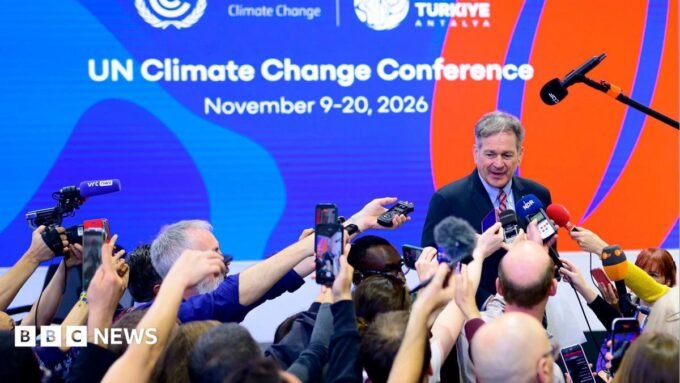
China is pushing for rapid electrification of its economy using low-carbon energy and will help other countries do the same, a senior member of the Chinese delegation at the Cop31 UN climate summit has said.
Wang Yi, a professor of energy and environment policy at the Chinese Academy of Sciences and a senior adviser to China’s government, said: “End-use electrification is a very clear direction. We can follow this direction while making the source of electricity clean. That’s the way to go forward.”
China is the biggest emitter of greenhouse gases by far, producing more than a quarter of the world’s total, so its push for electrification is significant.
At Cop31, countries are being asked to sign up to a target of deriving 35% of final energy consumption from electricity by 2035. Australia, the president of the negotiations, and the host nation Turkey have pushed the target and on Friday night Australia and China signed a joint statement endorsing the “35:35” goal.
But in the second draft text of the probably outcome from Cop31, released on Thursday, the electrification pledge was downgraded to one of a suite of voluntary options countries can take up to reduce their greenhouse gas emissions.
In an interview with the Guardian at the talks, Wang said: “China will do our best to realise clean end-use electrification, and also help other countries to improve. China has significantly reduced the cost of clean technology and products and we would like to share our experience with other countries.”
Experts have said electrification is the next vital step in the shift to a low-carbon economy, as the only way to diminish the close to 80% of fossil fuels still used for primary energy, mostly for transport, heating and industry.
While civil society organisations want any commitment made on electrification to specify that it must be met from clean sources, a pledge that leaves the choice to countries is likely to have more widespread support, as many – including China and India – are resistant to anything they feel smacks of “top down” interference in national plans.
But campaigners argue that allowing individual countries to decide risks leaving the door open to more gas-fired power plants. Some compromise language is also possible that would urge countries to decarbonise their power.
Last year, electricity made up nearly 30% of China’s energy use and it is on track to make that 35% by 2030. Electricity is several times more efficient than fossil fuels, meaning that it takes far less energy to run electric vehicles, heat pumps and industrial processes than their fossil fuel counterparts.
Wang said China was happy with the 2035 target, but that it would be harder to meet if the electricity was required to come entirely from low-carbon sources. “For this target, no problem. But if you think about ensuring clean electrification, that may be a little bit difficult, even for China. For other countries, it’s even more difficult,” he said.
China still has a large number of coal-fired power stations and is planning some new ones, though fewer than before. Wang said this would be used for back-up during the transition to clean energy.
One of the key issues at Cop31 is the “transition away from fossil fuels”, which was one of the resolutions passed at the Cop28 summit in Dubai in 2023, but which countries have failed to flesh out since. The phrase was included in the first draft of the “cover decision” outcome from Cop31, presented on Monday, but excised from the second draftissued on Thursday, to the dismay of many countries and campaigners.
after newsletter promotion
Wang said: “We agree with paragraph 28 of the UAE consensus [the transition resolution]. But maybe different countries have different roadmaps. It’s very difficult to have only one unified roadmap for every country. So maybe we will help other countries to have their own country-based solutions, to realise their own national way of establishing a new renewable-based power system.”
China is also concerned about trade barriers to its clean technology exports, including the tariffs that the US under Donald Trump has placed on Chinese goods, and the “carbon border adjustment mechanism” (CBAM) imposed by the EU. The CBAM penalises imports from countries with looser regulations on carbon than the EU, which forces companies in high-carbon sectors to pay for their carbon emissions in order to level the playing field.
Some smaller developing countries have criticised the EU for its CBAM, warning that it will hamper their manufacturing industries. The EU said it had processes in place to ensure smaller developing countries were not hurt.
Wang called for more work on trade issues at Cops. “They must come together to find a unified approach,” he said. “China and other developing countries, including the global south, disagree [with the EU] on this. But that’s why we should continue to strengthen our dialogue.”
Jiangwen Guo, a senior research fellow at the Chatham House thinktank, said other countries could learn from China. “China has very consistent top-down policies [and] sets a clear direction with high consistency, then follows with learning by doing,” she said. “In the great energy transition, there is no one ahead of China. China is creating the model for the globe.”
Negotiators at Cop31, which was scheduled to end at 6pm on Friday, were sent home late on Friday after the talks stalled, with a new draft text of a “cover decision” marking the main outcome of the negotiations not thought likely to emerge until some time on Saturday morning. The talks are likely to continue into Saturday and potentially beyond.