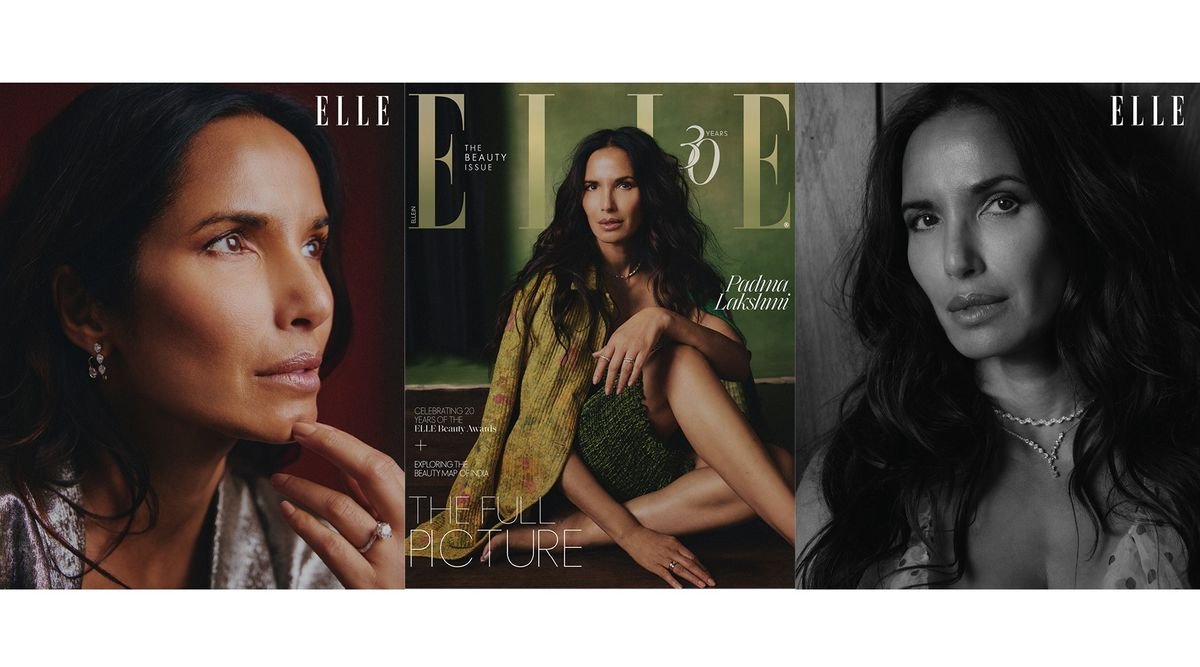




Ageing, Padma Lakshmi tells me, is a privilege. “I always feared getting older. Because I was a model and an actor, I was on television. And as women, we are told that we have a sell-by date. I’m here to tell you that it gets better. Don’t fear getting old.” And yet, for women, growing older has long been treated as something to resist rather than embrace. We are encouraged to celebrate our birthdays while concealing the years they represent, to grow wiser without looking older. It is a contradiction that Lakshmi knows intimately, having spent much of her career in industries where a woman’s appearance is under constant scrutiny. Today, she sees it differently.

It is a little past 8 pm in India when Lakshmi joins the Zoom call from New York, where her morning is just beginning. She’s sipping tea as we settle into a conversation that travels through her different avatars: The model who has occupied some of fashion’s most coveted spaces, the author and television personality who explores culture and identity through food, the advocate who has spent years fighting for women’s healthcare, and so much more. Through it all, she has remained remarkably candid about the experiences that have shaped her.
At 56, Lakshmi is disarmingly honest about what she misses from her younger years, but equally clear about what she has gained. “I do miss my thighs and the figure of my twenties. I was a lingerie model — no accomplishment of my own, just thanks to genetics,” she laughs. But the trade-off, she believes, has been so worthwhile. “The peace of mind I have in my fifties from knowing myself is much more precious than how lean my thighs were back then.”
For a woman who has spent much of her life being looked at, photographed and judged, beauty has always been complicated, partly because she grew up moving between two countries with very different ideas of what a woman should look like. In India, she was often told she was too thin, needed to gain weight and didn’t look good in a saree. In the US, the magazines told her something else entirely. “Everyone I saw was fair, blonde, blue-eyed and very thin and, you know, didn’t look like my mother who was much more curvy.”

What concerns her today is that these diverse ideas of beauty are increasingly beginning to look alike. “Because of the internet and social media, beauty standards are converging. And unfortunately, there’s a homogenisation of what is considered beautiful, both in the East and the West.”
Her scepticism extends to the international beauty industry’s growing fascination with Indian ingredients and traditional practices. “Is this genuine cultural appreciation, I ask, or another commercial opportunity? It seems like what’s being appreciated is the money the brands can make, and when there’s corporations involved, unfortunately, the first order of business is the bottom line.”

While she acknowledges a genuine appreciation for natural ingredients and holistic practices, she also recognises an industry constantly in search of its next big discovery. “Beauty and fashion, in general, are always at the forefront of discovering what’s new. And so when you can’t go forward anymore, you tend to go back.”
At home, Lakshmi’s relationship with beauty is more personal. She remembers oiling her daughter Krishna’s hair and body before every bath, a ritual she inherited from her own mother and grandmother. Today, she still makes her own bathing salts, essential oils and perfume. Her daughter, meanwhile, has developed a fascination with beauty products, partly thanks to the PR packages Lakshmi has passed on to her over the years. So, they came up with a rule: neither is allowed to visit Sephora alone!
Motherhood has also shaped the way Lakshmi thinks about ambition and the expectations women inherit. For daughters of immigrant families, success can sometimes come with a complicated sense of guilt, particularly when their opportunities extend far beyond those available to their mothers. Lakshmi, however, sees things differently.

“I don’t carry this guilt,” she says. “I know that my mother expects me to go beyond the borders of her own imagination.” Her mother moved to the US because of marriage and circumstances, but Lakshmi believes she also had ambitions of her own like studying further and exploring the world. “I think I’m living a life my mother would have lived if she could.”
That doesn’t mean the journey has been easy. Does she feel the pressure to work harder and be taken seriously as a brown woman in predominantly Western industries? “Oh, there’s not a day I don’t feel that. “I mean, I wake up in this body every day, and I feel like I have to work.”

She speaks about the additional effort required to establish credibility in spaces where women, particularly women of colour, have historically been underrepresented. It reminds her of something her friend and celebrated feminist Gloria Steinem, who passed away recently, once told her: “Some of us have become the men we wanted to marry.”
For anyone who has followed Lakshmi over the years, food has been one of the easiest ways to connect with her. From popular series ‘Top Chef’ and ‘Taste the Nation’ to her bestselling cookbooks and the recipes she regularly shares on Instagram, she has repeatedly invited audiences into her world through food. But for Lakshmi, food has never been just about what appears on the plate; it has always told stories of culture, class, identity and the people whose labour makes it possible.

She points to the disparity in how different cuisines are valued. French and Italian restaurants have long commanded premium prices, while Indian food has frequently been expected to remain affordable, regardless of the skill or complexity involved. “Pasta can be $100, but at the same time, a biryani can’t be $100,” she says. That perception, she believes, is slowly changing as Indian restaurants gain recognition in the global fine-dining landscape.

But the larger conversation, for Lakshmi, is about whose work we choose to value. Restaurant kitchens have traditionally been dominated by men, even as generations of women have preserved culinary knowledge within their homes. The recipes passed down by grandmothers, whether in Indian, Nigerian or Peruvian households, represent an extraordinary inheritance of skill and knowledge, yet rarely receive the same recognition as professional cooking. “I want to see women’s labour rewarded and respected,” she says.
If Lakshmi is mindful about the inequalities surrounding food, she is openly furious about those embedded within women’s healthcare.
After years of living with endometriosis, she founded the Endometriosis Foundation of America (2009) to challenge what she sees as a systemic failure in medicine: medical misogyny that has left women’s bodies under-researched, their pain under-recognised and their treatment options limited.

“I’m furious at science. I’m so angry. And it is out of that rage that we started the Endometriosis Foundation of America.” Her frustration is rooted in personal experience. For years, debilitating pain disrupted her life, highlighting how little attention conditions affecting women have historically received. She points to the longstanding underrepresentation of women in clinical research and the consequences of treating male bodies as the default.
Lakshmi makes an uncomfortable comparison: “If I had erectile dysfunction, there would be several pharmaceutical treatments advertised on television, I could probably continue going to work while dealing with it, but for someone living with endometriosis, the options are severely limited, there are no drugs to this day that are really proven and effective at relieving any symptomatic pain for me, other than hormone suppression,” she shares.

She is equally determined to change the way these conditions are understood within families and society. “At our foundation, we think of it as a family issue because when a woman is down with pain, everybody in her circle suffers.” For her, the conversation cannot end at awareness. It must translate into better research, meaningful investment and healthcare systems that take women’s pain seriously.
As the mother of a Gen Z daughter, Lakshmi understands the frustration of a generation growing up amid political and economic uncertainty. When our conversation turns to young people facing backlash for protesting, she is unequivocal: “Why can’t they? Do they not vote? Do they not pay taxes? “I think in any democracy, you must have free speech and a free press. And if you don’t have those two things, then you really don’t have a democracy.”
Her concern extends to the freedoms women are still fighting for. “My heart goes out to all the girls. Why is it always a girl’s life that gets limited? Why is her access to the world restricted because of male behaviour that continues to be tolerated and accepted by society?”
Fashion has been a constant through Lakshmi’s life, offering her a front-row view of an industry that has both celebrated and challenged her appearance.
Long before the red carpets and magazine covers, was young Lakshmi in Milan, trying to find her footing as a model after completing her bachelor’s degree. Her distinctive scar, initially viewed as something to conceal, became an asset after photographer Helmut Newton chose to feature it prominently in his images.

One of her earliest fashion memories is wearing Gianni Versace’s now-iconic black safety-pin dress at Convivio (1994), an AIDS charity event in Milan, a little before Elizabeth Hurley famously wore the design in London.
“Six months before, I had been a little theatre student at my university in Massachusetts. It was a very big swing,” she recalls. There is one regret, though. “I wish I had a photograph from that evening, but I wasn’t famous then, and nobody was particularly interested in documenting what I wore.”

Today, her wardrobe is an archive of fashion history, filled with pieces collected over decades. Among her treasures are beloved pieces from Tom Ford’s years at Gucci, including a particularly special velvet suit. “They only made two. I have the green one, and Madonna has the blue one.”
Over the years, Lakshmi has become something of a cultural crush, admired by men and women alike. She’s also credited by people on the internet as the reason for their gay awakening. “I love being a gay icon,” she says with a smile.

Her fashion journey recently brought her back to India for the Pirelli Calendar, alongside Aditi Rao Hydari, Freida Pinto, Anoushka Shankar and Lakshmi Menon. The experience celebrated different generations and expressions of Indian beauty, something Lakshmi particularly appreciated. Despite the gruelling schedule, what stayed with her was the craftsmanship involved in creating the images. “It was a joy to do an old-school photo shoot without AI-ing everything,” she says.
The Pirelli experience also reflects a broader shift in the visibility of South Asian talent internationally. Lakshmi remembers a time when she and Kal Penn seemed to be among the few Indian faces in American entertainment. While she welcomes the growing representation, she remains sceptical of the commercial motivations behind it. “Again, they’re not doing it because of the goodness of their hearts. It’s just to sell things.” For Lakshmi, greater visibility doesn’t necessarily mean meaningful change.
Lakshmi’s career has not followed a straightforward path. Food, despite becoming such a defining part of her public identity, was never where she initially expected to find herself. Acting and writing were her earliest ambitions, and she is now returning to scripted projects through her production company. “Better late than never,” she says.

One of the more meaningful ways she is using her experience today is for mentorship. For much of her career, Lakshmi recalls feeling alone, navigating industries without the guidance or support she wishes she had received. She is determined that younger women should not have to learn every lesson the hard way. “I wish there were more of me for all you young ladies out there,” she says.
For a woman who once worried about the limitations age might impose, experience has only expanded her life, giving her confidence, perspective and, perhaps most importantly, the freedom to challenge convention and make room for others to do the same.
Editorial Director: Ainee Nizami Ahmedi; Videographer: Keneth Ezekiel Joy; Stylist: Jahnvi Bansal; Makeup: Vishu Sinha; Hair: Anoop; Words by: Ekta Sinha; Bookings Editor: Rishith Shetty; Assisted by: Ananya Sahdev, Saiee Nalawade; Production: Elements Production; Location: Akshara Theatre