

 rahulNovember 18, 20263 Mins read2
Liu Jiakun, the Chinese architect known for translating lived experiences and natural elements into a distinctly humanistic architectural language, is the subject of a new exhibition at Shanghai’s Power Station of Art, tracing the Pritzker Prize winner’s three-decade career.
The 70-year-old architect, whose artful transformation of Yangshuo Sugar House Hotel in Guilin introduced his work to a wider audience, was also the guest editor for Louis Vuitton City Guide Chengdu in 2022.
Titled “The Moon and the Well” — named after a novel Liu wrote in the 1990s — the exhibition unfolds across eight chapters, tracing his early literary ambitions, best-known architectural projects and enduring fascination with craftsmanship. The latter would eventually inform his “low-tech strategy,” an approach that makes ingenious use of local materials, traditional techniques and adaptive building methods rather than relying on technological spectacle.
The latest installment in PSA’s “Architecture & City” exhibition series, the show is the ninth solo exhibition the museum has dedicated to a Pritzker Prize laureate and the first devoted to a Chinese architect. Open to the general public, the exhibition will run through Feb. 28.

Liu Jiakun
Courtesy
Liu’s architectural sensibility was shaped in part by an unlikely circle of early clients: a close-knit group of artists emerging from Chengdu’s creative scene in the 1990s — as these friends became newly minted celebrity artists, they turned to Liu to design their studios.
“After my friends made some money, they were ready to build their own studio,” Liu recalled. “Designing their houses is like doing a portrait drawing for these artists, my technical drawings needed to be as aesthetically pleasing as their own work, otherwise they refused to work with me,” added Liu.
Among those who commissioned him were prominent artists He Duoling, Li Xiaoming and Luo Zhongli. Beyond designing studios for Chengdu’s then-rising creative class, Liu also helped create a bistro run by poet Zhai Yongming, who would go on to become one of China’s best-known female literary voices. The exhibition featured photographs of Liu and his friends holding court at the bar, capturing a particularly exciting chapter of Chengdu’s cultural life.
The show then moves into Liu’s museum projects of the early 2000s, a period that coincided with China’s private museum boom. Through projects such as the Luyeyuan Stone Sculpture Art Museum and Jianchuan Museum of Clocks, Liu began developing an experimental yet understated approach to the relationship between space, materials and their surroundings.
One of the exhibition’s most affecting chapters, “The Collective and the Individual,” focuses on Liu’s work in the aftermath of the devastating 2008 Wenchuan earthquake. His Rebirth Brick technology, developed using rubble from demolished buildings, helped accelerate the reconstruction process while preserving the memory of vanished homes.

Liu’s Rebirth Brick technology.
Courtesy
With Hu Huishan Memorial, which was recreated for the exhibition, Liu turned to a minimalist architectural language to pay tribute to the young lives lost in the disaster.
“The earthquake area was actually not that big, but that experience completely reshaped me. It’s as if I had a new energy to work on larger projects, ones that focus on the relationship between architecture and people,” Liu said.
The experience also deepened his interest in anthropology, which eventually led to a series of ambitious public projects, including West Village and Eastern Suburb Memory in Chengdu, as well as Hangzhou Steelworks Park.
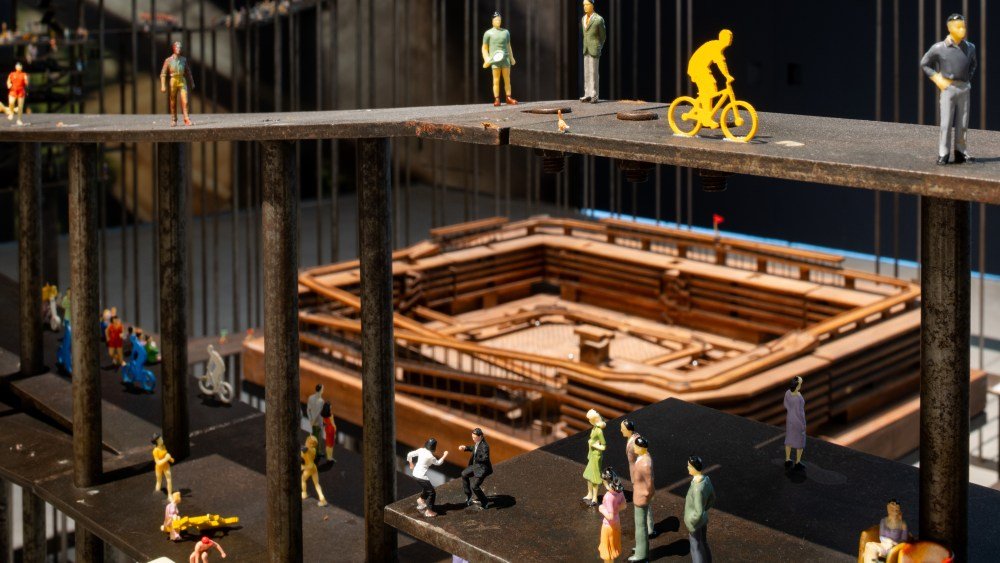
Originally conceived as a community sports center, West Village incorporates elevated running tracks that loop around sunken football and basketball fields, while public life unfolded across its five-story, open-air courtyard. The monumental circular structure, despite its grandeur, resembled a Chengdu hot pot.

West Village in Chengdu.
Courtesy
In more recent work, Liu has continued to explore traditional Chinese culture through an experimental lens.
At Yangshuo Sugar House, his Bamboo Tower installation on the riverside terrace was designed to be set alight, turning combustion into a fleeting architectural performance. For “With the Wind,” presented at the 56th Venice Biennale, Liu assembled an arcade from rows of fishing rods balanced so delicately that the slightest breeze could set the structure trembling, which was meant to mirror humanity’s precarious future.
The exhibition closes with “Here in Chengdu,” returning to the city where Liu has long lived and worked. In 2023, he founded Yulin Song Design Space, an independent platform for exhibitions and public events that extends his architectural practice into the realm of cultural exchange.

Inside “Here in Chengdu.”
Courtesy
For Liu, architecture is ultimately a functional art form, one that should reflect social realities rather than impose grand ideas — recalling a visit to Bangladesh, where he encountered the work of American architect Louis Kahn, Liu reflected on how the relationship between people and buildings can be temporary.
“It was the relationship between plants, the land and the floods that felt eternal,” Liu said. “You don’t need to explain any grand philosophy to the locals, they look at it and understand it intuitively.”