


 rahulNovember 18, 20267 Mins read1
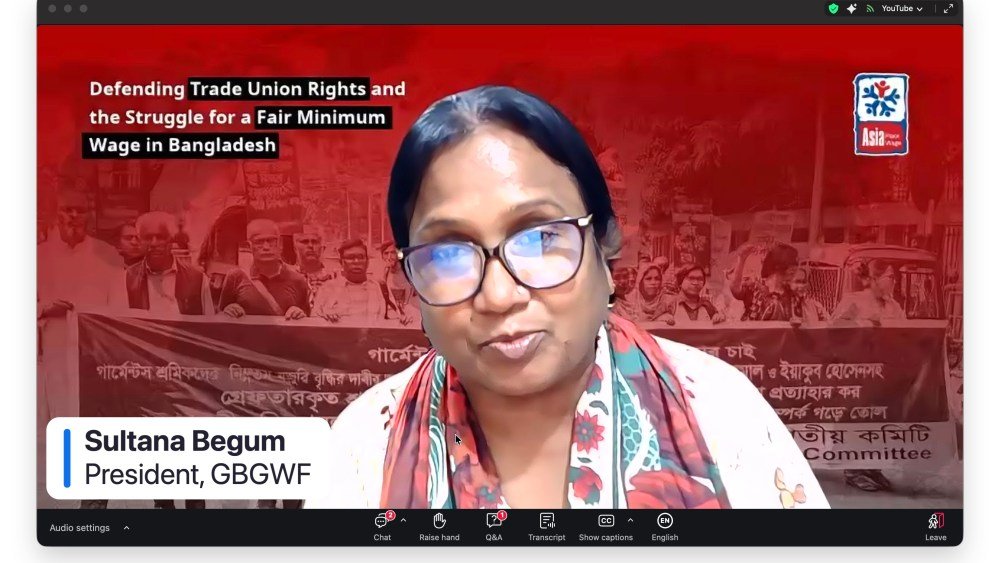
On Tuesday morning, Sultana Begum, president of the Green Bangla Garments Workers Federation, expressed her alarm not only at the increasing economic precarity of garment workers in Bangladesh but also at what she described as the “increasingly hostile” environment in which they and their representatives seek to exercise their fundamental rights, including freedom of association and the right to organize.
“As a woman trade union leader, one issue deeply concerns me: the arrest, detention and harassment of trade union leaders during the ongoing workers’ movement,” she said at an Asia Floor Wage Alliance webinar on the escalating minimum-wage protests roiling the country. “We have serious concerns about their treatment in custody, including allegations of torture and difficulties they face in securing bail. These leaders represent thousands of workers who want to organize, raise their voices and defend their rights.”
Minutes after the webinar ended, Sultana Begum was “dragged away by police,” the AFWA told Sourcing Journal.
The former garment worker had been explaining why workers were calling for a monthly minimum wage of 32,000 Bangladeshi taka ($256), up 156 percent from the 12,500 taka ($100) they are currently guaranteed. This was no arbitrary figure, she said through a translator, but rather one grounded in “actual household expenditures, the rising cost of living and their need to meet essential family expenses” amid persistent inflation that has outpaced wage growth since January 2022.
The numbers bear this out: A survey of nearly 300 garment workers across 30 export-oriented factories conducted by the AFWA’s affiliate trade unions found that while combined family incomes stood at 31,800 taka ($255), monthly household expenditures reached 45,202 taka ($362). Individual workers earned 15,300 taka a month, enough to cover only 34 percent of that total.
As a further indicator of financial insecurity, 62 percent of the workers surveyed reported carrying debt.
“Let me be clear: garment workers are not asking for luxury; they are demanding the right to live with dignity,” Sultana Begum said. “The cost of food, housing, healthcare, transportation and education has increased significantly. Yet, workers’ wages remain insufficient to meet their basic needs.”
At least 60 individuals, including union leaders, have been arrested since the start of November over the wage protests, though the exact number is difficult to verify. According to the IndustriALL Bangladesh Council, 10 regional leaders from its affiliates, including Ali Asgar, acting general secretary of the Garments Tailors Workers League, were taken into custody despite not being involved in the unrest. In a statement condemning the raiding of union offices and union leaders’ homes, the organization called the “indiscriminate arrest of trade union leaders…contrary to the spirit of cooperation and joint efforts to resolve the current situation.”
The clashes have intensified over the past several weeks, with workers blocking highways, torching vehicles and throwing bricks as police and paramilitary forces have deployed water cannons, tear gas and stun grenades. The chaos, which has led to the death of one garment worker, has forced the shutdown of hundreds of factories in industrial enclaves such as Ashulia, Gazipur and Savar, including 65 closed indefinitely under the “no work, no pay” provision of the country’s labor law.
But the upheaval took a turn for the worse on Monday when the minimum wage board postponed a crucial meeting because a worker representative fell ill, further inflaming tensions. Employers had been expected to present their proposed figure at the meeting. The next meeting is scheduled for Nov. 23, with a final decision on the new minimum wage structure expected in December. Workers are set to receive their first revised salary payments in January 2027.
Tayebur Rahman, assistant director at the Bangladesh Legal Aid and Services Trust, described many of the criminal cases against workers and union leaders as “fabricated.” These prosecutions, coupled with what he said was often a lack of clarity over the charges, have made providing legal aid a challenge.
“Whatever I have seen from some fabricated cases, after being arrested, they are charged with an old criminal charge,” he said during the webinar. “We have seen workers charged with a case that happened three months prior to the main incident.”
On Sunday, the American Apparel & Footwear Association, which represents some of Bangladesh’s largest apparel buyers, including H&M Group, Gap Inc., Calvin Klein owner PVH Corp., Levi Strauss & Co., The North Face parent VF Corp. and Zara owner Inditex, sent a letter to Prime Minister Tarique Rahman urging a “fair and sustainable outcome” based on a “credible and inclusive process in which representative employers’ and workers’ organizations can participate meaningfully, and workers can express their views freely and safely.”
“AAFA and its members encourage the government to ensure that the minimum wage review is conducted through effective tripartite consultation, with full respect for freedom of association and collective bargaining rights,” wrote Stephen Lamar, the organization’s president and CEO. “AAFA and its members also urge all parties to ensure appropriate safeguards against violence, intimidation [and] discrimination both during and after the review process.”
The AAFA had written similarly to Sheikh Hasina’s government at the end of 2023, when protests over the then 8,000-taka ($64) minimum wage came to a head just months before the Awami League head’s ouster following mass student-led anti-government demonstrations.
During that upheaval, four workers lost their lives, hundreds were injured and more than 130 individuals, including union leaders, were arrested and remanded. Factory owners and authorities also filed dozens of criminal cases alleging arson, vandalism and attempted murder that left some 40,000 unnamed workers at risk of arrest until the charges were dropped by the interim government in 2025.
This round of protests could see an upsurge if the eventual wage increase falls short of workers’ expectations, said Joseph Parkes, senior Asia analyst at risk intelligence company Verisk Maplecroft, which has ranked Bangladesh among the 10 highest-risk countries on its Civil Unrest Index over the past three years.
There are broader economic implications, too. The longer the turmoil drags on, the more it could undermine Bangladesh’s competitiveness in the region, particularly as rivals such as India and Vietnam increasingly appeal to buyers as more reliable options.
“The wage protests will further test the faith of international buyers after consecutive years of political turmoil,” he told Sourcing Journal. “Christmas ordering has already been upended by the cumulative impact of power cuts and gas shortages, and the current unrest will push delays and disruption into next year.”
The potential return of Hasina from India next month could add “another layer of political risk to the equation,” Parkes added. Recent protests by her supporters “underline that her plan to return despite facing the death penalty could prove incendiary, risking further operational disruption.”
Even so, continued labor unrest would be “more consequential” than a wage increase, said Pearl Pandya, senior analyst for South Asia at Armed Conflict Location & Event Data, a nonprofit that collects and analyzes real-time data on political violence and disorder worldwide. And with a likely “vast gap” between what workers expect and what factory owners are willing to accept, considering their own economic pressures, she said, a quick and satisfactory resolution could be difficult to achieve, even if it would be in everyone’s interest.
“With the timing coinciding with peak production cycles for spring/summer 2027 orders, factory owners would ordinarily be keen to resume normal operations soon,” Pandya said. “If they miss shipments, they have to bear significantly higher air freight costs. However, both sides—workers and factory owners—are feeling the squeeze from rising inflation, and that makes coming to an agreement even harder.”
She’s certain about one thing, however. Any strong-arming of demonstrators, whether through factory closures or police repression, is likely to prove escalatory.
At a discussion at The Daily Star on Sunday, Towfiqul Islam Khan, additional research director at Dhaka-based think tank Centre for Policy Dialogue, said that wage determination should take a scientific tack instead of turning into a “bargaining game between workers and employers” that leaves government to settle “somewhere in between” with little transparency about how the final figure is achieved. The dearth of reliable data, especially on regional inflation and living costs, he noted, is a major impediment.
At the same time, Khan said, workers have come to believe that mass mobilization is the only way to get higher wages, adding they have “learned from past experience that meaningful wage decisions only happen after taking to the streets, turning disruptive street protests into an unfortunate, ingrained part of our industrial culture.”
Speaking at the AFWA webinar, Laily Begum wondered aloud how long she and her fellow garment workers could live like this. She said that they weren’t demanding an unreasonable amount. A minimum wage should ensure that workers can afford nutritious food, decent housing, healthcare, education for their children and a life with dignity, not “simply be an amount that allows us to survive until the end of the month.”
“We have to sacrifice our own health and compromise our own personal needs,” she said through a translator. “It had been very hard surviving.”
Like Sultana Begum, Laily Begum said she was also worried about the retaliation workers were facing. Instead of being heard, workers were being beaten by police, she said.
“I want to live without fear,” Laily Begum said. “I want a better future for my family and the next generation of garment workers. We don’t want violence. We don’t want anyone to lose their life or freedom for demanding a fair wage. We want our government, factory owners and international buyers to listen and take responsibility.”
For Wiranta Ginting, international coordinator at the AFWA, any crackdown on the freedom to organize compromises the wage-setting process itself. Wage negotiations, he said, cannot be “genuinely fair” when workers face intimidation for exercising their rights. And when garment workers and trade union leaders face arrests and criminal charges for making legitimate wage demands, their ability to influence the outcome is undermined.
If anything, he said, Sultana Begum’s arrest only brought that argument into sharper relief.
“What happened to her and other trade union leaders and workers is not only a Bangladesh problem; this is happening inside the global supply chains that fill fashion retail stores,” Ginting told Sourcing Journal. “Every fashion brand profiting from Bangladeshi garment workers owns a share of this responsibility, and they must use it to demand the release of every arrested union leader and worker.”
During the webinar, Sultana Begum made a similar appeal to brands that she said “benefit from the labor and productivity” of millions of Bangladeshi workers, most of them women.
“But where is their responsibility towards the people who make their products?” she said. “International brands cannot continue to demand lower prices, shorter production lead times and higher productivity, while ignoring the poverty wages of workers. They cannot speak about sustainability, ethical sourcing, and responsible business practices while women producing their clothes struggle to afford food, rent and medical treatment.”