


 rahulNovember 13, 20262 Mins read1
The perennial concerns regarding data centres globally are their high consumption of power and water, which even had an impact on the recent US midterm elections. To tide over this crisis in global artificial intelligence (AI) and cloud computing, global majors like SpaceX, Google, Axiom Space and Blue Origin are working on a unique idea — having data centres in space.
An Indian space-tech startup, Agnikul Cosmos, has now formally marked its entry into this global race by announcing its plans to come up with one of the first dedicated facilities to make orbital data centre units. The company on Friday signed a deal with the Andhra Pradesh government to set up an orbital data centre unit in Tirupati district with an initial investment of ₹510 crore.
This comes almost a month after Google Suncatcher’s prototype space data centre went online after being launched on a SpaceX Falcon 9 rocket.
This will be a natural extension for Agnikul, which is the first company to offer patented technology for having an extendable upper stage of its launch vehicle act as a satellite bus hosting the data centre. Through the current investment, Agnikul is aiming to provide a platform for semiconductor majors to build GPU stacks that can directly integrate with the upper stage of its launch vehicle.
“We want to have a facility to build orbital data centre units so that the upper stage of our rocket can extend to be its own data centre platform, and this will be a separate centre for that,” said Srinath Ravichandran, co-founder and chief executive officer of Agnikul. He said this would be the first such centre in Asia and one of the first globally.
“For space-grade GPUs, no one has a leadership, with multiple semiconductor majors working on it. What we are telling them is to build the GPU stack and bring it to us, so that we can easily integrate it here with the upper stage of our launch vehicle,” he added.
The company has already roped in Bengaluru-based NeevCloud as its first customer. As per the deal, Agnikul will launch an orbit-based AI data centre module developed by NeevCloud’s AI SuperCloud platform into space. The advantages of a space data centre include sourcing power from sunlight, natural cooling and the ability to handle high-density AI workloads, cloud-enabled storage and data processing.
The announcement comes a day after Elon Musk’s SpaceX announced plans to invest more than $74 billion in two AI supercomputing campuses in Texas and Arizona, marking a major expansion of its business beyond rockets and satellite internet.
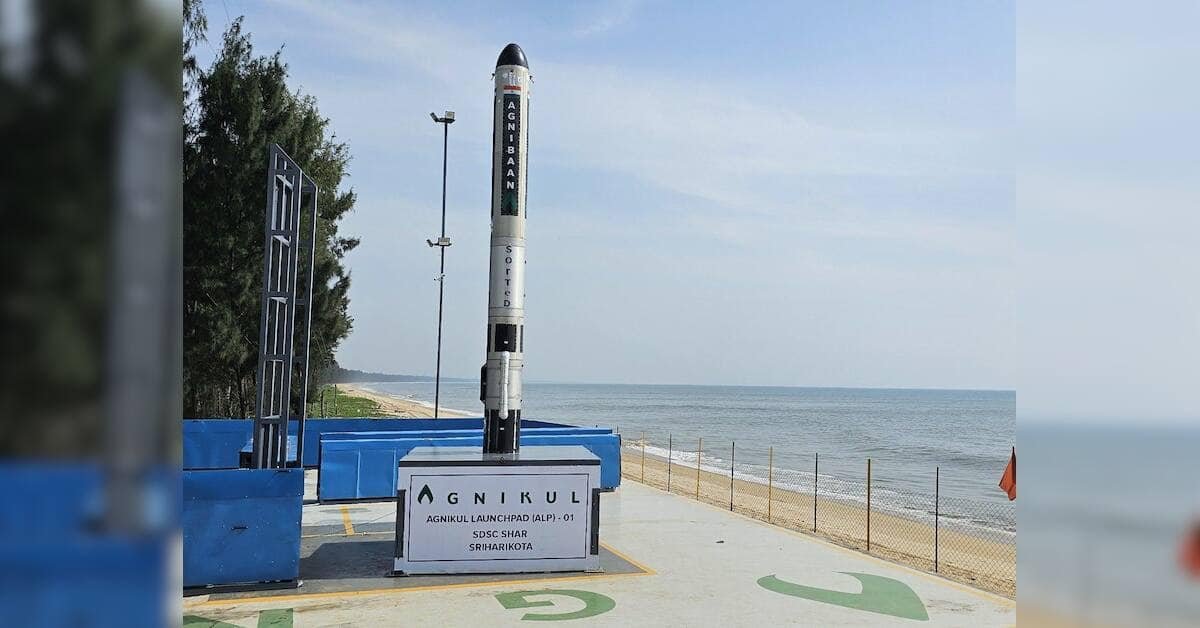
In May 2024, Agnikul made history when its Agnibaan SOrTeD mission lifted off from India’s first privately operated launchpad at Sriharikota. The mission also demonstrated several technologies, including the company’s 3D-printed semi-cryogenic engine.
In September this year, the company inaugurated two new units at its assembly and testing facility in Chennai, expanding its capabilities to test reusable rocket stages under flight-like conditions and manufacture critical launch vehicle components in-house.
“Our next launch is expected to be during the first half of next year. It will showcase our reusable launch vehicle and unique upper-stage technologies,” he added.