
Warren Buffett is passing the baton: 5 investment mantras the next generation can carry forward
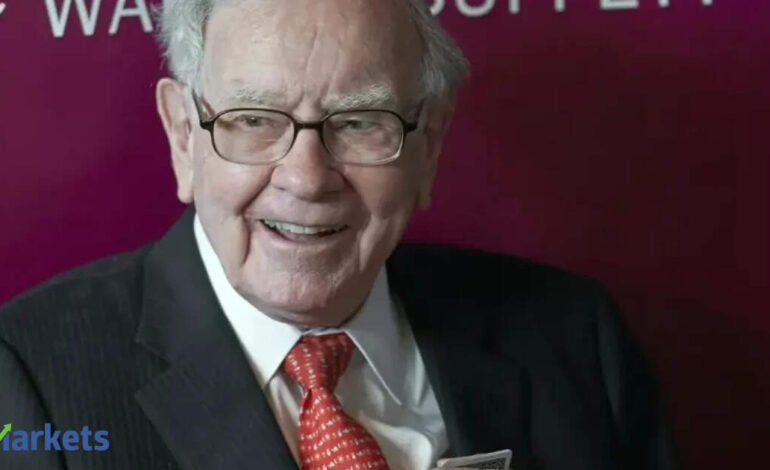

Berkshire said Buffett will become chairman emeritus, effective immediately. He will remain on the board and continue advising the company, bringing his judgment and perspective to the business.
As part of Berkshire’s long-standing succession plan, the board has elected Buffett’s son, Howard Buffett, as chairman. Greg Abel remains chief executive officer, while Susan Decker continues as lead independent director.
Howard Buffett has chaired the Howard Buffett Foundation since 1999, with a focus on global food security and conflict mitigation. He has also served on the boards of public and private companies and was a United Nations Goodwill Ambassador Against Hunger for the World Food Programme for nearly a decade.
The leadership change comes after Buffett handed the CEO role to Abel on January 1, 2026, following six decades at Berkshire’s helm.

Buffett, who turns 96 on August 30, 2026, remains closely associated with Berkshire’s investment decisions. In recent quarters, the company has built a $36.6 billion position in Google parent Alphabet.
ALSO READ: Warren Buffett steps down as Berkshire Hathaway chairman, named chairman emeritusFrom the boardroom to the portfolio, Buffett’s investing record has been shaped by a relatively small set of principles. Five stand out as the core mantras that defined his approach.
1. Don’t overpay for stocks
Buffett’s investment philosophy has centred on buying quality businesses at attractive prices.
He has rarely bought stocks at more than 15 times forward earnings, maintaining valuation discipline even when investing in companies such as Apple and Coca-Cola.
The approach emphasises analysing businesses, predictable cash flows and clean balance sheets. The objective is to limit the risk of permanent capital losses when markets turn lower.
2. Be patient — but know when to sell
Buffett has held some of Berkshire’s investments for decades rather than trading around quarterly results.
His most famous formulation is that Berkshire’s “favourite holding period is forever.” Coca-Cola, American Express and Wells Fargo have been among his long-term holdings.
But patience has not meant holding every investment indefinitely.
In recent years, Buffett has trimmed or exited positions in Apple, Bank of America, JPMorgan Chase, Goldman Sachs, Citigroup and Paramount Global.
He has also acknowledged investment mistakes, including his description of the bankrupt Dexter Shoe investment as his “most gruesome” mistake.
The combination of long holding periods and willingness to exit unsuccessful investments has been a recurring feature of Berkshire’s approach.
3. Stay within your circle of competence
Buffett has repeatedly argued that investors do not need to understand every industry. Instead, they need to know the boundaries of what they can evaluate.
“You only have to be able to evaluate companies within your circle of competence,” he has said, adding that knowing the boundaries of that circle is vital.
That principle shaped Buffett’s decision to avoid technology stocks during the dot-com boom of the late 1990s, when he believed he could not reliably forecast which young technology companies would survive.
The Nasdaq subsequently fell as much as 75% between 2000 and 2002.
When Berkshire eventually made a substantial investment in Apple in 2016, Buffett focused on consumer behaviour and brand loyalty rather than trying to forecast the technology industry itself.
4. Keep emotions out of investing
Buffett has consistently emphasised discipline during periods of market fear and exuberance.
At Berkshire’s 2025 annual shareholders meeting, he told investors to “check your emotions at the door when you invest.”
He demonstrated that approach after the 1987 US stock-market crash, investing roughly $1 billion in Coca-Cola in 1988 and 1989. By 2025, Coca-Cola’s share price had risen nearly 2,800% from Buffett’s original purchase price.
During the 2008 financial crisis, Buffett also provided capital to companies under pressure. He invested $5 billion in Goldman Sachs in 2008 and made a $500 million profit, excluding dividends, when the company bought back the shares in 2011.
His broader message has remained consistent: market volatility can create opportunities, but emotional decisions can also distort investment judgment.
5. Let compounding and time do the work
Buffett began investing at 12, buying Cities Services preferred stock in 1942. His wealth accumulated over decades rather than overnight. His net worth was about $20,000 at age 21, and he became a millionaire more than 13 years later. He became a billionaire at 55, more than three decades after he began investing.
That timeline has become central to the Buffett investment story: start early, remain patient and allow compounding to work over long periods.
The same philosophy has shaped Berkshire’s ownership of businesses such as Coca-Cola and American Express, which Buffett has held for extended periods.
A philosophy built around greed and fear
Buffett’s investment lessons have repeatedly returned to investor psychology. He has warned that a rising tide can conceal weaknesses, saying investors only discover who is “swimming naked” when the tide goes out.
The underlying principle is that strong markets can mask weak financial positions, poor management or accounting problems, while downturns can expose them. Buffett has also described greed, fear and folly as predictable features of markets, even if their sequence cannot be predicted.
His best-known formulation remains: be “fearful when others are greedy and greedy when others are fearful.”
As Buffett passes the chairmanship to the next generation while remaining on Berkshire’s board, those principles form the investment framework most closely associated with his six decades at the company.
Disclosure: This article has been written by Kumar Gaurav, who is not a SEBI-registered Research Analyst or an investment advisor. Gaurav does not hold any financial interest in the company as of the date of publication. The views/recommendations mentioned in this article, wherever applicable, are those of the respective SEBI-registered Research Analyst/brokerage and have been reproduced/reported with due attribution. They should not be construed as the views or recommendations of the EconomicTimes Digital or the journalist. Readers are advised to consider the original research report and make their investment decisions based on their own assessment.