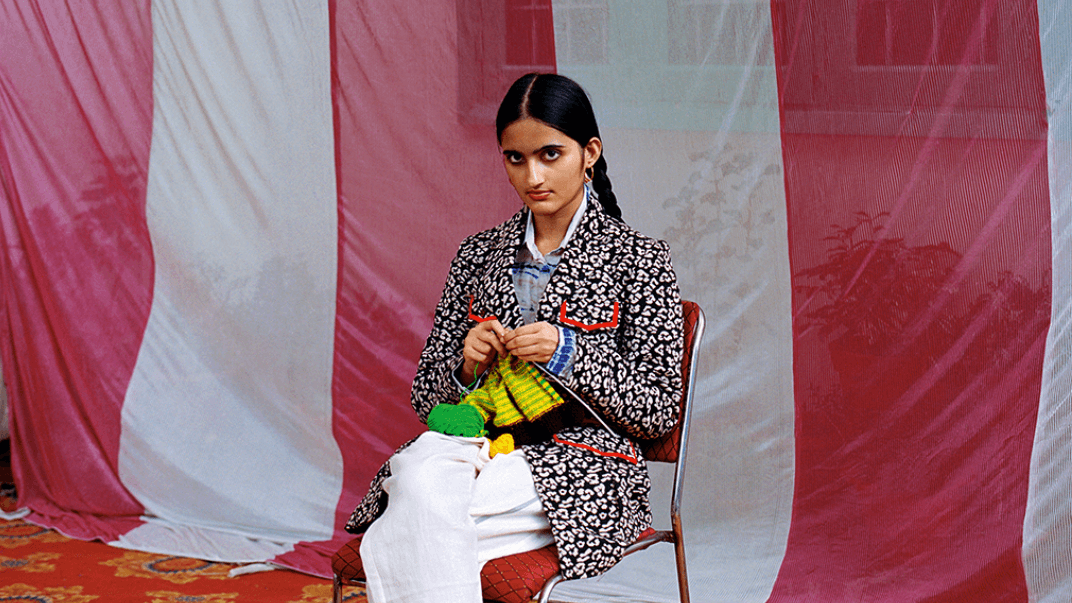
Meera Syal: “What is it about funny women that frightens men so much?”

I may have been a British-born kid, growing up in a rural village in the UK’s West Midlands, but our social life was ruled entirely by a big gang of my parents’ friends, all of them newly arrived immigrants from India. My parents, Surendra and Surinder, landed in London in the winter of 1959, and, far from home and homesick, these friends became their family—and therefore mine too. Like family, they felt that they had the right to tell me off whenever the hell they wanted, much of which seemed to have been specifically tailored to repress young women or stop them from ever having The Fun™: “Hai, don’t sit with your legs apart. What are you, a boy?”; “Put down that laddu! You can only get fat after you are married”; “Divorce? Call it ‘die-vorce’, because better you die than do that to your family.” One of the many warnings flung at me as a child by the mafia of aunties surrounding me was, “Enough jokes now, Meera. Time to be serious. Life isn’t all ha ha hee hee”—the last part of which became the title of the novel I wrote in 1999. Naturally, I recycled many of these quips for comedy material later on—a couple of them are actually chapter titles in my forthcoming memoir, Vigilauntie. But growing up with these rules wasn’t so amusing. I got their hidden subtext loud and clear: nice girls don’t take up space. They stay thin, presentable and quiet, and don’t even think about leaving an unhappy marriage. Even if you didn’t actually die, you would wish you had.

Now, as an adult and after a lot of expensive therapy, I can understand where this desperate need to confine and silence young girls began. Women grow up wearing the family honour like a wobbly crown. It doesn’t matter who knocks it off your head; it will always be the woman’s fault that she just didn’t hold onto it tight enough. Imagine growing up with this constant fear that saying or doing the wrong thing could soil your family’s reputation and get you thrown into the ‘unmarriageable dustbin’. So I now realise my aunties weren’t scary, they were scared. For me. Their controlling behaviour was the only way they knew how to offer protection.
It became clear to me early on that one of the most unladylike things to do was to be funny. Cracking jokes in public was strictly for the men. I would watch my uncles trade what were undoubtedly dodgy jokes, guffawing and backslapping one another, shouting over each other to repeat the punchline. Yes, I’m Punjabi, we are a noisy bunch. But if the women happened to be in the room, they had to pretend they hadn’t heard the naughty bits, or if they had, giggle politely behind their hands, eyes down—anything except actually be in on the joke. Not only did it seem unfair to me that the guys got to have all the fun, but I also knew that my aunties were pretty hilarious themselves. I had listened to them in our tiny kitchen, swapping stories about their annoying husbands, their English neighbours, their own bodies, saying things like, “I married a man with a big aubergine, and now it’s the size of a green chilli.” They were just as funny and filthy as the men. But they were only ever like this with each other. If any man popped his head around the door, the laughter would stop and the blender would roar back to life. I began to understand that being a funny man was admired, but being a funny woman was an act of subversion.
This was unfortunate because I saw humour all around me. The pretensions of the uncles who wanted to be more British than the British, changing their names from Bhupinder to Bob and eating their samosas with a knife and fork. The competitive tiger mothers who showed off their cubs at any opportunity: “My Bitoo wants to be a surgeon, so now he will perform open heart surgery on Mr Malhotra using just a crayon.” The spoiled sons, the raja betas, the lazy lumps who were showered with praise for managing to tie their shoelaces, while their sisters, who were straight-A students, would be in the kitchen doing the washing up. I found these quirks of British Asian behaviour both disturbing and hilarious. These observations would later become sketches in Britain’s first-ever Asian comedy sketch show, Goodness Gracious Me, which I wrote and performed. It turned out to be a ground-breaking hit. No one thought Asians could be funny, and before this show, brown people were always the butt of the jokes, never the ones making them. The show’s success proved what I already suspected: that humour was a powerful weapon, that it could both expose the uncomfortable truth like a sword and bring people together like a balm. But even then, I noticed the difference in reactions from men and women to our comedy gang of four. When we toured Goodness Gracious Me around the country, there were always hordes of women waiting to meet Sanjeev [Bhaskar] and Kulvinder [Ghir] after the show, wanting pictures, flirting madly. When any of the men saw Nina [Wadia] and me exit the same stage door, they would clamp a protective hand around their genitals and run away. What is it about funny women that frightens men so much?