


 rahulNovember 6, 20263 Mins read2
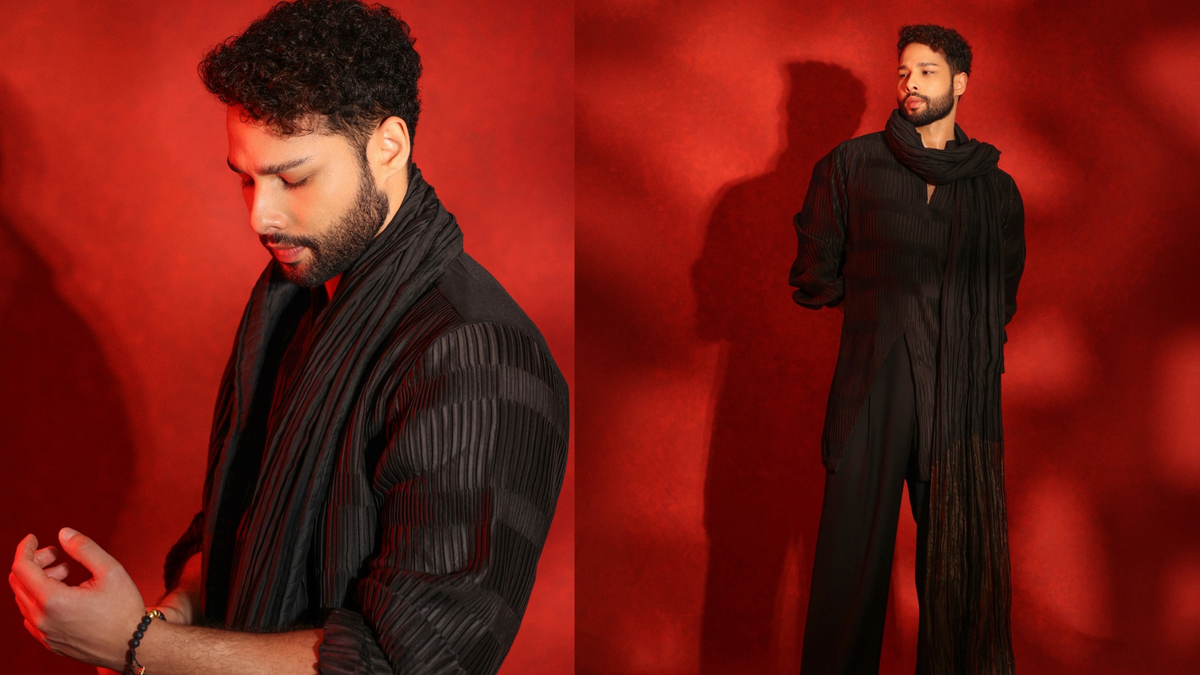
There’s usually someone, just as you’re ready to leave for a festive dinner, who thinks the black kurta could do with a little colour. Siddhant Chaturvedi offers a rather good argument for leaving it alone. His black outfit has plenty of drama, most of it courtesy of an odhani that falls well past the hem of his kurta. It’s the sort of flourish that makes an outfit feel right for a celebration without asking you to dress unlike yourself.
Styled by Rochelle D’Sa, the actor wears an Ashay kurta with wide-leg trousers, a Heena Kochhar odhani and Kolhapuris by Aprajita Toor. On paper, it’s a familiar combination. What sets it apart is how much room D’Sa gives each piece. The trousers are as generous as the kurta, and there’s enough length left in the odhani, even after it’s wrapped around the neck, for it to have a moment of its own.

The instinct with a long kurta is often to reach for a narrow pair of trousers. It’s a reliable combination, especially when the idea is to keep the focus on the kurta. Here, the trousers deserve equal billing. Siddhant Chaturvedi wears an asymmetric kurta with a high slit at the front, so the wide trouser leg is visible almost from the hip.
That opening makes a difference. With a straight hem, you might see little more than the trousers peeking out at the bottom. In this high slit kurta, the two pieces fall alongside each other, and the outline stays easy to follow all the way down to the sandals. There’s a useful idea here for anyone putting together a traditional outfit: sometimes the pair of trousers you’d normally rule out as too wide is the one that makes the kurta more interesting.

If there’s one detail to take from Siddhant Chaturvedi this festive season, it’s the way he wears the odhani. D’Sa loops it loosely around his neck and leaves one end long. It would have been easy to fold it neatly over both shoulders or choose a brighter shade to break up the black. Worn this way, it does something much more interesting. A contrasting stole would change the palette; a black one changes the shape.
Part of the appeal is that the two sides look different. On one side, the odhani drops nearly to the ankle. On the other, there’s a clear view of the kurta opening over the trousers. The generous drape gives the outfit a sense of occasion, but it still looks like something you could throw around your shoulders on the way out.

There’s one detail in Siddhant Chaturvedi’s styling that needs no shopping at all. He wears the sleeves pushed up his forearms, with a small beaded bracelet visible at the wrist. Beside the sweeping odhani, it’s a nicely informal gesture, much like rolling up a shirt sleeve once everyone’s settled in for dinner.
That mix of dressed up and relaxed is what makes this celebrity look feel wearable. The pieces are distinctive, but there’s no sense that they need constant straightening. A little asymmetry is part of the charm.

Siddhant Chaturvedi finishes with black Kolhapuris by Aprajita Toor. A few slim straps show beneath the trouser hems, giving the wide leg an easy finish. They’re a familiar choice for festive dressing, and that familiarity works in their favour here. With an odhani this long, a more elaborate shoe would have two details competing for attention at the ankle.
The sandals feel right for a festive dinner, but it’s the odhani that makes the outfit worth remembering. Siddhant Chaturvedi gives one end almost the full length of the look. When the drape is that good, black feels like a choice rather than a fallback.