


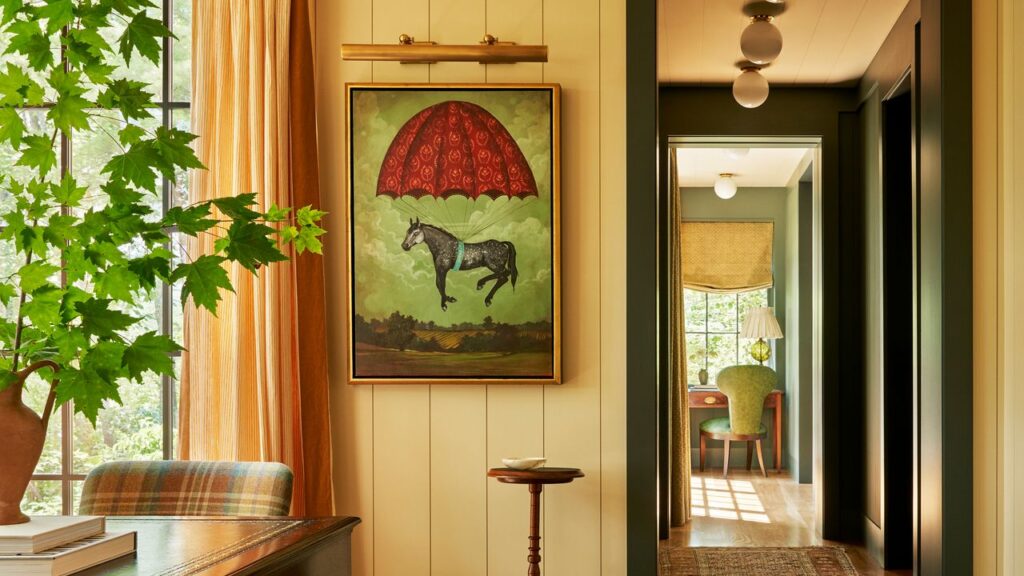
In an era when technology appears to have a chokehold on society, it’s natural to assume everything is possible through a tap, swipe, or AI prompt. However, when it comes to a well-appointed home, designers say: Not so fast. While some crave the human touch of hand-painted murals or a masterfully planned plate wall, a growing number of people are sidestepping the smart house for a more primitive setup. Goodbye, intelligent devices and Bluetooth-enabled everything. Welcome back, pared-back appliances and mechanical systems.
Call it what you want—“dumb homes,” “analog interiors,” or “lo-fi spaces”—but many are yearning for a simpler time. Before screens and Siri, to be precise. For Bari Jerauld, founder of Blank Slate Studio, the shift is a “response to overstimulation.”
“We spend so much of our lives on screens and in fast-moving digital environments, so the home has become the one place people desperately want to feel the opposite,” the London-based designer explains. “People are asking for warmth, character, and rooms that feel as though they have a history.”


In fact, Jerauld says she first noticed the rise of analog interiors when her clients specifically asked for spaces with a toned-down take on tech. Ditto for Thomas Jayne, an interior designer in New York City. “My clients are saying, ‘I just want to turn on one switch to turn on my lights,’” he says. “They don’t want to have to go to a computer and program and push.”
While a comprehensive system seems to offer whole-home control at your fingertips, Dr. Sally Augustin, PhD, an applied environmental psychologist, says otherwise. “Having to override the lighting system, for example, degrades your feeling of control and is a hassle,” she says. “We’ve all had our laptops crash, and smart systems can also misbehave. If your home is highly automated, you live under a cloud of potential failure.”
A tricked-out home rivaling Tony Stark’s superhero escape can elicit oohs and ahhs from guests, but Augustin says they often create an isolated atmosphere. “People are social animals,” she explains. “They really want to interact.” Designing a home around screens, she says, eliminates “the richer conversation we used to have.” “If someone has a question today, they whip out their phone and Google the answer.”
Venetia Rudebeck, co-founder of Studio Vero in London, says clients love the connectedness of old-school spaces. “A lot of the trend is being driven by families,” she adds. “Parents are much more aware of how much time is spent on screen, so they’re actively trying to shift that.”