



 rahulNovember 4, 20263 Mins read0
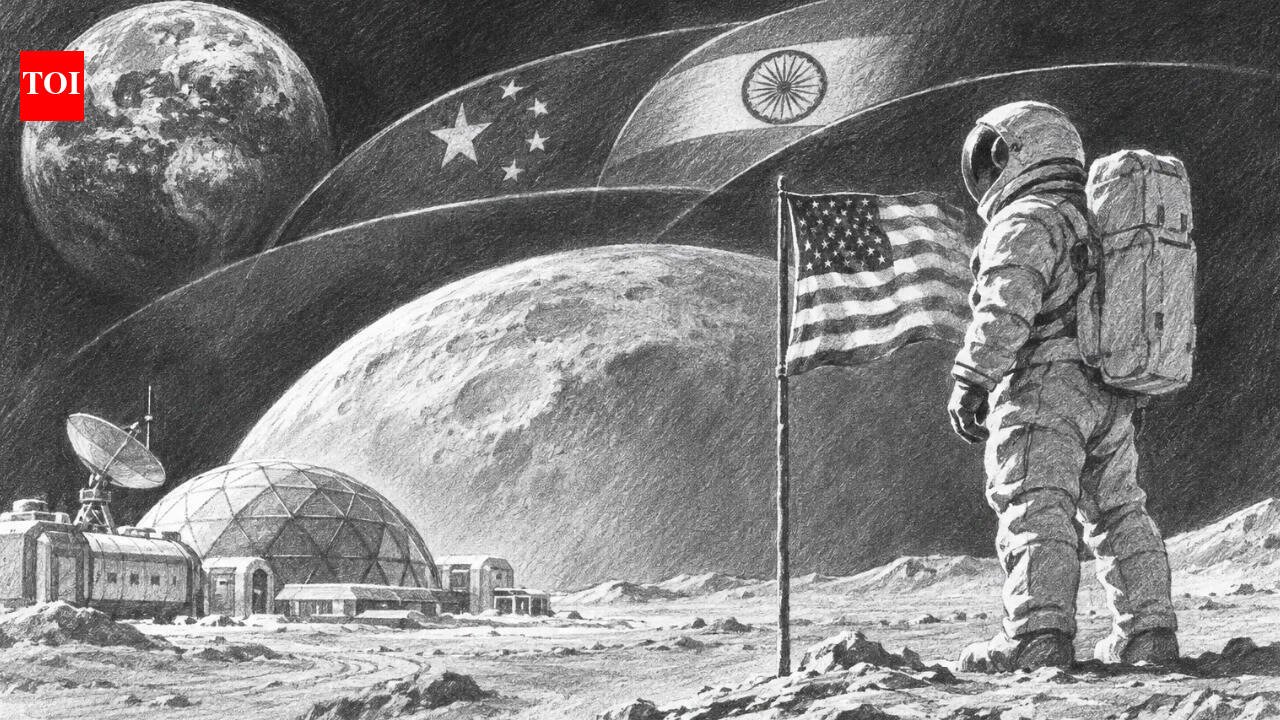
BENGALURU: As Americans voted in the midterm elections, US President Donald Trump issued a proclamation titled “The American Declaration of Freedom in Space”, declaring that the US would lead the exploration, development, use and settlement of space.Promising a return to the Moon by 2028, a permanent American lunar presence and an eventual human mission to Mars, the proclamation links space leadership directly to economic prosperity and national security.But beneath its rhetoric of freedom and exploration lies a larger geopolitical question: who will set the rules for humanity’s expansion beyond Earth, and will space remain a global commons or become an arena of competing national interests? For India, which has its own ambitions for human spaceflight and lunar exploration, the declaration brings this question into sharper focus.Susmita Mohanty, director general of space think tank Spaceport SARABHAI, says: “Trump describes space as ‘the province of all humans’ while, almost in the same breath, declaring his intention to establish a ‘permanent presence by American citizens’. The tension between these two assertions is difficult to ignore: a domain ostensibly belonging to all humanity is simultaneously being framed as a sphere for enduring American dominance,” she said.She also questioned the assertion of American superiority, pointing to the history of international contributions to space exploration. Russia, for instance, remained indispensable to American human spaceflight for nearly nine years after the retirement of the Space Shuttle fleet in 2011, transporting US astronauts to the International Space Station until SpaceX’s Crew Dragon began crewed flights in 2020.Mohanty also pointed to China’s growing capabilities. Since 2007, China has completed six lunar missions, including two sample-return missions, and is working towards landing astronauts by 2030. “Space exploration has historically been a collaborative endeavour, one that repeatedly reminds terrestrial superpowers that their dominance has its limits,” she said.
The implications extend beyond the US-China lunar race. Lt Gen AK Bhat (retd), director-general of the Indian Space Association (ISpA), believes the proclamation signals a shift towards competing frameworks for governing space activities.“There’s now a clear divide of two groups: the Artemis-led group and the ILRS-led (China-Russia) group. Space colonisation, ownership and other things that have been talked about will definitely sow the seeds for future contests and maybe confrontation,” he said.The legal question is particularly important. Article I of the 1967 Outer Space Treaty describes space as the province of all mankind, while Article III prohibits national appropriation of celestial bodies. The proclamation, however, explicitly speaks of establishing a permanent American presence and developing resources, subject to international obligations. It does not itself confer ownership of lunar territory.
India’s position is complicated by its participation in multiple international frameworks. It signed the Artemis Accords in June 2023, but also signed the 1979 Moon Agreement, which it has not ratified. The two frameworks have different approaches to aspects of lunar resource governance.In Aug 2026, Nasa invited Isro to join its Moon Base programme, building on the Artemis partnership. India, meanwhile, has its own Space Vision 2047, including the Bharatiya Antariksh Station by 2035 and a human Moon landing by 2040.
Share your thoughts in the comments
Be respectful · TOI community guidelines
For Bhat, this calls for a wider national debate on India’s positioning. “The issue is basically where India aligns its cards. Though signing of the Artemis Accords was an indicator of our inclination, there has to be an internal debate within the Indian community,” he said.He also cautioned against dismissing the proclamation as political rhetoric. “It does not matter whether we take Donald Trump seriously or not. The signature on the paper is that of the President of the United States, aligning the policy for the future.”For India, the challenge may be to work with competing space powers without being confined to their geopolitical choices, while ensuring it has a say in the rules governing the next frontier.