


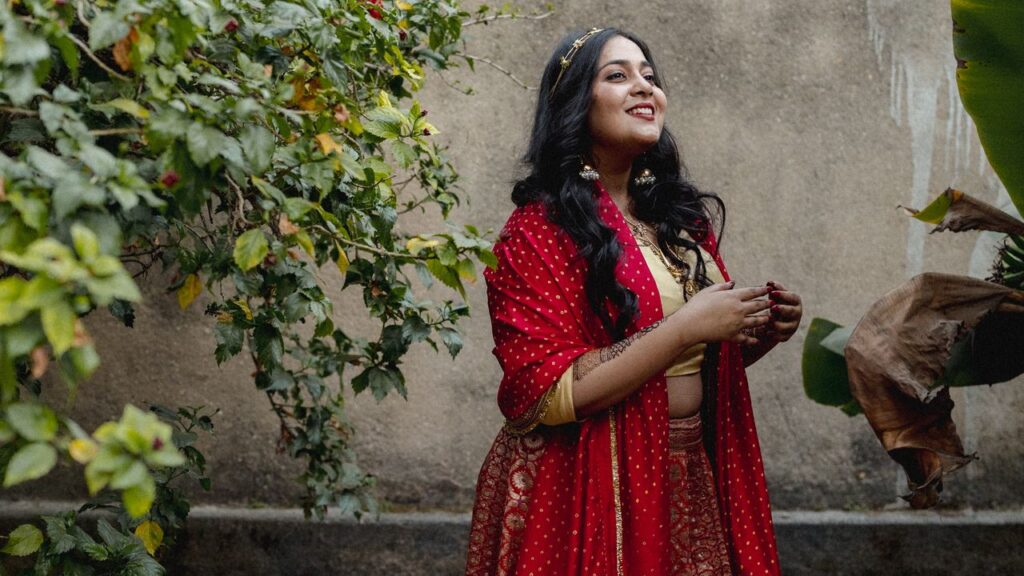
The fabric for the veil was picked by her mother in Varanasi—a scarlet Banarasi brocade silk with gold floral motifs—to which Somya and Yash added a hand-embroidered gota patti border. The metallic frills along its edges, called kiran because they mimic the rays of the sun, cast a divine halo around the wearer as they catch the light.
But wearing such heritage is no easy feat. “Nothing could make that veil stick to my head, not even clips and pins, because it weighed over 3 kilos,” Lochan says. “So eventually, I had to wrap it around me like a shawl to keep it from running away from me.”
Then came the gharara for her sangeet, which Lochan wanted in the exact shade of her favourite lipstick—Dolce and Gabbana’s The Only One, matte, 625. She found her match at Akilah, a boutique in New Delhi’s Shahpur Jat—but in two separate pieces. A pink gharara with scalloped edges made the perfect canvas, while a sage green one with sequinned embroidery had the details she wanted, both in Banarasi silk. “So I got them to merge the two, and commissioned it in the exact shade of red from my lipstick, which I also wore during my sangeet.”
Her trousseau is made up largely of commissioned pieces, including a custom-made Raw Mango silk-satin blouse in gold—originally conceived in deep forest green—along with a couple of other garments she picked off the brand’s racks for various ceremonies.
Growing up in Bihar, Banarasi saris seemed to belong to her mother and aunts’ generation. They were beautiful but intimidating, and eventually came to be seen as outdated. “I asked, why would a girl like me want to wear a Banarasi sari when I can, you know, wear a chiffon or a georgette or a satin silk, or a habutai silk…” she says. Then she stumbled upon Raw Mango, whose imagery and campaigns made Banarasi and Chanderi saris feel contemporary and aspirational.
The dupatta she wore for her haldi, which she later repurposed as her wedding odhni in Berlin, and her reception sari were both bought during that time. She also saved up to buy a saffron Hazari sari before gifting it to her sister for the tilak ceremony. “I knew that I was collecting something that is beautiful, and that holds a lot of value,” she says, recalling how her grandmother’s handspun Banarasis have survived for over 50 years. Raw Mango, she adds, “just sort of corroborated what we already believed in.”

