


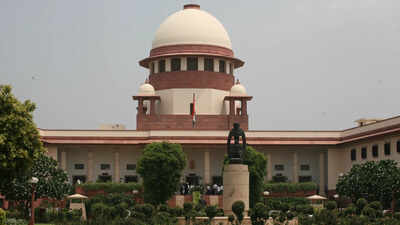
NEW DELHI: Underscoring the need for an independent and impartial process for selection of the chief election commissioner and election commissioners, Supreme Court on Thursday said Election Commission must not only act independently but must also be seen to act independently. The court questioned why Parliament, while framing the law, decided not to include Chief Justice of India in the selection panel.A bench of Justices Dipankar Datta and Satish Chandra Sharma said the CJI was part of selection panels for CBI director and Lokpal, and asked what could be the reason for excluding him from the process of selecting CEC and ECs — posts that are among the most important for a democracy. The court reserved its verdict on the Centre’s plea that the matter be referred to a constitution bench.The court is hearing challenges to the constitutional validity of the 2023 Act, under which CEC and ECs are appointed by President on the recommendation of a selection committee consisting of PM, leader of the opposition, and a Union Cabinet minister nominated by PM. SG Tushar Mehta argued that the court could not begin with an assumption that the PM would act against democratic principles.
People must trust PM’s decisions, says SG Mehta amid challenge to authority
In 2023, a five-judge constitution bench of SC had directed that pending enactment of a law by Parliament, appointments should be made by a panel comprising the PM, CJI and leader of the opposition to infuse independence into the process. Parliament subsequently enacted the 2023 Act, which replaced the CJI with a cabinet minister.Attorney general (AG) R Venkataramani and solicitor general (SG) Tushar Mehta urged the bench not to question the wisdom of Parliament, arguing that doing so would amount to interference with the independence of the legislature. The AG said Parliament’s legislative choice could not be questioned merely because another model was possible, and that “Parliament cannot be gagged”. The SG added that the three organs of the state — executive, legislature and judiciary — were independent, and their independence must be respected.“People must trust the Prime Minister. The office of the Prime Minister has a sanctity attached… If his decision is not to be trusted and is to be seen as necessarily a bad-faith exercise, then why not have a provision that even while selecting his cabinet he must consult some former judge or outsider?” SG Mehta said.Mehta added that one organ of the state could not proceed on the basis that the PM and other ministers would act in bad faith or against constitutional principles simply because they have the numerical majority.The bench clarified that there was no question of not trusting the PM. However, it asked the SG how many ministers in the government had cases pending against them, recalling that the court had earlier reposed trust in the elected government to ensure that people with criminal antecedents were not appointed as ministers.“It is not a lack of faith. The election commissioner has to be an independent person. Should there not be a show of fairness? We are not saying fairness has not been achieved by this committee. Just like justice is not only to be done, it has to be shown to be done, we are on the second part,” the bench said.Government requested that the petitions be referred to a larger constitution bench, arguing that an important question of law was involved. This plea was strongly opposed by senior advocates D Seshadri Naidu, Gopal Sankaranarayanan, Prashant Bhushan and Sanjay Parikh, who contended that government was raising this ground after 20 days of hearing and should not be allowed to do so.
Share your thoughts in the comments
Be respectful · TOI community guidelines
In an affidavit, government countered the petitioners’ claim that the independence of Election Commission would be compromised by replacing CJI with a cabinet minister. It maintained that there was no flaw in the law passed by Parliament, and that free and fair elections had never been casualties even when appointments were made solely by the executive for over seven decades.Government described as hypothetical the suggestion that vesting the executive with exclusive authority in EC appointments would necessarily compromise the independence of the poll watchdog.