


Death has always been so seductive to jewellery designers. For Sabyasachi Mukherjee, it isn’t about a skull on a ring or a jewelled skeleton. A sarcophagus, an object designed to contain a dead body, becomes inspiration for something to adorn a living one. It isn’t as perverse as one would imagine. A wrist cuff featuring 18-karat and 22-karat gold with garnet cabochons and studded with brown diamonds has been inspired by a 3rd century Roman sculpture: a marble sarcophagus with lions felling antelope. Another wrist cuff takes inspiration from a Roman sculpture dated 260-270 CE.
Both sarcophagi belong to The Metropolitan Museum of Art in New York. The designer’s high jewellery collection, drawn from the art of the Byzantine Empire, and the first of a multi‑year collaboration with The Met, will debut at New York Fashion Week on September 15. At a tour of his new store at The Citadel in Mehrauli, New Delhi, Mukherjee recalls that when he initially received the invitation to collaborate with The Met, on email, he dismissed it as spam. What made The Met collab an irresistible proposition, he explains, is its “modern voice on antiquity”. Mukherjee accessed The Met’s Byzantine holdings — a collection he describes as among its most impressive — and found inspiration in objects including funerary pieces and sarcophagi. The ancient becomes wearable under his lens, and each jewel carries a QR code pointing the buyer back to its source.


The Gaudi-inspired ceramic fruit hand-painted by an artisan in Kolkata brings Mukherjee ‘’glee”
The complete 100-piece jewellery collection will be revealed at the Sabyasachi SS27 showcase later this month, nearly 20 years after his initial 2006 NYFW debut in New York. All Mukherjee reveals about the garments is that it will be “modern couture” with emphasis on practicality and wearability.
During the store preview, Mukherjee dwells on the importance of good journalism and the need to promote Indian culture. When someone in the group asks him what luxury means to him now, his response is “sleep and silence”. He talks about finding quietness in the noisiest places, and about sitting in coffee shops and observing people. He talks about music that makes no sense but gives him joy — Alisha Chinai’s 1985 hit ‘Tarzan, My Tarzan’ is still living rent-free in my head courtesy that tour.
At 26,000 sq.ft, the new store is a “mini Calcutta” of corridors, rooms, tea, Gaudi-inspired ceramic fruit, music and references gathered from his own visual archive. There are Indian goddesses on the walls, 120 chandeliers, about 200 antique carpets, and little knick-knacks.


“If you buy the jewellery, you can actually go into The Met and find the room where the original product is housed and see it. The idea is to be able to give people a product that’s inspired by a museum but also connect them to the source of inspiration.”Sabyasachi MukherjeeDesigner
Mukherjee has spent much of his career negotiating the space between India’s past and the global luxury market. With The Met collaboration, that negotiation becomes unusually explicit. Excerpts from an interview with the designer:


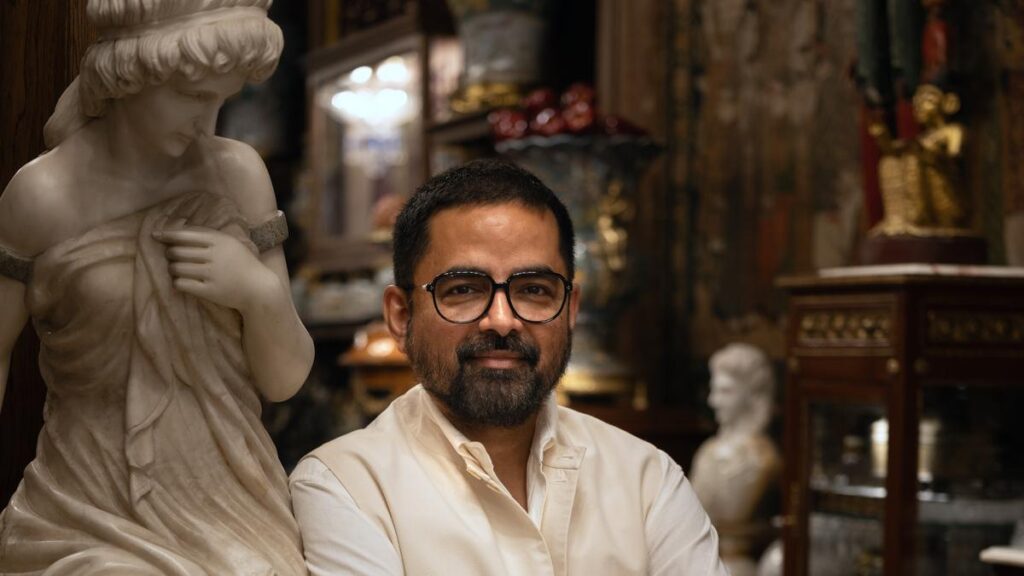
“A lot of things in this store don’t make any sense, as they don’t belong to a high-end store, but I like the democracy of different things put together,” says Sabyasachi Mukherjee about the art and curiosities in his store.
Why do you often look to the Byzantine Empire for inspiration?
The two things that have always excited me in history are the Byzantine Empire and the Spice Route. I like the idea of people landing in different ports, in different parts of the world. New things are built with the exchange of the old and the traditional. Whether it’s the Greeks, the Romans, the Far East, India, the Islamic Empire, they all found a confluence in the Byzantine world. The conflict between the Islamic Empire and Christianity led to the genesis of things, which were built with provocation and love and yes, conflict. That’s why I chose that empire for inspiration, because I thought that was the most dynamic time in art.
Sabyasachi Mukherjee’s Byzantine jewellery
| Video Credit:
The Hindu
Tales from the crypt
A cuff has been inspired by the marble sarcophagus titled ‘Triumph of Dionysos and the Seasons’. This highly ornate and extremely well-preserved Roman marble sarcophagus came to the Metropolitan Museum from the collection of the Dukes of Beaufort and was formerly displayed in their country seat, Badminton House in Gloucestershire, England. An inscription on the unfinished back of the sarcophagus records that it was installed there in 1733. In contrast to the rough and unsightly back, the sides and front of the sarcophagus are decorated with forty human and animal figures carved in high relief. The central figure is that of the god Dionysos seated on a panther, but he is somewhat overshadowed by four larger standing figures who represent the four Seasons. The figures are unusual in that the Seasons are usually portrayed as women, but here they are shown as sturdy youths. Besides the sarcophagi-inspired pieces that have been previewed is a pendant necklace crafted in gold, studded with tourmaline, garnet, jasper, lapis lazuli, and jade. It is inspired by a marble funerary relief from the Imperial Roman period depicting a family from Thrace, Northern Greece and Danube province.


‘Triumph of Dionysos and the Seasons’ marble sarcophagus


And the cuff inspired from it
Having full access to The Met, with its massive collection spanning more than 5,000 years, and its non-public storage vaults, can be overwhelming.
The beautiful thing was that every curator took me under their wing and also showed me the unseen archives. Even if The Met has so much that the public can see, it’s like the tip of the iceberg. When you speak to curators in a museum, you really learn about stories that you can’t really understand when you are there as a bystander.
Was there an Indian connection to anything that you have selected in this first collection?
There is a necklace inspired by the coins that I found in the Islamic wing and it dates back to Jahangir in Agra. They were actually Zodiac coins and he was one of the first people to do that because astrology was very big at that point of time.


There are Indian goddesses on the walls, 120 chandeliers, about 200 antique carpets, labyrinthine corridors, a tea lounge
What does it mean for an Indian designer to interpret the collection of an American museum? Rather than just exhibit in it.
The museum happens to be American but the product is global. India has such remarkable soft power, of craft, that it is probably one of the few countries that can take an object from a museum and reinterpret it and create it to the highest standards of craftsmanship. Because in many parts of the world that kind of craftsmanship doesn’t exist anymore.


Sabyasachi Mukherjee with Josh Romm, Head of Global Licensing & Partnerships, The Met
In an interview with me last year, you said you were getting out of the wedding business because that was the direction globally. Do you still stand by that?
100%. I didn’t start off as a wedding wear designer. I started off as a ready-to-wear designer. I’m probably going back to that. I also think that to build a business entirely on weddings can become difficult because so many of your social rituals are dependent on the zeitgeist. Which keeps changing every year because the world is changing so fast. What you held as gospel five years ago is not the same anymore. Also, I think the country is becoming younger. It’s important to be able to move into a non-occasion wear business because you can catch the depth and the width of it.


Roman marble funerary relief (2nd–3rd century A.D.)
| Photo Credit:
The Metropolitan Museum of Art


The necklace inspired from it
Calling all Bengali jewellers
There has been an advancement in jewellery in both Reliance and the Aditya Birla Group. So what you are doing in this category is closely watched.
I did jewellery much before Mr. Birla bought into my company. I’m a Bengali and have grown up seeing good jewellery. The funny thing is that if you go into the ecosystem of films most of the technicians in films are either from Chennai or from Calcutta even if they’re in Bollywood. As for the ecosystem of jewellery, 99% of all the craftsmen, whether they’re based in Chennai or Jaipur or Bombay, are all from Calcutta. So I’m also trying to create a reverse migration for these craftsmen.
Many of them work in companies where they’re not allowed to eat meat or fish. Eventually you can’t speak your language in a remote place, where you also can’t eat the food that you’re used to eating. Crafts people need to be emotionally happy to do better craft. I want to create this reverse migration where I bring all the best craftsmen from the jewellery houses all over India back to Bengal.
And at which stage are you now with this?
I’m almost there. Many of them are coming back because crafts people find their way. Like what I’ve said about journalism or industry, the biggest joy to crafts people is when you can sustain the highest form of art or craftsmanship and make money. [The craftspeople] know that when they come to Sabyasachi’s atelier they will be able to expand their hands and minds into creating the best jewellery, which is not always going to be commercial jewellery but great in terms of craftsmanship. And that they will also be able to make money and come back home to their wives and children and food and land and language. I think it’s wonderful that in my lifetime I will be able to do that.
Is it easy to let go of your earlier perceptions of fashion? That takes a lot of self-awareness.
And also to let go of your ego. Sometimes, the biggest mistake is that we don’t change our verticals because we are constantly living on past glory. Sometimes it is because of laziness and a lack of courage. When you are the king of a particular vertical, you think ‘let’s keep at it’. I’ve always said that when I become very successful in a particular vertical, it’s time for change because then you also become complacent and you miss out on the bigger picture. While the wedding industry is great, I think consumption has changed.


Can you say you are now a jewellery designer who makes fashion as opposed to a fashion designer who makes jewellery?
Jewellery almost attributes to about 33% of our turnover (about ₹200 crore of ₹650 crore in revenue for the last fiscal year). Very soon jewellery will become the bread and butter and jam and everything else will become salt and pepper. In the next few years, jewellery will far outperform any category that we are doing. The other dark horse that is raising its head slowly is our accessory business. It is our fastest growing business and will cross ₹100 crores this year. Not long ago it wasn’t even a business, it was just a fledgling of an idea. So it also shows how India is changing.
India was never an accessory first country, it was a clothing and jewellery first country. New people, new change. The good thing about buying a designer accessory is that you can repeat it again and again. You can wear it with high street, you can wear it with ready to wear, you can wear it with couture, you can wear it with designer and it still gives you status. I think Indians are learning a new way of dressing up ‘upwardly mobile’ without having to spend a packet of money on clothes.


“I will give the lighting in this store a 7/10,” says Mukherjee about this new store, adding that he is still not a 100% satisfied with the lighting. A store dedicated to jewellery is coming up soon.
You have often highlighted the need to grow, to create more employment.
You need to become more profitable so you can give people bigger bonuses. Because, you know, one thing that people don’t understand is that, when you run a business, those who work for you are your family and they have needs and expenses. They want to send their children to better schools, eat better, travel better, consume better. With growing inflation, it is more and more important to be able to build larger profitable businesses.
How many artisans worked on this jewellery collection and would you be highlighting them?
I think we had about 85 to 87 artisans who worked on it. When we do shawls and saris we talk about our weavers. Here the highlight will be the storytelling about the product but the artisans all belong to Bengal.
For a section of Instagrammers, their idea of the Byzantine Empire is going to be via you and the storytelling around these jewellery pieces on your handle. So who owns the right to reinterpret museum history?
In this case, The Met still holds its rights. They have said only one thing to us: we do not want you to replicate what we have in the museum. We want you to take inspiration from that and create something new. Because the idea is to take objects of curiosity and create a modern interpretation with them, but keep the spirit of the product. Everything goes through a vetting process. Only when the curatorial team and the licensing team agree together can you actually release the product.
Where to buy
At select Sabyasachi stores but not at The Met store.
“This merchandise was not meant for The Met store. You know, it’s a multi-year collaboration, so at some point of time we will create more accessible products that museum goers can buy. The idea was also to be able to reinterpret these crafts with the highest form of craftsmanship. I wanted to start at the top, and with a trickle-down theory, slowly get down with products and price points. The first part of the collections will be sold in our own stores and we will speak to our retail partners worldwide, whether it’s Bergdorf Goodman, Neiman Marcus, Saks, and so on.”
Could you give an example from what is on display at your new Delhi store? There is the cuff, for instance, inspired by a well-preserved Roman marble sarcophagus (see box).
All the pieces that I’ve been inspired by from The Met are objects, not jewellery. So I’ve not taken Byzantine jewellery and recreated it. I’ve taken a Byzantine object, which could be a sculpture or a statue, and made that into jewellery. The people at The Met like that you don’t take literal inspiration from a product.

Is there something contradictory about taking objects in a public museum and turning their visual language into something that now costs hundreds of thousands of dollars?
That is not really a problem because of the fact that you have to also understand how it’s made. It’s jewellery at the end of the day. The cost is not because of the design. The cost is because of the product. If you did it in terracotta or if you did it in steel, it would not cost that much. What makes precious jewellery precious, apart from the raw material, is if you can find an inspiration or storytelling that also gives it historical relevance.
You have said that your jewellery at some point will belong in a museum. Do you think the Sabyasachi brand is becoming a kind of a private museum?
I think it’s a public museum more than a private museum but one of the reasons why my products will probably find a place in the museum tomorrow is because what do museums do? They protect and preserve what’s rare and what stands for a particular era of time that by nature of rarity becomes an antiquity. In years to come if we don’t learn to preserve India’s soft power, like for instance what happened at one point of time with the muslin sari or what could have happened if the Salvis did not rescue the Patan Patola [the Salvi family of Patan, north Gujarat, has been weaving double ikat Patan Patola for nine centuries], a lot of our soft power will just disappear. Because there is no patronage. I always think that craft is the first flag bearer of culture but I would really like to build a house that taps into and preserves human wisdom.
Top 3 museums to visit
“I think The Met, the V&A and the Louvre. There’s also the Guggenheim and so many more. But for people who want to see a larger collection of decorative arts, I think these museums are the better choices. The other museums are more niche, whether it’s The Frick, the Guggenheim or even the MoMA for instance. But these are the big superstars. In India, I would say Dr. Bhau Daji Lad Museum because I love it. The Calico Museum is more fashion and textile and I love it too, but the decorative arts superstar is the Bhau Daji Lad Museum.”