


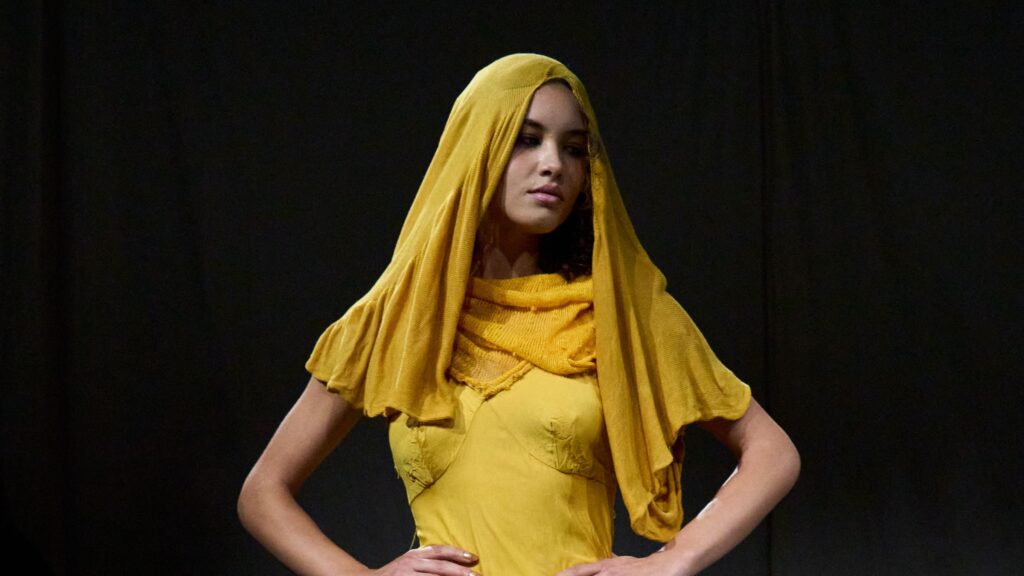
The intense atmosphere of obscure ritual invoked by Paolo Carzana drew a small congregation to a church in Earls Court this season. It was after dark as his other-worldly people draped, wrapped, and knotted into his organically-dyed layers began to enter a Carzana cloister—a rectangle of calico suspended in the center of the nave.
The sense of a power-dynamic given off by the relationship between Carzana’s goddessy head-draped women and the young men who walked amongst them was deliberate. “To me, the menswear has this feeling of being a workman, like a blacksmith or carpenter or builder. They are representing workmen, skilled workmen, like my dad, who can make anything,” he said. “And I wanted the women to feel like they’re dictating the room and owning everything about themselves.”
The head-dresses created by Nazir Mazhar, suggesting abstract medieval wimples, draped demi-hoods, or at one point a saffron cloud, are an indivisible part of Carzana’s myth-building. Unravelling the labyrinthine meanings behind this imagery is pointless—is it a dystopian post-apocalyptic vision, or some sort of spiritual hope-offering? Probably all of that, together. “Everything I’m trying to ever do, always has a contrast of strength and fragility in it. Contrast, or a conflict.”
His choice of venue is always significant—whether it be his back garden, the British Library or an ancient pub. The history of this church, St Cuthbert’s, is no exception. “Father Bill Kirkpatrick used to be a prominent figure here. He dedicated so much of his life to the AIDS crisis that the church became a refugee center. One of the few places that welcomed people who needed help. He was also someone who was guiding Princess Diana when she was supporting AIDS patients, so that made a massive difference in the world.”
Of course we need to be told of this dimension, and of Carzana’s other fragment of background narrative, which was about the sun. Everything he uses, including the organic cotton calico, the peace silk, hemp, and all the dyes he concocts (using turmeric, marigold, and wine tannin this time) is grown, and therefore dependent on the sun. “It’s this amazing entity we need for life. It’s given us everything in this collection. But because of what humans have done, it’s now destroying too.”
On the brighter side, though, things are looking up for Carzana. Thanks to Dover Street Market (and an army of interns), he’s now enabled to sell his hand-made pieces internationally. That seemed almost impossible when he began making things in his uncompromising ways. I’s a kind of miracle, but one Carzana’s making happen himself.