


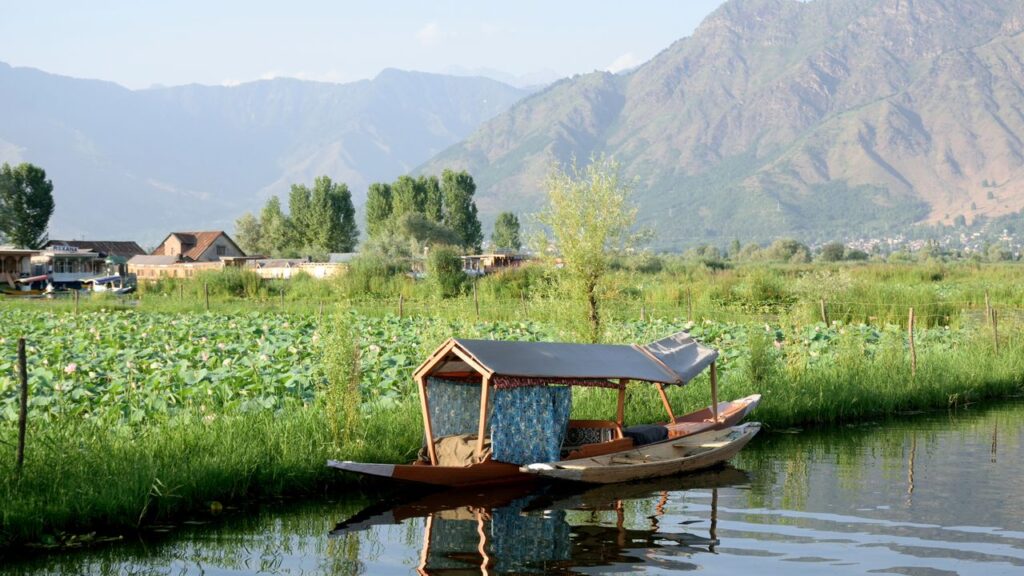
At Asian Paints’ Aks-e-Kashmir, I had perhaps the most quintessential tourist experience of all: struggling to row a shikara in Dal Lake while the oarsman smoothly manoeuvred it without breaking a sweat. In collaboration with four contemporary artists, Aks-e-Kashmir painted 40 locally-owned and operated shikaras to illustrate different facets of Kashmir’s traditions and artistic heritage. While researching and conceptualising his design about the crafts of Kashmir, Srinagar-based Owais Ahmed got to know his home city better. The artist points out how, until recently, even a local like him had never given a second thought to the artisans who create the region’s celebrated papier-mâché handicrafts, wood carvings, pashminas and sozni embroidery. Only a few months ago did he watch them at work in downtown Srinagar. Zahra Javed, also a local, focused on calligraphy and culture, weaving in tributes to Shalimar Bagh, pink nuun chai, breads like lavasa and the floating markets of Dal Lake into her turquoise and pink design, which also incorporates poetry about the land such as Amir Khusro’s famous Persian couplet, later repeated by Jehangir: “If there is paradise on earth, it is here, it is here.” Sheehij Kaul, who is based in Delhi and has Kashmiri heritage, painted her shikara with the flora, fauna and ecology of Kashmir, from the tulip gardens to the lotus stems.


Mumbai-based artist Shweta Sharma’s design explored the region’s folklore. Her research led her down many rabbit holes. “Did you know Kashmir has eight seasons?” she asks me excitedly, then tells me the tragic folktale of Himal and Nagrai, a princess and shapeshifting snake king who fall in love, only to meet a tragic fate. “A lot of stories take a sad turn,” she winces, before telling me about her hyperfixation: poetess Habba Khatoon, the Nightingale of Kashmir, who is said to have wandered around the highlands singing haunting verses after Akbar exiled her husband. Needless to say, Khatoon features on Sharma’s shikara: the artist even learned to write in Urdu so she could paint on the poetess’ name.