


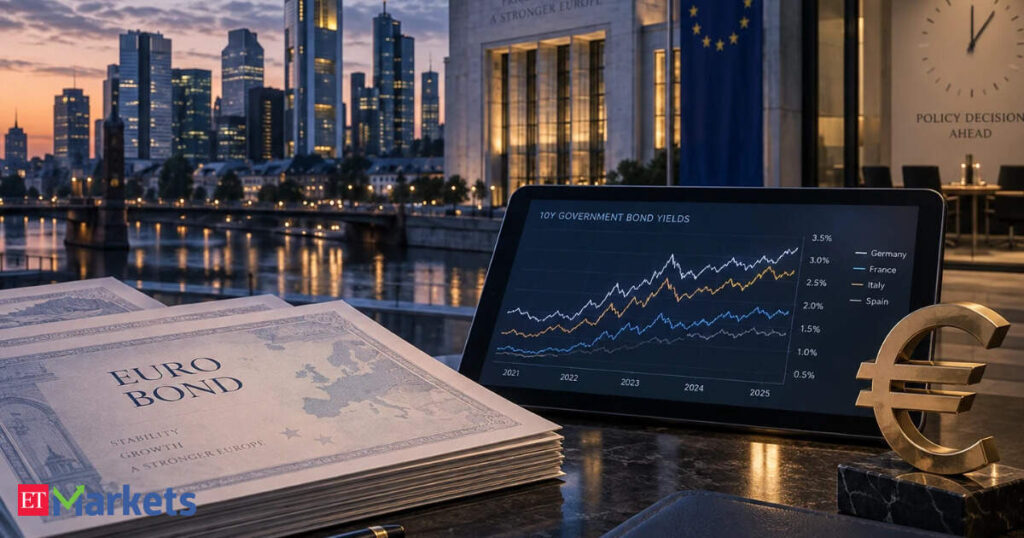
Germany’s 10-year government bond yield, the benchmark for the euro zone, was little changed in early trading at around 3.38%, remaining close to last week’s 15-year high.
According to the report, the ECB’s policy meeting on Thursday is the key event for euro zone bond markets this week. While investors largely expect the central bank to raise interest rates, attention is focused on whether policymakers will provide clues about the future path of monetary policy.
Also Read |Global Market: Yen rally threatens to unravel lucrative carry trade ahead of BOJ rate decision
Markets are also dealing with renewed pressure from energy prices. Brent crude oil has moved closer to $100 a barrel, while Dutch benchmark wholesale gas prices have risen to their highest levels since late 2022. Higher energy costs could add to inflationary pressures and complicate the ECB’s policy outlook.


Live Events
Political developments in Germany have also added to market uncertainty. The far-right Alternative for Germany (AfD) secured a historic victory in a state election over the weekend, raising fresh questions about the country’s political landscape and its potential implications for Europe’s largest economy.
Other major eurozone bond yields were broadly stable. France’s 10-year yield was unchanged at 4.25%, remaining close to its highest level since 2008, while Italy’s 10-year yield slipped 1 basis point to 4.20%.Also Read | Global Market: Japan GDP revision signals resilience as markets brace for BOJ policy move
Shorter-dated German yields edged lower, with the two-year yield down 1 basis point at 2.98%.
Investors are therefore entering the ECB meeting with several competing forces shaping the bond market, including persistent energy-price pressures, political uncertainty and changing expectations for monetary policy, the report stated.