


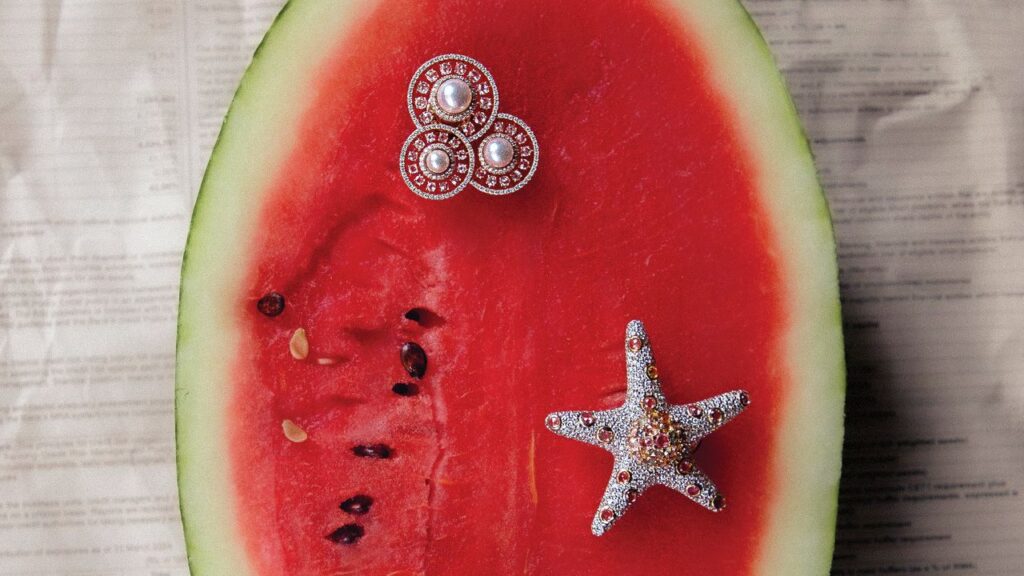
On a particularly exhausting day in 2023, I trundled along the dusty Lucknow Delhi stretch of National Highway 24 in Uttar Pradesh. Alongside fellow passengers battling various degrees of motion sickness, I pined for a clean meal. Just as we were about to give up hope, a giant jhumka sculpture appeared as we neared the town of Bareilly.
While this particular artwork, embellished with zari work, weighed nearly 200 kilograms, the inspiration itself dates back to the Chola dynasty, as depicted in temple carvings of deities. Mughal artisans later refined its structure while preserving its ornate appearance. Over centuries, it’s travelled through cinema, music and popular culture, most memorably in the 1966 song ‘Jhoomka Gira Re’ by Asha Bhosle, which famously referenced a jhumka falling in a Bareilly bazaar.
The town itself has no proven historical connection to jhumkas. But did it matter? When news broke recently of the singer’s passing, Bareilly’s jewellers reported a surge in jhumka sales. The jimikki kammal—the Malayali equivalent of the jhumka—was also immortalised in the 2017 viral song ‘Entammede Jimikki Kammal’, to the point where even the American talk show host and comedian Jimmy Kimmel acknowledged its popularity.
The ear, then, and everything placed upon it, is a convergence of cultural strands moving in wildly different directions. Usha Balakrishnan, jewellery historian, tells Vogue India that it functions as a microcosm of the body. “Nerves in the ear connect to all the important functions—fertility, intellect, the cardiovascular and nervous systems, emotional well-being,” she says, adding that this governs the choice and location of piercings.


Navya Jayamohan
Among the Muria community of the Bastar district in Chhattisgarh, piercings and perforations take on a more functional meaning; ornamentation is only secondary. Parth Varshney, a production designer and artist who grew up there, says that the Murias are a landlocked people, but somehow marine shells, or cowries, were carried inland through old trade networks to a region with no coast-line. “That turns up across men’s ritual dress: stitched into the bison-horn head-dresses worn for the hunt and the gaur dance, strung through bandoliers and armlets,” he says.
For the Murias, ear jewellery holds an additional significance for the men. The ornament is the lurki, a small brass ring. “It tracks the passage children make through the ghotul; it symbolises the move ment from boyhood to becoming a man.” The ghotul is a mixed youth dormitory where teens meet before deciding, on their own, who they’d like to marry.