


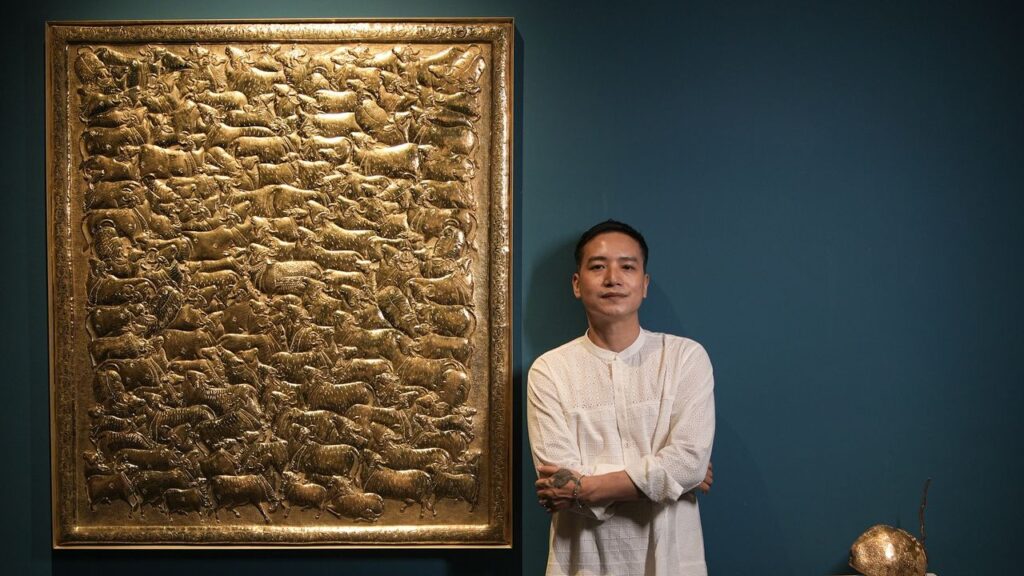
Jenjum Gadi was a menswear designer for twenty years, popular for reconceptualising Northeast India’s tribal heritage into contemporary designs. Then, sometime in 2020, he turned his attention away from fashion to explore the world of art, with brass as his primary medium. “Art feels more personal to me,” says the 44-year-old designer from Arunachal Pradesh ahead of his second solo exhibition at Gallery Vayu in New Delhi. “With fashion, there was always the pressure of serving commercial interests or catering to the client’s needs. I like art because I am making what I wish.”
While Gadi’s 2024 debut exhibition Apase featured a selection of brass fruits and vegetables inspired by the produce grown in his mother’s garden, Ngok Dollu, which means ‘my village’ in his native language Galo, feels more personal. It explores Gadi’s childhood memories of growing up in the ’80s in Arunachal Pradesh’s Tirbin village, where the internet was yet to arrive, open fields were in abundance and leading a communal life was the norm. “It’s a simple and uncomplicated carry-forward of my first show,” he says. “This time, I am looking at my wider village community and landscape.”


To this end, Ngok Dollu showcases a series of flora and fauna-inspired solid brass sculptures and pichwai-esque beaten-brass panels that Gadi observed as a child while performing quotidian tasks such as climbing trees, hiking mountains, catching fish in the river, and helping his mother sow and harvest vegetables in their garden. To develop the pieces, Gadi worked closely with artisans in Rupa, Arunachal Pradesh, where generations have been working with indigenous brass repoussé techniques to make gates for temples and monasteries, and jewellery for locals. The result: rotund coconuts complete with dense foliage; banana clusters complete with intricate ridges on their stalks; star-shaped chilli flowers; and the trunks of ageing trees for birds to perch on—all in a metal considered ordinary.
Inspired by Rajasthan’s pichwai art discipline, Gadi’s brass panels capture the quiet scenes from a pastoral life. Think:grasshoppers and bees around paddy fields on a sultry summer day, domestic cattle quietly grazing amidst wildflowers, women washing utensils by the local tubewell and a vast expanse of bamboo groves. Gadi recounts first seeing pichwai in 2002 as an undergraduate student at the University of Delhi, and feeling mesmerised by it. “While Srinathji is at the centre of these paintings, the trees, cows, lotuses in the background—they are not just decorative elements.” This ecocentric visual language resonated with Gadi, an animist, who firmly believes that all flora and fauna carry a divine spirit within them. “Rendering the pichwai style of storytelling onto my brass panels allowed me to preserve the element of spirituality in my works as well.” The centrepiece of Ngok Dollu, a panel that Gadi holds personal, carries this idea at its core.