


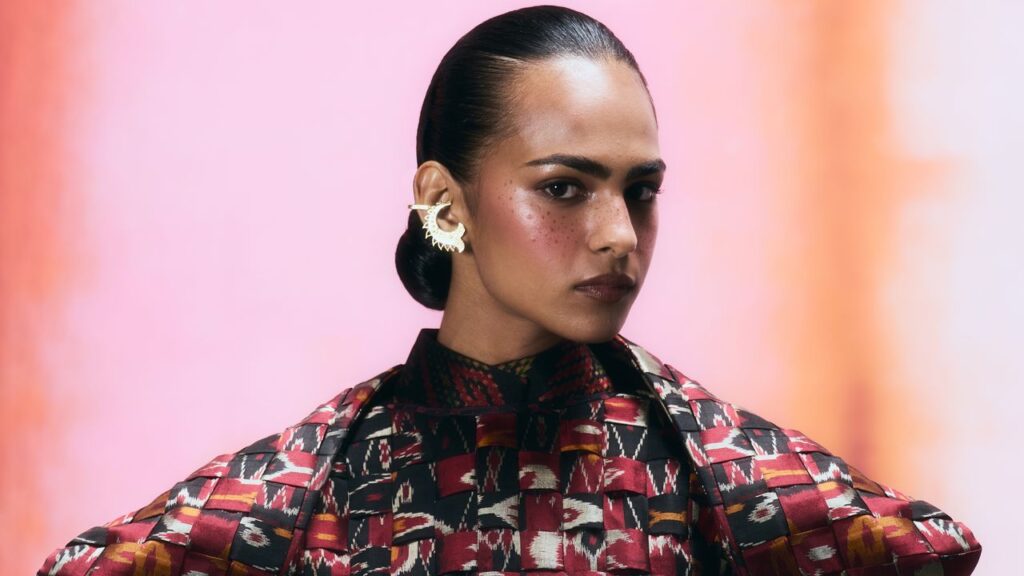
The fashion cognoscenti are right; you can tell when a designer loves women just by looking at their clothes. In the case of Mayyur Girotra, one look at his recent collaboration with Swadesh—the craft initiative helmed by Nita Ambani under Reliance Foundation—will tell you that the designer loves heritage crafts. In the collection, you will see that Kanchipuram silk sits beside a Pochampally weave; Banarasi brocade work and bandhani are in a playful conversation; an already complicated weave like ikat is further woven into basket-mesh design. The attention to detail is not limited to the surface of the garments—shibori-dyed linings lurk nonchalantly beneath layers of silk, proof that real luxury extends beyond what the eye can see. Tailored into ankle-length coats and kimono-style sleeves, Girotra pulls these Indian crafts out of their usual context and give them a new identity, while somehow making it seem like they have always belonged together.


For Girotra, there’s more to craft than a finished garment. He has spent years travelling to craft clusters, working directly with weavers and karigars, and advocating for them in the Indian fashion industry. He believes that the craftspeople behind India’s most celebrated textiles are not just as anonymous suppliers, but true artists. “They are the MF Husains, Souzas and the Razas of our country,” he says. His collaboration with Swadesh gave him access to new clusters and textiles, and the freedom to interpret them in his way. In signature Girotra fashion, this means in the colourful and maximalist manner, with a touch of androgyny.
Below, the designer talks about what cultural preservation truly means today, and what we can look forward to in his next collection.
Vogue India: How does a collaboration with Swadesh fit into your wider design repertoire?
Mayyur Girotra: The foundation of my craft-oriented work is that the craft community—whether I’m working with artisans in Kanchipuram (Tamil Nadu), Barmer (Rajasthan) or Varanasi (Uttar Pradesh)—has to be treated with respect and as artists. Swadesh and Mrs Ambani are also on the same page. She works towards the welfare of the clusters, while ensuring that the art is preserved, so it was an easy collaboration. When my team and I spent two days with Swadesh’s clusters in Varanasi, I saw the way they were aided with more looms, and it’s remarkable.
We’re working with crafts like Kanchipuram, Banarasi, bandhani, Pochampally, Patan patola, and kalamkari. I designed a basket-mesh for the first time, which was quite a task.