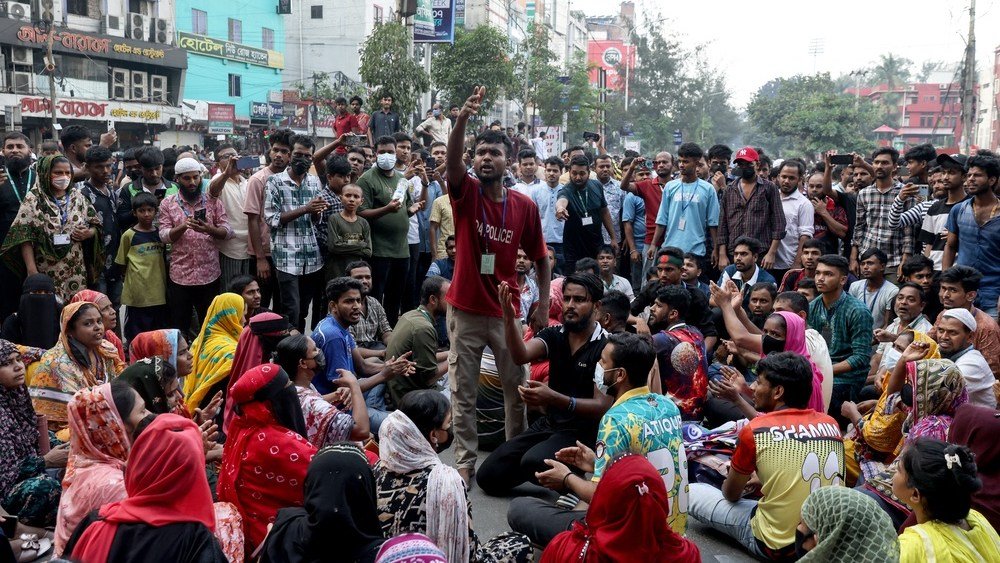




Bangladesh’s government formed a new wage board on Sunday to review garment workers’ pay amid intensifying protests over low wages that have shuttered hundreds of factories and paralyzed transport across major industrial areas. Despite the announcement, thousands of garment workers continued to stage demonstrations in and around Dhaka, resulting in clashes with police who fired tear gas and water cannons to disperse the crowds. In the Mirpur neighborhood, at least one police vehicle was set on fire.
Workers are demanding a minimum monthly wage of 30,000 Bangladeshi taka ($245), more than double the current 12,500 taka ($100), saying that their earnings can no longer keep pace with inflation, which has driven up the cost of food, transportation, housing and healthcare. Exacerbating matters are the unrelenting gas and power shortages, which, coupled with U.S. tariff uncertainty, have forced partial or total production stoppages, making overtime pay, once a crucial source of income, no longer a guarantee and, in some cases, eliminating entire jobs.
“Workers have made clear that the current minimum wage is insufficient in supporting workers’ needs, particularly in the current climate,” Mayisha Begum, labor program officer at the Business and Human Rights Centre, a labor advocacy group, told Sourcing Journal. “The demands of protesting unions and workers, who form the backbone of Bangladesh’s largest export sector, must be at the center of the decision.”
Ariful Haque Choudhury, the labor minister, told reporters that the six-member wage board was formed after discussions with workers’ representatives and industry leaders. The board comprises two representatives each from workers and employers, along with a government representative and a neutral member. He urged workers to return to work, warning that prolonged disruptions could delay export shipments and payments from international buyers, creating further problems for an industry already under strain.
Indeed, the escalating situation recalls the 2023 minimum wage protests that resulted in four worker deaths, hundreds of arrests and mass criminal charges against tens of thousands of workers, only dropped by the interim government two years later. Already, protests in multiple cities have disrupted operations at 529 factories, affecting nearly 1 million workers, according to the Bangladesh Garment Manufacturers and Exporters Association. Mahmud Hasan Khan, the trade group’s president, told Reuters that if protests persist, “we will have no option but to invoke the ‘no work, no pay’ provision” due to illegal striking.
For labor advocates, a familiar refrain centers on brands’ role in creating the conditions that make protests like this necessary in the first place.
“Garment workers in Bangladesh are in the streets because 48 cents an hour is not enough to feed their children,” said Scott Nova, executive director at the Worker Rights Consortium, a Washington watchdog group. “Brands drive the problem by demanding unreasonable prices from suppliers, and brands can fix it by committing to absorb the cost of the wage increase workers are seeking. If brands do not act responsibly, workers will face the brutal repression and criminalization of their protests, as happened in 2013…and 2018…and 2023.”
The American Apparel and Footwear Association, which repeatedly called on the Bangladeshi government to drop “baseless” criminal charges and First Information Reports filed against garment workers and labor leaders following the 2023 demonstrations, called the establishment of a new wage board a “critical opportunity” to deliver a fair wage that allows garment workers to support themselves and their families.
“AAFA continues to call for a transparent, an annual inclusive minimum wage review process that meaningfully engages all stakeholders, particularly labor groups and trade unions, and takes into account Bangladesh’s economic realities,” Steve Lamar, the trade group’s president and CEO, wrote in an email. “A fair outcome depends on a process in which workers can make their voices heard safely and freely.”
The Bangladeshi government, he added, must “safeguard union and collective bargaining rights, unequivocally condemn violence, threats and intimidation and ensure that workers and other participants are protected from retaliation throughout the review process and beyond.”
Nazma Akter, founder and executive director of Dhaka-based workers’ rights group Awaj Foundation, expressed dismay at the mayhem that has unfolded at the demonstrations, including reports of police and protestors hurling brick chips at each other. Vandalism and burning are “not the solution,” Akter said, adding that union leadership does not condone them. At least 58 police officers have been injured since Saturday, authorities said, and 57 people arrested.
She, too, encouraged brands to intervene and offer fair prices that would facilitate a better wage.
“If brands chose to support a living wage for workers rather than squeezing supplier profit margins, workers would be significantly better off,” M. Azizul Islam, director of the Centre for Sustainability, Accountability and Governance at the University of Aberdeen, told Sourcing Journal. His research found that brands frequently engage in unfair purchasing practices with Bangladeshi suppliers, burdening them with additional costs and squeezing their profit margins. In some cases, suppliers sold their clothes for less than it cost to make them, even to major brands such as H&M and Inditex.
“This severely impacts suppliers’ capacity to pay even minimum wages,” he said. “If brands claim themselves as responsible brands, they must ensure a living wage for workers. We need a global accountability mechanism surrounding this to ensure that brands implement their commitment.”
And while governments often worry that raising wages too sharply could erode competitiveness, this isn’t necessarily the case, said Md. Rafiqul Islam Rana, an assistant professor of retailing at the University of South Carolina. Pointing to the examples of Cambodia and Vietnam, which he said have raised garment wages over time without losing their standing in global sourcing, Rana argued that better compensation can improve retention, reduce absenteeism and turnover, and support productivity and product quality.
“Bangladesh also needs to recognize that its competitiveness depends on much more than cheap labor,” he said. “Unreliable energy supplies, infrastructure limitations, financing difficulties and transportation delays can be just as damaging to factories as rising wages.”
As automation and AI play a growing role in apparel manufacturing, Bangladesh will find it increasingly difficult to compete on low labor costs alone, Rana said.
“The industry’s long-term competitiveness must come from productivity, quality, innovation, reliable infrastructure, and a workforce that is fairly compensated,” he added. “Otherwise, Bangladesh risks remaining trapped in a cycle of low prices, low wages, and limited opportunities to move into higher-value production.”
On Monday, Salahuddin Ahmed, the home minister, said the government was taking firm action to halt the protests.
“Those engaging in unlawful activities and conspiracies under the guise of labor movements will be tackled with an iron hand,” he said after meeting with industry leaders. Ahmed also noted, however, that Prime Minister Tarique Rahman had instructed officials following an emergency cabinet meeting late on Sunday to “ensure workers’ rights and improve their living standards” while ensuring that production and exports continued “unhindered.”