


 rahulNovember 8, 20267 Mins read1
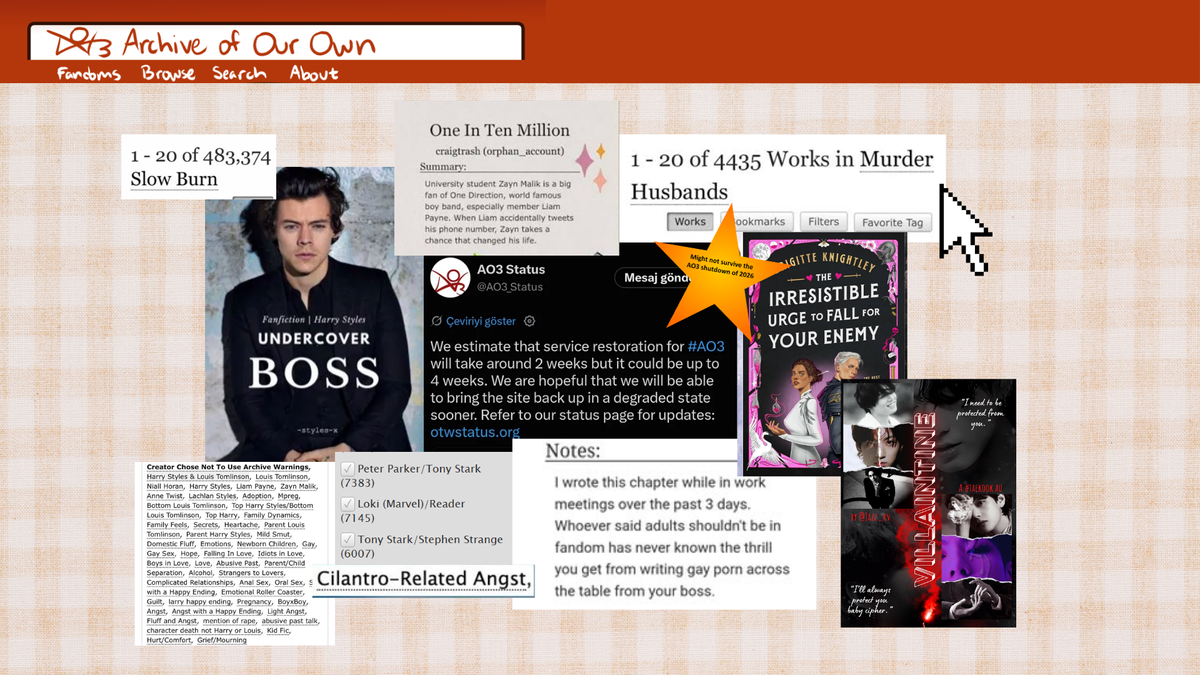
There are few things more humbling than discovering that the 176,000-word enemies-to-lovers fic you were halfway through is suddenly inaccessible. You don’t remember the author’s name. You don’t remember the title. You definitely didn’t download it. And now you’re staring at a loading screen like you’ve just lost a family heirloom.
Because, as it turns out, we were never prepared for the possibility that the fanfiction we thought would always be there could simply disappear.
We estimate that service restoration for #AO3 will take around 2 weeks but it could be up to 4 weeks. We are hopeful that we will be able to bring the site back up in a degraded state sooner. Refer to our status page for updates: https://t.co/YAyyoTDOpE
— AO3 Status (@AO3_Status) October 29, 2026
AO3 has gone down before. Maintenance or glitches happen. But for anyone unfamiliar with the archive, Archive of Our Own (AO3) is a non-profit, fan-created platform that hosts millions of fanfiction stories across thousands of fandoms, from K-pop idols and Marvel superheroes to fictional characters from books, films and television. It is essentially a massive, searchable library of fan-created stories, where readers can filter by characters, relationships, genres, tropes and tags, bookmark their favourites, leave kudos and interact with authors. Unlike commercial reading platforms, it is largely community-driven and built around preserving transformative works.
The fanfiction girlies know the drill: wait a little, refresh a few times, complain on Tumblr and get back to whatever 200,000-word slow burn currently has you in a chokehold. This time, though, is different. What initially looked like routine maintenance quickly turned into an outage expected to last at least two weeks, and potentially four weeks. The Organisation for Transformative Works (OTW), the non-profit that operates the archive, later confirmed that it had detected evidence of a security incident and was investigating its scope. It has said that no works, bookmarks or kudos have been deleted, although it cannot yet rule out whether user account information was accessed.

For a website where the usual solution is to refresh the page a few times, losing access to the entire archive for weeks is basically like someone confiscating your entire lip gloss collection and saying, ‘Maybe in a month.’ And that has sent the internet into something between a panic attack, and a natural disaster drill.
The fanfiction girlies, it seems, have entered their doomsday prepper era.
We have a particular soft spot for this entire crisis because we grew up reading Wattpad and AO3. And if you were a teenage girl on the internet in the One Direction era, you probably know exactly what I mean. There was a time when opening Wattpad at midnight was practically a personality trait. You would start with one innocent story, find yourself three chapters deep into a fictionalised romance with your favourite boy band member, and suddenly it was four o’clock in the morning. The next day, you had school, absolutely no sleep, and a very strong emotional attachment to a man who had no idea you existed.
We were, to put it delicately, the horny girls of the internet. The girls reading stories that would make our teenage selves blush, stories that were sometimes wildly explicit, occasionally terribly written, and almost always impossible to put down. From One Direction fanfiction to the more elaborate Star War universes, and later the AO3 rabbit holes, we were consuming hundreds of thousands of words about people we had never met, and fictional relationships that had somehow become more important than our actual social lives.
And we were not exactly hiding it from each other. We had our favourite authors, our reading lists, our very specific tropes, and our own little internet vocabulary. We knew what an AU was, what a slow burn meant, why enemies-to-lovers was superior to almost every other romantic arrangement, and why a little hurt/comfort could fix an otherwise terrible day.
It is easy to look back at this phase and call it embarrassing. Teenage girls have always been particularly good at being told that the things they enjoy are embarrassing. But I don’t think we give fanfiction enough credit for what it did. It made reading a habit for people who might never have picked up a 500-page novel. It encouraged girls to write, experiment with storytelling, develop their own voices, and find communities around interests they couldn’t necessarily discuss offline.
Fanfiction was an accidental reading machine. Nobody was assigning us these stories to finish for a test or we had a reading list. We were reading because we wanted to know what happened next, because the author had left us on a cliffhanger, because the comments section was going off, or because we had discovered a particularly compelling fictional universe. And, importantly, it was ours.
The thing about fanfiction is that it was never just about the stories. It was about the people making them, sharing them and building entire worlds around characters who already existed somewhere else.
A lot of this labour was unpaid, uncredited and often dismissed as teenage-girl nonsense. Girls were writing entire novels on their phones, editing fan videos, running Tumblr accounts, translating stories, creating fan art, and building communities that could span countries and time zones. They were learning how to hold an audience’s attention long before anyone started calling it content creation.
There was also something important about the freedom of these spaces. For queer readers, particularly those who didn’t see themselves reflected in mainstream entertainment, fanfiction could offer room to explore identities, relationships and desire without having to explain themselves. For women, it offered the freedom to rewrite characters, question canon relationships, give overlooked characters entire backstories, and create the romantic or sexual narratives mainstream entertainment wasn’t always interested in telling.
I’m crying they’re making sad ao3 edits on tiktok https://t.co/vyoiHgXkjT
— TK/Atlas ❕ (@CLlCKTK) October 29, 2026
It wasn’t all perfect, of course. There were badly written stories, problematic tropes, and plenty of questionable plot decisions. But there was a sense of creative ownership that is harder to find on today’s internet, where everything seems to be measured by engagement, monetisation, and how quickly a piece of content can be replicated.
Now, fanfiction has become a recognised pipeline into publishing and entertainment. After began as One Direction fanfiction on Wattpad before becoming a bestselling book series and film franchise. Fifty Shades of Grey famously began as Twilight fanfiction. Stories and tropes that once circulated through anonymous accounts and fandom forums now influence the books sitting on bestseller shelves.
The industry has discovered what teenage girls knew all along: people will happily spend hundreds of hours invested in a fictional relationship if you give them a reason to care.
And yet, the original spaces where so much of this creativity flourished are still treated as something of a niche internet curiosity.
Não fumo Não bebo Não transo Não usos drogas Não uso nada Único vício q tenho é Ao3 E ainda me tiram isso? N tô acreditando https://t.co/tS7twdaQj1
— clarita barxotinha 🇧🇷🇫🇷 (@barxota) October 30, 2026
The funniest thing about this whole situation is realising just how many fanfiction girlies there actually are. You don’t even have to be one anymore.
Maybe you haven’t opened AO3 in three years. Maybe your last fic was a Harry Styles one you read in your bedroom at 17. Maybe you went through your Marvel phase, your K-pop phase, your Succession phase or your inexplicable period of reading 300,000-word Harry Potter AUs and then moved on.
Instagram is suddenly serving fanfiction recommendations, and filling up with people mourning unfinished fics. Tumblr is doing what Tumblr does best: turning collective panic into content. Personally, I haven’t read fanfiction in ages. Which is apparently exactly why Instagram has decided that now is the perfect time to introduce me to the fics that I would have absolutely loved three years ago. Thank you, algorithm. Impeccable timing.
And then there is Dramione. Dramione edits. Dramione recommendations. People screaming about Manacled. Readers recommending one fic because you liked another fic because you liked a book that was probably inspired by another fic. The algorithm has found the rabbit hole, and is now pushing you down it personally.
You may not know what a ship is. You may not know the difference between an AU and a canon divergence. You may have never heard of a ‘hurt/comfort’ tag in your life.
But you know AO3 is down. The internet will make sure of it.
AO3 isn’t the only place fanfiction exists, of course. Fanfiction has lived everywhere from Wattpad and FanFiction.net to Tumblr, Reddit, Discord and, increasingly, social media. But AO3 has become something particularly important: an archive built around the idea that fan-created work deserves to be preserved.
You find something because someone recommended it. You leave a comment. The author replies. Suddenly, a story about fictional people has become a tiny social world. You might know an author only as @zarrylover404. You don’t know their real name, where they live or what they look like. But you know exactly what they like to write. You know which character they always make suffer. You know they’ll probably have a recommendation for your latest hyper-specific enemies-to-lovers craving.
Which brings us to the slightly bigger, slightly more existential question: How much of our lives are actually on the internet? Your friendships live in WhatsApp chats. Your photographs live in iCloud. Your professional life lives in Slack. Your reading list lives on Goodreads. And your favourite author might exist entirely as a username on AO3. We put so much of ourselves into platforms that we rarely stop to think about what happens when one of them disappears. Not forever. Just for a few weeks.
Long enough to realise how much you depended on it.
There is also a reason this particular outage feels different from losing access to another social media platform. AO3 was built by and for a community that has spent years defending the value of transformative work, often in the face of censorship, copyright anxiety and the commercial internet’s tendency to treat fan-created culture as disposable. Its non-profit structure, and volunteer-led operation are part of what makes it distinct.
@ god take ao3’s suffering, multiply it, and pass it on to chatpgt https://t.co/JyHDkKXU2i
— nen (@exoskimbros) October 30, 2026
Perhaps that is why the response has been so immediate and so personal. Fans aren’t simply waiting for a website to come back. They’re trying to preserve a piece of internet history that has been built by ordinary people, many of them young women, who were never necessarily doing it for money or recognition.
There is something particularly funny about watching fanfiction spill out into the rest of the internet at exactly the moment AO3 has disappeared. But there is something genuinely meaningful about it, too. The fandom doesn’t stop existing when you close the website. It just moves. It leaks into Instagram, Tumblr, Reddit, group chats and book recommendations. It turns up in the publishing industry. It becomes a film. It becomes a bestseller. It becomes a trope you see in every other romance novel.
The archive may be offline. The ecosystem is very much alive.
Why India’s Queer Community Is Rewriting The Rules of Sex Education