


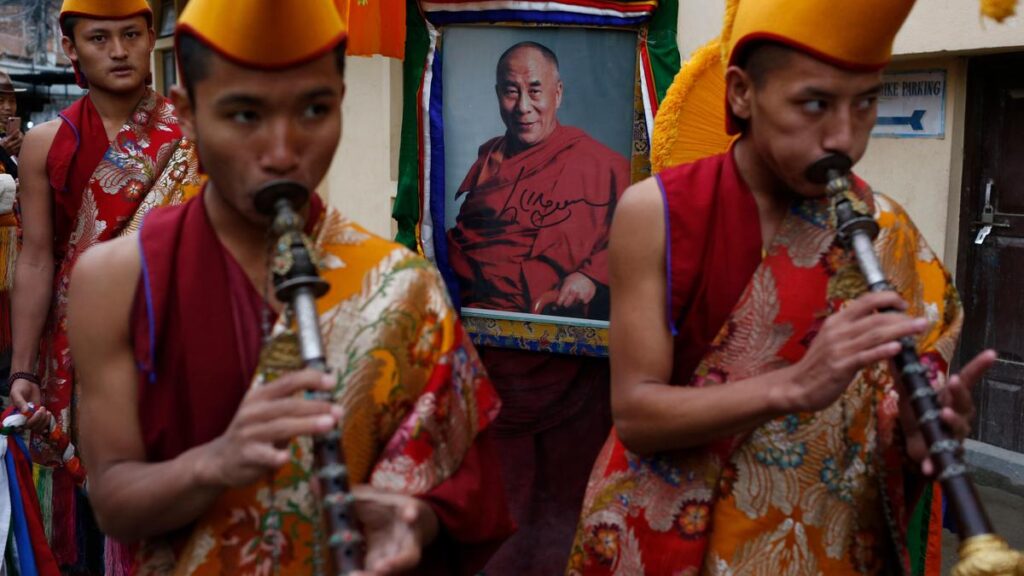
A conference on Tibetan studies scheduled later this month in Kathmandu was called off at the request of the government of Nepal, which, however, has not made any official statement in that regard.
The cancellation of the scholarly conference, in which around 700 participants were expected, including scholars from China, has now stoked a larger debate over whether the Nepal government acquiesced to pressure from Beijing, which in recent years has steadily expanded its sphere of influence in Kathmandu. Questions have also arisen over whether Kathmandu became overtly cautious and asked for the event to be cancelled — on its own volition — so as not to offend Beijing.
The International Association for Tibetan Studies (IATS), the organiser, described the cancellation as unexpected and called the development an unwarranted interference in a purely academic event.
The Himalaya Centre for Asian Studies at Kathmandu University, the Nepali convener, has said the event had to be called off on the government’s instructions. The conference was scheduled for August 23-29 in Kathmandu.
The sequence of events in the weeks before the cancellation is significant. An official at the Ministry of Foreign Affairs said Chinese Ambassador to Nepal Zhang Maoming, in a meeting with Foreign Secretary Amrit Bahadur Rai in the third week of July, had “discussed” the event.
“The discussion was peripheral, not to the extent of concern,” the official said, asking not to be named. The Foreign Ministry, he said, had also informally asked the Chinese envoy whether Beijing had any specific concerns about the conference.
The official did not say China had asked Nepal to cancel the event. But, his account establishes that the conference had been discussed at a senior diplomatic level and that Kathmandu was seeking to ascertain Beijing’s position.
Weeks later, the event was called off.
Rupak Sapkota, who holds a Ph.D in International Relations from Renmin University of China, said the cancellation does have to do with Chinese concerns, which he believes were serious.
He, however, drew a distinction between Beijing asking Nepal to stop the event and Nepal itself making a move to avoid a potential complication.
“I believe the Chinese concern was serious. Yet, instead of Beijing asking to stop the event, Nepal came under pressure, Nepal felt pressure,” he said. “The concerns may not have amounted to stopping the event, but could have made the Nepal government rethink the decision, given its own plethora of issues amid a changing geopolitical order.”
Sensitive politics
China’s longstanding apprehensions about Tibet are well known, and Nepal has historically sought to prevent its territory from being exploited for anti-China political activities.
“Amid talks about the succession of the Dalai Lama, who himself has on a couple of occasions said about his reincarnation from any other country, Chinese sensitivities are natural,” he said.
“In this regard, though a purely scholarly event, its Tibetan connection put Nepal under pressure.”
Nepal is home to roughly 12,000 Tibetan refugees, while several others pass through Nepal on their way to India, where the Dalai Lama lives in exile.
There have been several protests by Tibetan refugees living in Nepal, and police in the past have been used to quell them. Nepal has maintained that it will not allow any protests, rallies or activities on its soil against friendly nations, and such events by Tibetan refugees are always under close watch of Nepali security agencies.
That sensitivity has also been visible around public events involving the Dalai Lama. While his birthday celebration is a routine event in Nepal, it is usually limited to the boundaries of monasteries and schools. The recent celebration, however, also became a topic of discussion, with at least seven former Nepali ambassadors to China objecting to the open participation of some Western diplomats.
Mr. Sapkota says that since the Dalai Lama is both a spiritual and political leader, an event related to Tibet could be an inconvenience for Beijing.
Sandwiched between India and China, Nepal’s geopolitical balancing has remained a challenge for every government.
Governments led by Nepali communist parties have often tended to be more tilted towards the north, an unease for India, historically a long-standing development partner and friend for Nepal.
Difficult choices
Sanjay Upadhya, analyst and author of the book Nepal and the Geo-Strategic Rivalry between China and India, says the cancellation underscores Nepal’s complex position amid China’s sensitivities regarding Tibet and Nepal’s obligation to safeguard its sovereignty and academic independence. “It goes beyond mere administrative concerns,” he said. “If a scholarly discourse on Tibet can be obstructed solely because Beijing deems it inconvenient, it raises questions about Nepal’s capacity for autonomous decision-making.”
Mr. Sapkota says the Nepal government also appears to have examined potential security threats emanating from the conference itself. “In light of a recent self-immolation by a Tibetan in New York, concerns over whether such an act could occur during the conference are understandable,” he said. “Yet, the cancellation decision could also have stemmed from other concerns, including the possibility of the conference being used by anti-China forces.”
For Mr. Upadhya, the issue extends beyond Tibet or the conference itself and goes to Nepal’s strategic independence. The question, he said, is whether Kathmandu can adhere to the One-China policy without allowing Chinese sensitivities to impede legitimate academic inquiry or influence domestic decision-making.
Mr. Upadhya says Nepal’s “One-China” stance appears to be broadening from solely restricting anti-China activism to also limiting Tibet-related academic activities. “The principal issue at stake is whether Nepal will allow China’s sensitivities to affect its academic freedom,” he said. “The larger concern is whether Nepal risks setting a precedent whereby foreign sensitivities might constrain academic discourse. The event has now been moved online.
The IATS Board, in a statement on August 8, said that despite repeated requests, it had not received any formal written information from the government and had not yet been given any explanation for the last-minute decision.
“The effective cancellation of this conference by the authorities will raise questions about holding future academic events in the country, and is likely to result in economic and reputational damage,” the Board said.
Mr. Sapkota cautioned against interpreting the cancellation as evidence that Nepal simply follows Beijing’s wishes. Chinese influence in Nepal has grown, he said, but Nepal has not always acted in accordance with Chinese preferences.
He pointed to Nepal’s decision to move ahead with the U.S.-funded Millennium Challenge Corporation (MCC) compact despite Chinese objections as an example of Kathmandu taking a decision that did not conform to Beijing’s position.
Saying Nepal bowed down to Chinese pressure, therefore, could be over the top, he said, adding, “Beijing may have seen the Tibetan studies conference as an initiative involving Westerners, while Nepal may have calculated that allowing it to proceed could create unnecessary complications.”
Mr. Upadhya says the cancellation also illustrates the difficult choices facing Nepal.
“The primary challenge for Nepal remains balancing prudence with the preservation of its strategic autonomy,” he said. “The chain of events in the past weeks does indicate that Nepal may be proactively avoiding potential complications, especially in its dealings with China.”