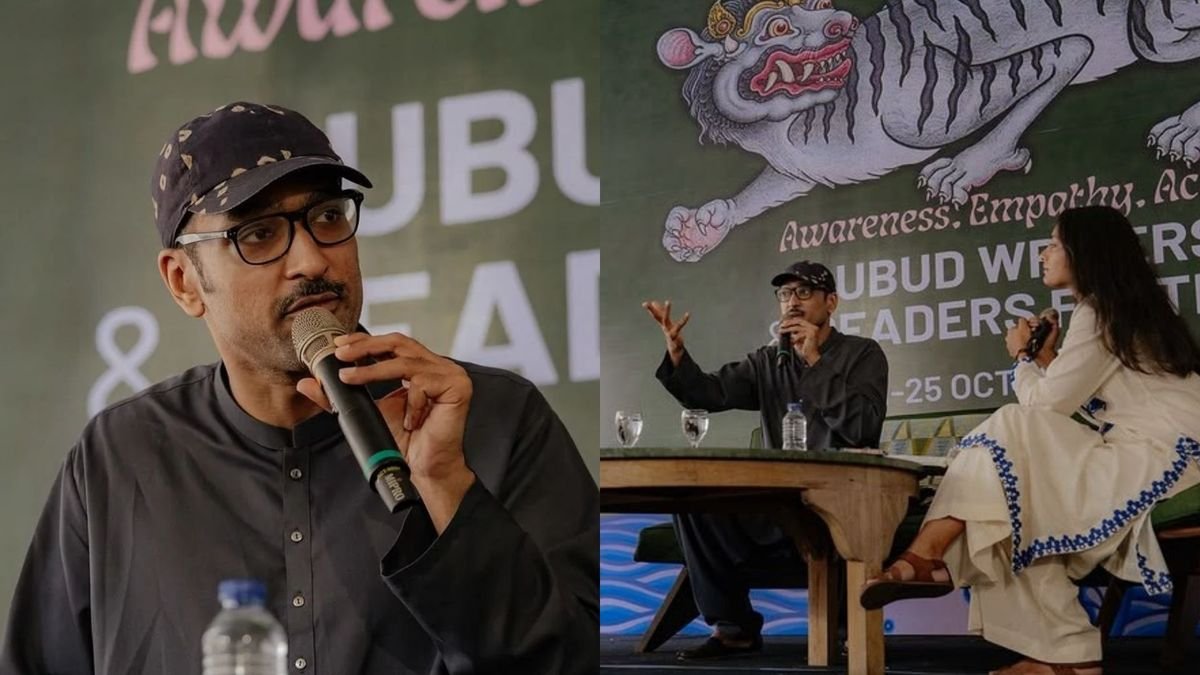




The morning I met Ali Sethi in Ubud, the Balinese sun was unusually relentless. A cool breeze moved through the lush paddy fields, offering little relief. Ali Sethi needed sunscreen, so I passed him mine, a bottle I’d bought in Canggu on the shopkeeper’s enthusiastic recommendation. Sitting by the pool at Bumi Kinar, a boutique retreat overlooking the Petanu River, we agreed that sunscreen in Bali is less a holiday essential than a matter of survival.
For an Indian and a Pakistani, it was an unlikely place to meet, though perhaps an apt one. With political tensions making travel between our countries increasingly difficult, we joked that we’d found neutral ground in the heart of Indonesia. Soon, we were talking about Calcutta (now Kolkata) and how Sethi’s grandmothers remembered shopping at New Market. I grew up in the same city, spending much of my childhood wandering its crowded lanes and occasionally getting lost. For a brief moment, the city belonged to both of us, through our overlapping histories, though only one of us can now return to it freely.
And then there were the memories of dancing to ‘Pasoori’ late into the night at Delhi clubs during my university years, long before I imagined sitting across from the man who sang it, let alone admitting it to him. Those nights now feel distant, belonging to a version of my life I barely recognise. The song, though, has stayed with me, slipping into newer moments.

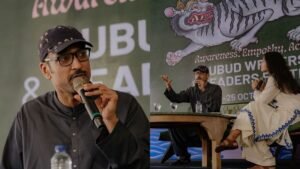
At the Ubud Writers & Readers Festival 2026, Sethi was warm and candid. He spoke about India with affection, recalling friendships, cities, and connections that politics cannot quite erase. In this ELLE exclusive, we talk about ghazals, exile, memory, and the ways longing can connect us, even when geography and politics insist on keeping us apart.
Ali Sethi (AS): I’m entirely shaped by border crossing.
For my grandmother’s generation, all this music was part of one world. Bombay, Calcutta, Kashmir, Bhopal, Lahore, Amritsar. It was one circuit. She would often talk about buying diamonds in Bombay, shopping at New Market in Calcutta, or holidaying in Srinagar. By the time I was growing up, none of that was possible. These places had become obscured, veiled by arbitrary borders. Movies and music became the way we accessed one another.

I remember watching Nagina, with Sridevi and Amrish Puri, and intensely relating to the nagin. She’s misunderstood, potentially lethal, but actually quite loyal and lovely. A misunderstood lass with special powers, to put it that way. Through these films, we encountered words like icchadhari naag, shakti, shanti and chinta. These weren’t part of everyday language in Pakistan, where we’d use more Persianate Urdu vocabulary. These movies gave us access to another vernacular, and at the time, it was a radical education in the alternative.
I feel much of what I do now serves that same purpose, particularly for children growing up in the diaspora who experience the language through music. Parents tell me that their two-year-old, before speaking a word of Hindi or Punjabi, was already singing ‘Pasoori’. Music is a powerful way of imparting cultural literacy.
AS: Oh yes, I did grow up in a very unorthodox home in many different ways. My father was a book publisher, editor, and television presenter. He’s an intellectual, a thinker, a very political person. My mother has been an activist for women’s causes her whole life. She published my father’s paper, The FridayTimes, and gave a voice to marginalised artists, dancers, classical musicians, painters, and poets.

I grew up going from a protest on the street to a drawing room filled with cigarette smoke, where lawyers discussed filing a habeas corpus petition. I would fall asleep to that chatter. It was the most familiar sound to my child self.
My ustad, Naseeruddin Sami Sahib, once told me not to forget my ancestral calling. When I asked what that was, he said, “You come from a family of media. Media is your caste.”
For the longest time, I didn’t quite figure out what he meant. But looking back, I think he meant that growing up in a home full of discourse was where my earliest muscles and skills were formed. What you absorb as a child, the mahaul, the atmosphere you grow up in, shapes you much more profoundly than you realise.
I’m very much a creature of my upbringing. It made me unorthodox, subversive, brave when I have to be, and committed to openness: of story, dialogue and possibility.
AS: I think there’s a widespread unfulfilment in South Asian culture. We are the land of arranged marriages. We are the land of, you know, whatever you do, don’t tell; whatever you do, don’t lose your caste.
The Urdu scholar Ralph Russell once said that ghazals are about the pain of arranged marriages, because love and marriage are two separate things. You marry the person society requires you to marry, and love someone you can never have, who may not even know you exist. These questions of permission, possibility, and expression are articulated through longing.

Queer poets and courtesans have used veiled expressions of love. Revolutionary poets like Faiz Ahmed Faiz, repeatedly jailed and censored by dictatorships, used unrequited love to speak about a society and its unfulfilled dreams. And in that sense, longing and the quest for union with the beloved become potent tools of rebellion. On the surface, you’re unable to be with the person you love. At a deeper level, songs, poems, and ghazals become pathways to transcendence and transformation.
AS: The song is yours. It’s theirs. I’m totally into that! It’s more powerful when a song invites interpretation and engages the listener’s imagination. As a child, I heard ‘Ain’t Nobody Loves Me Better’ as “Ain’t nobody, just remember”. I thought it was about showing people that you could do something. I sang it that way for years, until someone in America corrected me. By then, it had become another song in my head. I wasn’t going to change its meaning.
‘Pasoori’ has been interpreted as an India-Pakistan song, an expression of queer love or a boy-girl romance. I’m open to all of it. There’s actually a word for this: polyvalent. A song can carry multiple meanings. You might hear a ghazal and think it’s about your own situation; someone else might say it’s about a poet jailed for being a communist. Both meanings can be true.
Contemporary Western culture has become very literal, very on-the-nose and identity-driven. Everything has to be narrowed down to a particular meaning. But there’s something more powerful about open-endedness and mystery.
AS: There’s sadness, angst, and honestly, anger. So much of my audience is in India. Some of my favourite musicians are there, and so many people I’d love to collaborate with. It’s a natural connection, and this culture of bans and blocks is unnatural.

But we’re used to these arbitrary regimes and periods of dosti and dushmani. It’s a love-hate relationship. As Shakespeare said, “My only love sprung from my only hate.”
It’s miraculous that we’re able to remain connected through art, even when we’re barred from accessing one another. The songs are in people’s hearts, playing at weddings and in clubs.
‘Chan Kithan’ has had a revival on Reels in India. People can’t tag me or use the original audio, so someone records it and uses that instead. It’s like the Cold War, when art was blocked and had to be smuggled across. I think my music is being smuggled across, but by people who are into it. I’m not doing it.
It’s another state of exile. My teacher once said that exile is a state of great fruitfulness. Perhaps people listen with even more attention because the music is blocked. There’s a kind of forbidden love between us.
AS: Nusrat was a real maverick. He took this ossified medieval musical form and made it hot. When I was a child, he was the biggest rock and pop star in our world. We worshipped him. I remember listening to his qawwalis for two hours when I was 10. It was so exciting!
He made this intense, mystical music accessible to everyone: young and old, rich and poor, urban and rural. His music transcended language, age, and culture.

It’s also anomalous and wonderful that a middle-aged, overweight, balding man was the most beloved musician in our linguistic culture. Do we have someone like that now? No. Today, singers need hair transplants, Botox, and they have to be thin. It’s not about the music anymore.
Nusrat reminds us of what a musician can be in a transcendent element, like a shaman summoning lightning and zapping you with energy, possibility, and madness. He wasn’t a six-pack-abs figure, which is what so many popular musicians aspire to be now.
AS: I’m a cosmopolitan person. I grew up in Lahore, went to college in America, and moved back to Pakistan. I trained in Hindustani music and studied English literature. I’ve always been drinking from many streams, straddling different worlds.
I can speak Urdu, English, and Punjabi. I can also write songs in Urdu and Punjabi, and books in English. This isn’t contrived. It’s natural to me. When you’re enriched by many streams, it’s only natural for you to synthesise. As a multicultural person, my job is not to assimilate. My job is to synthesise.

In the West, there’s often an assumption that someone coming from far away will assimilate into a Western mould, or one cut out for a brown person. You’re expected to fit into a racial category. But race doesn’t operate in quite the same way in South Asia.
I hate the idea of dumbing down my heritage or simplifying my perspective just to make it legible to a white audience. That’s not me. I’ve never done that, and I hope I never will.
AS: I hope so. I think my brain is fried from watching Reels and TikTok. Maybe I’m consuming more than I’m creating. I’ve been busy with music, travelling, performing, and recording. I write, produce and compose my own music, but I would love to return to prose.

I recently read a novel called Perfection by the Italian writer Vincenzo Latronico, and it was one of the best things I’ve read in a long time. I also spoke to Katie Kitamura last night, which got me thinking about how much I enjoy being immersed in a particular kind of narrative voice. I found that in a novel, rather than in a song or a podcast.
ASI: Ooh, goodness. I’m done with longing, really! I want to belong now.
I’ve had a long period of longing. I want to feel rooted in many places. I want to feel at home and at ease wherever I am, whether that’s America, Indonesia, Pakistan, or somewhere else. We need to stop hedging our bets as travellers and journeymen in this integrated world. We should be able to speak as travellers from a position of authority. The perspective of a traveller, a migrant, or an exile is no less powerful than that of a native.
Our perspective can update and enrich traditional ideas of home, country and belonging. I feel ready to take part in that. I’m not searching anymore. I feel at ease. I feel at home.
Inside Lali: Sarmad Sultan Khoosat On Love, Loss And The Absurdity Of Marriage