



 rahulNovember 22, 20265 Mins read1
There are few accessories that carry as much cultural weight as a watch. Long before they became objects of investment or symbols of luxury, watches had already established themselves as markers of personality, power, and personal style. Think of James Bond and the inevitable conversations around the watch he wears on screen, or the way a timepiece can become as recognisable to a character like their wardrobe. From the red carpet to the front row, and from cinema to fashion campaigns, watches have always occupied an interesting space in popular culture. They are functional, certainly, but they are also deeply personal objects, often saying as much about the person wearing them as the clothes they choose.
In an era where luxury is becoming increasingly experiential, watches are finding a renewed place in the conversation. The appeal is no longer limited to a recognisable logo or a price tag. There is a growing curiosity around the stories behind a timepiece: the craftsmanship, the movement, the design language, and the heritage that goes into creating something intended to last generations. In India, where luxury consumption has evolved considerably over the last decade, this shift is particularly interesting.
The country’s relationship with luxury has always had its own cultural vocabulary. Jewellery, in particular, has never been merely ornamental. It is tied to family histories, celebrations, inheritance, and individual expression. Fine watchmaking, however, is beginning to find its own audience, with a growing generation of collectors looking beyond the familiar markers of prestige to understand the artistry and technical mastery behind a watch. It is a market that is still developing, but one that international luxury Maisons are increasingly looking at with long-term interest.

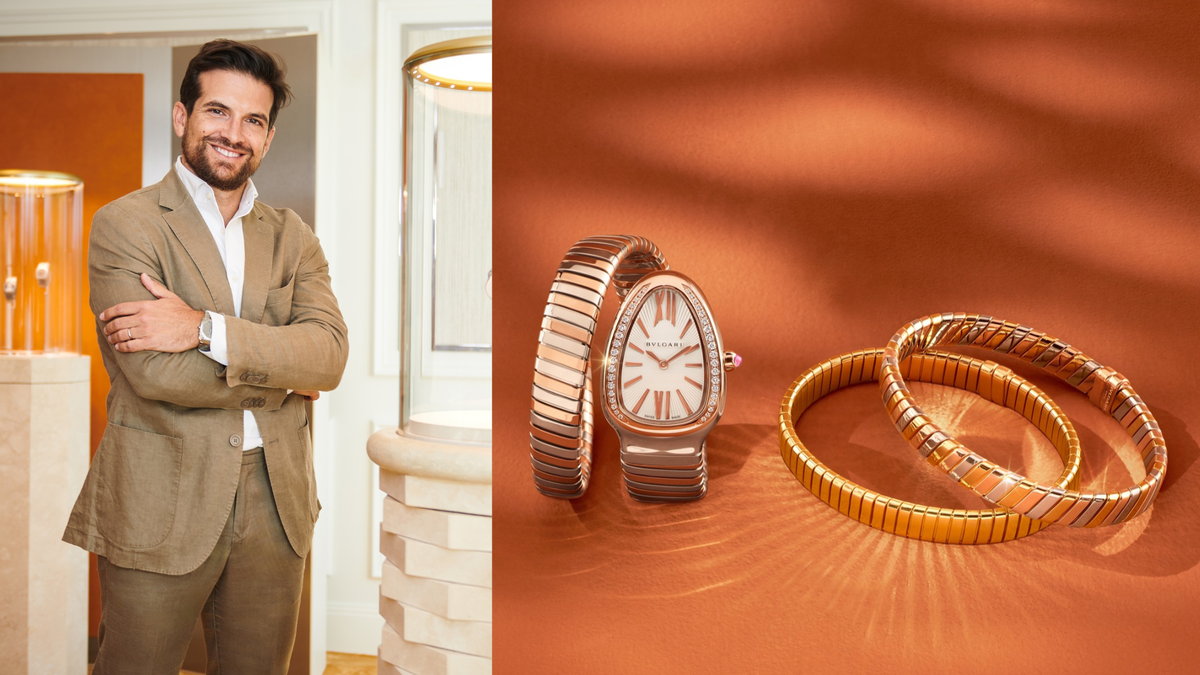
For Bvlgari, this presents an interesting opportunity. A Maison whose identity is deeply rooted in Roman jewellery and Italian design, Bvlgari has spent the last few decades establishing itself as a formidable name in Swiss watchmaking. At the centre of this evolution is Jonathan Brinbaum, Managing Director of the Watch Business Unit, who sees India’s potential not as a passing luxury-market trend, but as a relationship worth building over time.
Speaking about the Maison’s identity, Brinbaum describes Bvlgari as a brand that was born out of jewellery and design, with its Roman heritage continuing to influence its watchmaking language. From the unmistakable curves of Serpenti to the architectural codes informing its collections, the Maison’s aesthetic has always been a defining part of its appeal. But design alone does not tell the entire story. Over the last 25 years, Bvlgari has made a conscious investment in developing its Swiss technical expertise, including its acquisition of Gérald Genta and Daniel Roth in 2000. This investment helped establish the technical foundations for what would become one of its most distinctive watchmaking signatures: ultra-thin movements.
“The last 25 years have been very important and structural for Bvlgari, because we invested in technical Swiss craftsmanship savoir-faire,” he explains. The decision to make thinness its area of expertise eventually led to the Octo Finissimo collection, and its record-breaking achievements in ultra-thin watchmaking. For Brinbaum, these milestones have been more than technical victories; they have helped establish Bvlgari’s legitimacy within the world of fine watchmaking. “We are born in design and now, I would say, supported and boosted by our Swiss savoir-faire,” he adds.

But while pop culture might introduce a new generation to the world of watches, building a lasting relationship with fine watchmaking requires something more. For Bvlgari, India is a market where this relationship has the potential to grow organically. Brinbaum is quick to acknowledge that the country remains a relatively small market for the Maison’s watch business, but believes its long-standing relationship with jewellery gives it a distinctive advantage. “India has a very long-lasting history with jewellery. It is part of the true culture of the Indian people, and we are jewellery-born, so I think the link that we have with that can be strong,” he says.
What interests him, however, is the growing curiosity around watches themselves. Indian collectors, he observes, are becoming increasingly informed about international watchmaking, with a greater appreciation for the technical and creative processes behind a timepiece. Rather than viewing India through the lens of another emerging luxury market, Brinbaum believes it is important to recognise its individual cultural identity. “I don’t like the approach of calling India the ‘new China’. India has its own culture of knowledge when it comes to jewellery. Even the way Indian collectors are approaching watchmaking is very respectful and knowledgeable,” he says. For Bvlgari, the ambition is to nurture this interest rather than chase immediate commercial opportunities. It is, as he puts it, about taking a long-term strategic approach.
The conversation around luxury’s next generation is equally interesting. There is often an assumption that younger consumers are moving away from traditional luxury, choosing experiences and more immediate forms of gratification over objects that come with a significant price tag. Brinbaum, however, sees things a little differently. Having interacted with young watch collectors, he believes their approach to luxury is far more considered than it is sometimes made out to be. They continue to value heritage, craftsmanship and technical mastery, but are less interested in being told what luxury should look like.
“I think young generations are still looking for something with heritage, something that is serious. They are very knowledgeable and approach luxury in a very serious way,” he explains. “At the same time, they don’t like luxury to dictate what taste should be. They want their own design, their own take on things.” It is a distinction that luxury brands would do well to understand. Today’s consumer isn’t necessarily looking to reject established Maisons or their histories; they simply want the freedom to interpret them on their own terms.
In India, Brinbaum believes Serpenti Tubogas is a particularly interesting example of this relationship between a Maison and its audience. With its sculptural silhouette, distinctive coiled form and unmistakable jewellery sensibility, the collection has developed an identity that extends beyond its function as a timepiece. It has become an expression of personal style, particularly among women. What makes this especially significant is that it was never conceived as a watch specifically for a younger audience. Instead, it was a design that remained true to Bvlgari’s identity, and found its own following across generations. “We don’t want to create products like Serpenti Tubogas specifically for young generations. It is simply that the design tapped into something in their taste,” he says.
This brings us back to the delicate relationship between heritage and innovation, something that sits at the heart of Bvlgari’s watchmaking philosophy. For Brinbaum, the two cannot exist independently. A Maison must understand where it comes from, but it cannot allow its archives to become a reason to stop moving forward. He often returns to Bvlgari’s heritage for inspiration, looking at its Roman roots, and architectural codes as a starting point for contemporary interpretations. Octo Finissimo, with its distinctive architectural design and pursuit of ultra-thin watchmaking, is a testament to this approach.

“Heritage is at the core of everything we do. But if you only keep your heritage without modernising it, you are freezing your brand, which is not what I want to do,” he says. “Innovation, for me, is the only way to protect the brand in the future.” It is an interesting perspective in an industry where legacy is often treated as the ultimate selling point. For Brinbaum, however, the real value of heritage lies in what a brand chooses to do with it.
Perhaps that is what makes Bvlgari’s position in the watchmaking landscape particularly compelling. It is a Maison that doesn’t have to choose between its jewellery beginnings, and its ambitions in technical horology. Instead, it brings the two together, allowing Roman creativity and Swiss craftsmanship to inform one another. And as India’s luxury consumer becomes more curious, informed and individualistic, there is room for this kind of watchmaking identity to find its audience.
After all, a great watch is never just about keeping time. It is about the stories we attach to it, the design we recognise ourselves in and, sometimes, the legacy we choose to carry forward. For Bvlgari, the challenge is to keep creating those stories without ever standing still.