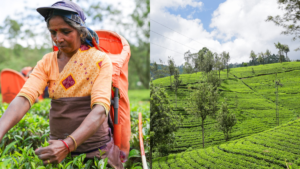




It was 8.30 in the morning at Somerset Estate, and Mary Theresa could pick tea faster than I could properly see it. Two leaves and a bud, nothing more, nothing less, disappeared into the basket on her back with a rhythm so practised it looked automatic. It wasn’t. By the end of the week, the illusion that tea is a simple, everyday drink produced by equally simple means would have completely fallen apart.

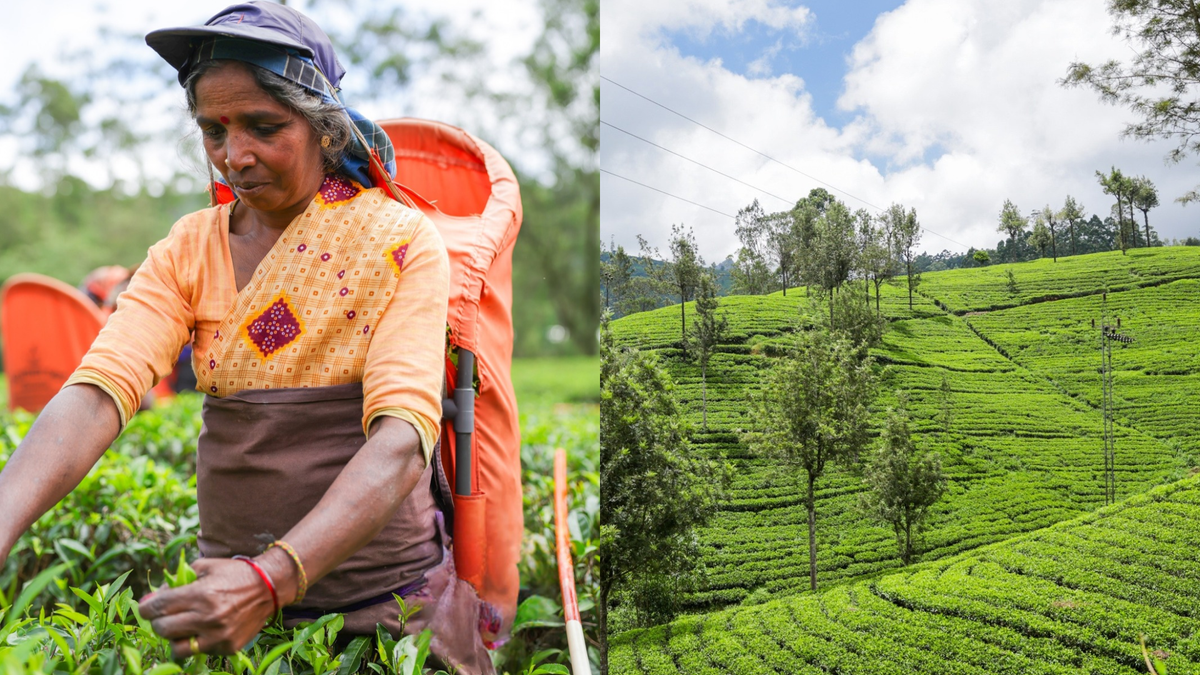
Harvesting tea looks, from the window of a moving car, almost idyllic: women in the morning mist, baskets on their backs, endless green hills that seem designed for postcards. Standing in the middle of the field is another matter entirely. Tea plucking is unforgivingly precise. A rod is laid across the top of the bush as a guide. Anything above it is ready to be picked; anything below remains untouched. The aim is always the same: two leaves and a bud, removed together in one clean motion.
Mary Theresa made it look absurdly easy. I did not.
After a brief demonstration, I was handed a basket and invited to try. Twenty minutes later, I looked down to find a small, dispiriting pile of individual leaves, each separated from the others as though they had collectively decided to go their own way. A proper plucker keeps the bud and its two leaves attached. Mine had become botanical confetti. I will not be quitting my day job.

The failure was oddly useful. My shoulders already ached. For the first time, I had physically felt the work behind a cup of tea. It takes roughly four to five kilograms of freshly plucked leaf to produce a kilogram of made tea, and the people on the estate work from 6.30 in the morning until four in the afternoon. From a distance, the work had looked almost meditative. Up close, it revealed itself as skilled manual labour disguised as grace.
That lesson became the thread running through the week I spent in Sri Lanka attending the 95th session of the Dilmah School of Tea’s Advanced Tea Inspiration programme. Days moved between estates, factories, tasting rooms and classrooms, each dismantling another assumption about one of the world’s most familiar drinks.
One statistic stayed with me: tea contains more than 600 known aromatic compounds. It sounded absurd until I found myself staring at rows of tasting cups, trying, and frequently failing, to distinguish citrus from hay or malt from peach.
Each day involved tasting close to ten teas. Slurping, it turned out, was compulsory. Apparently, tea deserves the same indignity usually reserved for a good wine. Pulling the tea quickly across the tongue aerates it, carrying aroma towards the nose where much of flavour is perceived. Before long, the noisy tasting room had stopped sounding strange.

We were also reminded that tea is hygroscopic, absorbing moisture and odours from whatever surrounds it. Store it carelessly and those smells become part of the cup. The same plant grown in Sri Lanka’s Nuwara Eliya and in Darjeeling produces entirely different teas, shaped by altitude, rainfall and soil. Tea has its own vocabulary of terroir. Most of us simply never learn it.
Those lessons became clearer inside the factory.
Photography wasn’t permitted inside the factory, but the smell arrived first: warm, grassy and faintly sweet. Freshly plucked leaves passed through withering, rolling, oxidation and drying before emerging almost unrecognisable from what had arrived from the estate only hours earlier.
Standing just outside was Dilhan Fernando, chairman and chief executive of Dilmah, the tea company founded by his father, Merrill J. Fernando. Watching workers move through the factory, he smiled when I mentioned the aroma.
“How can anyone forget it?” he asked. For Fernando, the scent is inseparable from childhood. His earliest memories are of his father’s small tea estate, where he first learnt that tea begins long before it reaches a cup. “At the heart of it, we don’t make the tea,” he said. “Nature does that. Our job is to harness that and bring it to the tea drinker.”
It was a sentiment that explained much of what I’d seen over the previous few days. For Fernando, conversations about tea rarely stayed on flavour or production. They drifted instead towards the people who grow it. Estate workers, he said, are less like employees than extended family, people whose names he still remembers and who, on his visits, still coax him into singing traditional Sri Lankan songs in the fields.

“If you don’t create value in the social dimension, and value in the natural dimension, then you have no right to create value in the commercial dimension,” he said. “Otherwise, that’s extraction.”
That philosophy has shaped Dilmah since its beginnings. Founded on the idea that tea should be grown, packed and exported from Sri Lanka, the company has long argued that more of its value should remain where it is produced. Nearly four decades later, that grower’s perspective continues to shape the business.
If the mornings were spent understanding where tea comes from, the evenings explored where it could go.
One evening paired tea with live music. Another paired it with cheese, followed by an omakase dinner. The combinations were unexpected, but they all pointed to the same idea: tea could be appreciated with the same care usually reserved for wine.
That spirit of experimentation is something Amrit Fernando, who leads innovation at Dilmah and represents the family’s third generation, hopes more people will embrace. If his father speaks about tea as heritage, Amrit speaks about possibility. For him, tea isn’t something to be confined to a teacup. It can find its way into a protein shake in the morning, a cocktail in the evening, or wherever curiosity takes it.
“It’s your imagination that limits you,” he said.
That philosophy now extends to India through Thambapanni, Dilmah’s first range of Indian teas. Each tea, personally tasted and named by Dilhan Fernando, who has also written the tasting notes that accompany it. It is an unusually personal touch, reflecting the same emphasis on origin, character and the grower’s perspective that shaped the week.
Yet, for all of that, Dilhan has little interest in competing with masala chai. In fact, he speaks about Indian tea traditions with obvious admiration. “There’s no point in us, as Sri Lankan growers, bringing an Indian tradition to India and competing on Indian tradition,” he said. “That would be quite presumptuous.”
Instead, he hopes to broaden the conversation around tea, offering another way of appreciating it without replacing the rituals that already exist. By the end of the week, I still couldn’t identify six hundred aromatic compounds or pluck two leaves and a bud without making a mess of it.
Tea no longer began with a kettle.
It began with Mary Theresa, moving through the mist with a speed and precision I could never quite match. It carried the memory of factory floors scented with warm, drying leaves, tasting rooms where a loud slurp was a mark of professionalism and conversations that wandered as naturally from flavour to farmers as they did from rainfall to responsibility.
I don’t imagine I’ll ever identify six hundred aromatic notes. But I doubt I’ll ever drink another cup without thinking about the two leaves and a bud that began it all.