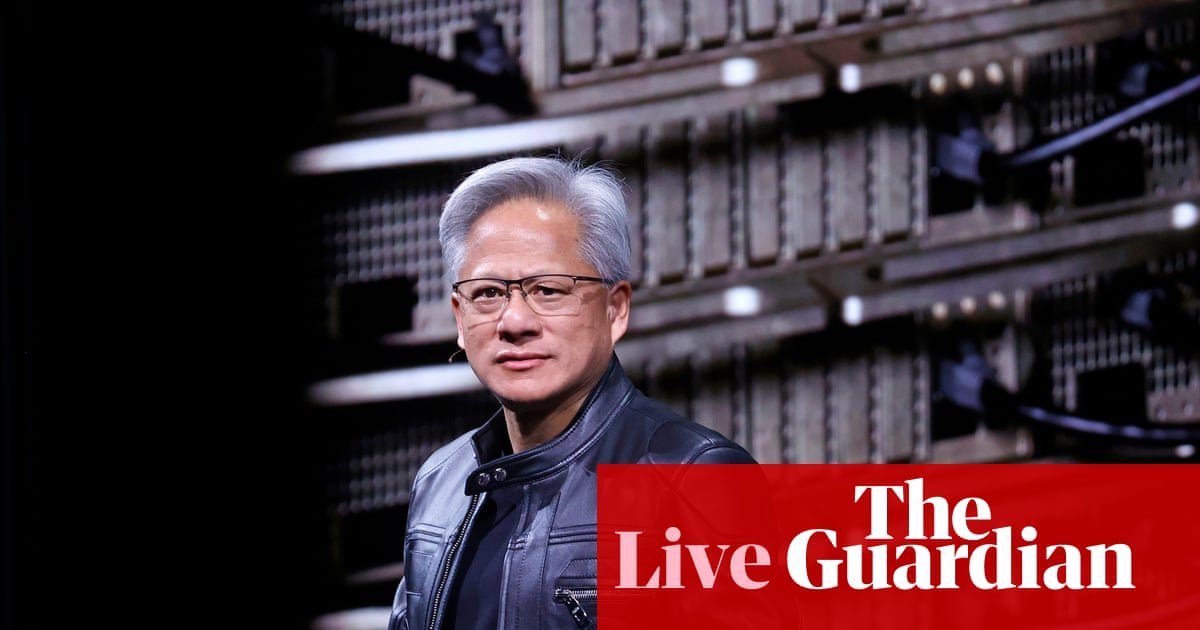
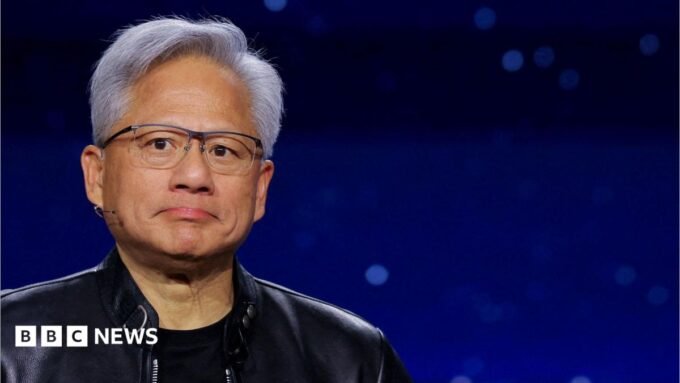
Growing calls for Congress to crackdown on chip exports to China
US House Speaker Mike Johnson has said there is a growing consensus in Congress on limiting chip exports to China after the resignation of Nvidia CEO Jensen Huang.
Huang stepped down after reports of a romantic relationship with a businesswoman whom US authorities suspect of spying for the Chinese government. The case has revived claims among China critics in Washington that US export policies are too weak, boosting calls for more restrictions.
In the last week, representatives from both sides of the aisle have called for tougher restrictions on China’s access to advanced AI chips; chips that could underpin China’s surging AI development.
House Speaker Mike Johnson speaks with reporters outside his office on Capitol Hill. Photograph: Mariam Zuhaib/AP
Nvidia’s advanced AI chips are widely used to develop cutting-edge AI models, making the company key to the US race against China to build superior AI systems. The US has sought for years to limit China’s access to Nvidia’s chips because it wants its own companies to stay ahead in the race.
“The export controls on chips to China has been a big issue around here,” Johnson told reporters at the US Capitol, adding he favoured limiting China’s access to the advanced technology. “I think there’s a developing consensus in Congress that is an important position to take.“
Congressional Republicans are keen to attach new restrictions on exporting advanced AI chips to China in the annual defense authorisation bill, a must-pass measure that funds the military and typically attracts bipartisan support, according to a Senate aide, who spoke to Reuters on the condition of anonymity.
Key events
Republican Senator Jim Banks has said that for the last two years, US lawmakers have been pushing to stop America’s “high-end computer chips from being exported to China.”
Banks said he hoped that Jensen Huang would come and testify before Congress.
Nvidia opposed my legislation a year ago. They opposed other export control laws.
We have a lot of bipartisan questions and concerns about what’s happened over the last year that would allow some of these issues to continue to occur.
Continued from the last post:
A growing number of lawmakers criticised Lutnick for the administration’s refusal to add dozens of Chinese companies to a key US trade blacklist. In June, Reuters reported the Trump administration had held off from adding China’s AI startup DeepSeek, memory chipmaker CXMT and more than 100 other companies flagged as national security risks to the trade blacklist.
The US has not posted any additions to that list since October 2025, the longest stretch between new postings in more than a decade. Reuters earlier reported that the US commerce department has not added new Chinese companies to that list for fear of escalating tensions between the US and China.
US Senator Elizabeth Warren speaks in September. Photograph: Evelyn Hockstein/Reuters
“Secretary Howard Lutnick and Under Secretary Jeffrey Kessler must explain why they have not closed export control loopholes and act today to ensure our advanced technology is not fuelling China’s military,” Democratic Senator Elizabeth Warren said.
Warren, who will chair the senate banking committee starting in January, wrote to Lutnick, secretary of state Marco Rubio and White House chief of staff Stephen Miller, telling the administration to preserve all documents related to Nvidia’s exports of advanced AI chips to China and related national security risks.
Separately, US Senator Ron Wyden of Oregon and Representative Richard Neal of Massachusetts, the top Democrats on the Senate finance committee and House ways and means committee, wrote to Lutnick on Thursday, saying they were investigating the administration’s approval of sales of Nvidia’s advanced AI chips to Chinese companies “with concerning links to the Chinese government, military, and sanctioned entities.”
The lawmakers also questioned Trump’s decision to grant Nvidia permission to sell its advanced H200 AI chips to China in December 2025 in exchange for a cut of the export sales through a Commerce Department action, which they called “an unconstitutional export tax.“
Jensen Huang supported more exports to China, despite repeated calls from China hawks in both parties to crack down on Beijing’s access to the technology.
Why is US commerce secretary Howard Lutnick in the spotlight?
Republican Tim Scott – the chair of the US Senate banking committee – has called on Howard Lutnick to testify over the Nvidia scandal, as senior White House officials reportedly mull whether the commerce secretary should be pushed out of the Trump administration.
As the fallout over the loss of one of the AI industry’s most significant figures continues, Lutnick has faced accusations he has not done enough to restrict chip shipments to China.
The White House and commerce department did not immediately respond to requests for comment after Reuters reported White House officials were discussing Lutnick’s future. Earlier on Thursday, a White House official said Donald Trump “maintains complete confidence in the secretary and his ability to carry out the position”.
Jensen Huang listens to Howard Lutnick at the G20 Innovation Ministerial summit in September. Photograph: Jonathan Drake/Reuters
The New York Times reported on Thursday that Lutnick has clashed with other Trump officials over how to regulate sales Nvidia’s chips – and that he has faced accusation from inside the administration that his department is “too cozy with Nvidia and its co-founder, Jensen Huang” and failed to “adequately police the firm’s chip sales to China”.
A number of Republicans have gone public with their demand that Lutnick explain his agency’s apparent failure to block Megaspeed – the company linked to Alice Huang – from buying advanced chips. US officials had reportedly started to monitor Alice Huang after suspecting the firm she worked for was diverting powerful Nvidia AI chips to Chinese firms, in potential violation of export restrictions.
“The obvious question is why did he choose to sell advanced chips?,” Republican Senator John Kennedy said in an interview on Wednesday.
Secretary Lutnick needs to answer that in front of God and country. If I were he, I’d call a press conference this afternoon and explain what happened and why he agreed to sell ‘em chips, and I would stop doing it.”
Kate Lamb
As questions abound about Megaspeed, Singaporean authorities said in a statement on Thursday that Alice Huang, the Chinese woman at the centre of the global spy drama had been barred form re-entering the city state after a 2025 investigation into the company.
The ministry of home affairs said it had held Alice Huang’s passport from June 2025 until February over “potential false declarations” related to Megaspeed, which is registered in the country.
Eventually she was released with a stern warning, but she has been barred from re-entering the country.
Megaspeed International’s office in the Ocean Financial Centre in Singapore. Photograph: Taryn Ng/AFP/Getty Images
Huang was being investigated in Singapore as part of a larger probe into several companies, including Megaspeed.
Singapore police said last October they were investigating Megaspeed over “suspected breaches of our domestic laws” after a US senator requested the commerce department investigate whether the firm had diverted Nvidia chips.
In Taiwan, the interior minister told lawmakers on Wednesday that Alice Huang was also now barred from entering the territory.
Kate Lamb
From a lottery retailer in rural Australia to a dilapidated storefront in Kuala Lumpur, and an unexpectedly quiet office in Singapore, as the Nvidia scandal has unfolded more information has emerged about the activities of cloud computing firm Megaspeed, and its former director Alice Huang.
On its website, Megaspeed, which is registered in Singapore, describes itself as a Nvidia cloud partner in the Asia-Pacific region.
In the past three years, Megaspeed has been one of Nvidia’s biggest foreign customers, purchasing nearly $5bn in AI chips and advanced hardware.
But questions have been raised about the seeming incongruity between its corporate presence and business activities.
Singaporean news outlets, The Straits Times reported that Swiftdata, which owns Megaspeed, has a registered business address that an interior design firm says it has occupied for over four years.
When the New York Times visited Megaspeed’s Singapore headquarters last year, located in the central business district, only two employees were present.
In Malaysia, one of Megaspeed’s offices was reportedly a dilapidated store front in Kuala Lumpur. Another was located in a shopping mall, the Times reported. When one employee emerged in the mall, she was asked what the company did. “It’s not clear,” she responded.
The convenience store where Megaspeed has a registered business, in the regional town of Seymour, inVictoria, Australia. Photograph: Melanie Burton/Reuters
Meanwhile in Australia, Reuters tracked corporate filings of Megaspeed affiliates that led it to a man in his twenties born in Shanghai.
The individual is also registered as director of Megaspeed’s Malaysian, Indonesian and Thai units, according to Reuters.
Unable to contact him, Reuters tracked his home address to a small newsagent and lottery retailer in a regional town outside Melbourne where they found a woman who said she was his mother.
The woman said she had run the business for about 16 years, that her son was based in Shanghai and had nothing to do with the Singaporean company.
Some US lawmakers are pushing for a swathe of new legislation that would affect the export of AI chips from America.
The AI Overwatch Act would give Congress more power over advanced AI chip exports.
The Chip Security Act would require companies to track the location of advanced AI processors to prevent smuggling.
The Match Act would pressure US allies to restrict sales and maintenance of advanced chipmaking equipment destined for China.
The Remote Access Security Act would give the Commerce Department the tools to stop Chinese firms from renting overseas data centers to access Nvidia chips.
US representatives from both sides of the aisle have been questioning Donald Trump’s decision to grant Nvidia permission to sell its advanced H200 AI chips to China in December 2025 in exchange for a cut of the export sales.
Trump’s close ties with billionaire Jensen Huang have also come under renewed scrutiny after revelations about the former Nvidia CEO’s affairs, including with a businesswoman alleged to be a spy for China.
Over the past two years, Huang has voiced support for the Trump administration’s AI agenda and met the Republican leader many times, lobbying for looser restrictions on Chinese access to Nvidia’s sophisticated AI chips. Huang and the White House have argued that continuing US sales to China would keep Chinese customers reliant on US technology.
Democratic and Republican lawmakers are now calling for a halt to exports of advanced AI chips to China.
Stocks in Asia rose slightly on Friday after a turbulent week dominated by the revelations of Jensen Huang’s extramarital affairs that culminated in the Nvidia CEO’s resignation.
His exit has plunged the chipmaker into crisis and sent shock waves through the AI industry.
But a commonly used index of Asia-Pacific shares outside Japan was up 0.26% on Friday, reversing some of its 1.3% fall from the previous session. South Korea’s Kospi rose 2.35% while Japan’s Nikkei added 1.4%.
A dealer watches computer monitors near the screens showing the Korea Composite Stock Price Index (KOSPI) on Friday. Photograph: Lee Jin-man/AP
Nvidia shares fell 3% in after-hours trading, while those of its customers, including South Korea’s Naver, extended declines on Friday, with Naver down 2.75%.
“[Huang’s] departure leaves a vacuum that will be difficult to fill … We do not assume existing commitments change, but new deals could take longer or require more compensation as investors look for reassurance about Nvidia’s role,” analysts at JP Morgan said in a note.
The bigger implications are for the rest of the AI trade, particularly GPU financing and infrastructure deals in which Nvidia would presumably be involved as a supplier, investor or provider of contractual support.”
Jon Zauderer, Citi’s head of specialist sales and a TMT specialist, said competitors such as AMD, Arista and Broadcom could benefit from the Nvidia fallout.
If you think about the uncertainty that’s created about a potential management change, investors are going to look for alternatives.”
Analysis: Jensen Huang built an AI kingdom. Now he’s gone, will Nvidia’s ramparts be breached?
Aisha Down
Can the AI economy survive without its “central bank”? What does Jensen Huang’s fall mean for the world’s second-most valuable company, and what might a tremor in its fortunes mean for the world?
Nvidia’s sky-high valuation is based on the fact that it designs and sells the advanced AI chips, called graphics processing units (GPUs), that underpin the AI economy. Without these, AI models such as ChatGPT and Claude could not be trained and would not run.
This has made the chipmaker arguably the most important player in AI and, at times, the most valuable company in the world. Huang’s departure sent shares in Nvidia plunging 13% in early trading.
Jensen Huang speaks to Donald Trump and US House Speaker Mike Johnson. Photograph: Kevin Lamarque/Reuters
But what makes Nvidia irreplaceable – and far more integral to the AI economy – is its web of relationships, most of these led by Huang himself.
One aspect of this is Nvidia’s complex web of ties with the companies actually building AI infrastructure, a mess of circular finance that implicates US tech giants and many of the world’s governments.
Calls for US commerce secretary Howard Lutnick to testify over Nvidia
The US Senate banking committee Chair – Republican Tim Scott – has sent letters to Donald Trump’s commerce secretary Howard Lutnick, along with Jensen Huang, asking them to testify.
A growing number of US lawmakers have criticised Lutnick, asking whether the government was properly overseeing Nvidia’s exports to China.
US commerce secretary Howard Lutnick waves after disembarking from Marine One earlier this week. Photograph: Bonnie Cash/EPA
“Recent reports raise serious concerns about our national security and the protection of sensitive US technology,” Scott wrote on X. “I am requesting that Nvidia CEO Jensen Huang and Commerce Secretary Howard Lutnick testify before the Senate Banking Committee.”
Scott said he would consider subpoenaing Huang if he does not voluntarily appear. “The American people deserve answers,” Scott said.
Senior Democrats have said Congress must demand answers from Jensen Huang and Nvidia, after the CEO resigned on Thursday.
Senate Democratic leader Chuck Schumer has said Huang and Nvidia must answer whether US national security has been put at risk, adding that the Trump administration also must answer for what it did once it learned about Huang’s relationship with a suspected Chinese spy.
Chuck Schumer speaks at a press conference earlier this week. Photograph: Nathan Posner/Anadolu/Getty Images
Among the questions that need to be answered is what the president knew when he personally invited Huang aboard Air Force One on a state visit to Beijing earlier this year, Schumer said in his social media post on X.
Americans deserve to know that those at the highest levels of power are putting America first, not their bottom line or their personal friendships.”
House Democratic leader Hakeem Jeffries has said he is demanding a classified briefing for all members of Congress about the Nvidia situation.
Jeffries said to the extent that national security may have been compromised, Americans deserve answers, adding that Huang’s resignation was the “right thing” to do.
Nvidia’s chief financial officer, Colette Kress, has been named as interim CEO while the board searches for a successor.
Her ascension marks the end of Jensen Huang’s 33 years at the helm of the company he co-founded.
Kress, 59, joined Nvidia in 2013 after nearly 25 years at companies including Cisco and Microsoft. She is a regular contributor to the company’s quarterly earnings calls, and has overseen Nvidia’s rise from a niche firm geared toward video game chips to a trillion-dollar AI juggernaut.
“Colette has helped lead Nvidia through a period of extraordinary growth and has a deep understanding of our business, customers, operations and financial position,” Harvey C Jones, the newly named chair of Nvidia’s board of directors, said in a statement on Thursday. “The board has full confidence in Colette and the leadership team.”
Kress wrote that Nvidia’s “strength has always come from its people” and that she was “committed to building on the extraordinary foundation Jensen created over the last 33 years”. She will serve as both the CEO and interim CFO until the board names a permanent successor.
Donald Trump called Jensen Huang two days before he stepped down as CEO of Nvidia and urged him to fight for his job, the New York Time has reported.
The president’s close ties with the Huang have come under renewed scrutiny after revelations about the former Nvidia chief’s affair with an alleged Chinese spy were revealed.
Over the past two years, Huang has voiced support for the Trump administration’s AI agenda and met the Republican leader many times as Nvidia sought to sell advanced chips to the Chinese market and lobbied for looser restrictions on Chinese access to Nvidia’s sophisticated AI chips.
Jensen Huang, his wife, Lori Huang, and Apple’s Chair Tim Cook attend the state dinner for Xi Jinping in September. Photograph: Brendan Smialowski/AFP/Getty Images
On Thursday the president sat down for a lengthy podcast interview with the sports pundit Stephen A Smith where he expressed sympathy for Huang.
Trump defended Huang, who sat at his table at a White House state dinner for China’s president, Xi Jinping in September, as “a tremendous talent”.
“I can tell you this, somehow he’ll end up in his feet,” Trump added. “I mean, I know him; I know him pretty well. I always thought of him as a fine man.”
“I spoke to him yesterday,” the president continued. “He’s he’s going through hell.”
Flowers were placed outside Nvidia’s headquarters in Santa Clara, California on Thursday afternoon; an apparent tribute to former EO Jensen Huang.
Flowers outside the Nvidia HQ. Photograph: Haven Daley/APThe flowers were left after CEO Jensen Huang resigned after the revelation of two extramarital affairs. Photograph: Manuel Orbegozo/ReutersNvidia got its start when three engineers – Huang, Chris Malachowsky and Curtis Priem – gathered in 1993 at a Denny’s diner in San Jose, California, not farm from where Nvidia’s office is today in Santa Clara. Photograph: Manuel Orbegozo/Reuters
Nvidia immediately named Colette Kress, the company’s chief financial officer, as the interim CEO. It’s possible she could stay on permanently, but the company could also name another candidate for the full-time role.
Names that have been floated include Ian Buck, who manages Nvidia’s AI hardware and software products, and Rene Haas, a former Nvidia employee and the current CEO of Arm Holdings, a UK-based chipmaker.
Rene Haas, chief executive officer of Arm Holdings. Photograph: Bloomberg/Getty Images
Whoever takes over from Huang will have tremendous sway in the burgeoning world of artificial intelligence. The entire AI ecosystem relies on Nvidia, which engineers advanced chips used to train AI models and power companies such as OpenAI, Anthropic and Google. Nvidia is also a central driver of the US economy and one of the world’s most valuable companies, with a market cap of around $4tn.
The board said it was starting a search for Huang’s permanent replacement and is considering internal and external candidates.
Lisa Su attends an event in Washingon last month. Photograph: Evan Vucci/Reuters
Haas, the CEO of Arm Holdings, is also well-known at Nvidia, having worked there for seven years as a vice-president and general manager before joining Arm in 2013. Lisa Su, the CEO of chipmaker AMD, is also being named as a possible replacement for Huang. Her company is Nvidia’s most direct and fierce competitor; she’s also a distant cousin to Huang.
Donald Trump has reacted to the resignation of Huang by saying Huang “has done a fantastic job,” and adding, “There is only one man to take his place – TIM COOK of Apple.”
“A Legend replaces a Legend!” Trump wrote on his social media site of Cook, who is Apple’s former CEO.
Trump says it is not yet determined whether Alice Huang was a spy
Donald Trump has reiterated that it is not yet determined whether Alice Huang was a spy.
In an interview released late on Thursday, the President was asked whether Jensen Huang should have resigned.
The big thing is, was the woman a spy? And I don’t know if that’s been determined yet. But if the woman was a spy, yes. If the woman was not a spy, perhaps it would be different.”
On Sunday, Jensen Huang admitted he had been unfaithful to his wife, Lori, without naming anyone involved.
Alice Huang attending a dinner with Nvidia CEO Jensen Huang in Taipei last year. Photograph: CTI/Reuters
Huang has denied any knowledge that Alice Huang allegedly worked for the Chinese government. The pair were seen together around the world, dining in restaurants and attending meetings, over the past few years.
Earlier on Thursday US attorney general Todd Blanche said that the Justice Department has not yet reached a conclusion on whether Alice Huang was a Chinese spy.
Blanche said at a press conference that “of course” the FBI was investigating reports that Alice Huang was working for the Chinese government.
Beijing has denied Alice Huang is a spy and Huang herself has not spoken publicly.
Growing calls for Congress to crackdown on chip exports to China
US House Speaker Mike Johnson has said there is a growing consensus in Congress on limiting chip exports to China after the resignation of Nvidia CEO Jensen Huang.
Huang stepped down after reports of a romantic relationship with a businesswoman whom US authorities suspect of spying for the Chinese government. The case has revived claims among China critics in Washington that US export policies are too weak, boosting calls for more restrictions.
In the last week, representatives from both sides of the aisle have called for tougher restrictions on China’s access to advanced AI chips; chips that could underpin China’s surging AI development.
House Speaker Mike Johnson speaks with reporters outside his office on Capitol Hill. Photograph: Mariam Zuhaib/AP
Nvidia’s advanced AI chips are widely used to develop cutting-edge AI models, making the company key to the US race against China to build superior AI systems. The US has sought for years to limit China’s access to Nvidia’s chips because it wants its own companies to stay ahead in the race.
“The export controls on chips to China has been a big issue around here,” Johnson told reporters at the US Capitol, adding he favoured limiting China’s access to the advanced technology. “I think there’s a developing consensus in Congress that is an important position to take.“
Congressional Republicans are keen to attach new restrictions on exporting advanced AI chips to China in the annual defense authorisation bill, a must-pass measure that funds the military and typically attracts bipartisan support, according to a Senate aide, who spoke to Reuters on the condition of anonymity.
Opening summary
Jensen Huang is expected to testify before the US Congress in the next fortnight, after the Nvidia CEO stepped down from the multi-trillion dollar company on Thursday, plunging the chipmaker into crisis and sending shock waves across the global AI industry.
House foreign affairs chair Brian Mast, a Florida Republican, told reporters on Thursday that congressional staff spoke to Nvidia on Wednesday night about a date and location for Huang’s testimony.
Mast and two other leading House Republicans asked Huang last week to brief them behind closed doors about his relationship with Alice Huang, an alleged Chinese spy.
Huang has denied any knowledge that Alice Huang allegedly worked for the Chinese government. The pair were seen together around the world, dining in restaurants and attending meetings, over the past few years.
The outside of the Nvidia headquarters in Santa Clara, California. Photograph: Manuel Orbegozo/Reuters
It has been reported that Jensen Huang also had an intimate relationship with two Nvidia employees, which added to the pressure on Huang, with the company’s board calling a meeting late on Wednesday to discuss the chief executive’s future.
Huang’s exit could have far-reaching consequences for US chip export policy and the broader AI ecosystem, given the ex-CEO’s push to preserve access to the Chinese market as well as his close ties with US president Donald Trump.
Jensen Huang resigned on Thursday as chief executive of Nvidia after reports of extramarital affairs with an alleged Chinese spy and a company employee, bookending a stunning fall from grace of one of the leading figures of the AI boom. He will be replaced on an interim basis by Nvidia’s chief financial officer, Colette Kress, until a successor is named.
Shares in the chipmaker plunged by 14% when Wall Street opened, after Huang’s departure was announced and ricocheted through the global economy, before recovering tofinish more than 4% lower as uncertainty about Nvidia’s future leadership troubled investors eased somewhat.
US House Speaker Mike Johnson said there was growing consensus in Congress on limiting chip exports to China after the scandal. Lawmakers from both parties have called for tougher restrictions on China’s access to advanced AI chips, threatening access to chips that underpin China’s surging AI development.
On Thursday came reports that the ousted former CEO had an intimate relationship with a second employee. The revelation, reported by Reuters, follows allegations of two other extramarital affairs that led to Jensen Huang’s dramatic resignation – one with Alice Huang, an alleged Chinese spy, and another with Kimberly Powell, Nvidia’s vice-president of health care. Powell has been approached for comment. On Sunday, Jensen Huang admitted he had been unfaithful to his wife, Lori, without naming anyone involved.
A statement from Nvidia’s board of directors confirming Huang’s departure did not mention the spying scandal and personal conduct revelations, instead paying tribute to Huang’s “profound” contributions to the company he co-founded. “Jensen’s contributions to Nvidia are profound. Nvidia is one of the most consequential technology companies in the world. The board and the company thank Jensen for his immeasurable contributions to the company and the industry,” the statement said. It added that Huang had resigned as chief executive, president and Nvidia board member “effective immediately”.
Donald Trump, who had defended Huang at first as the scandal threatened to overwhelm Nvidia co-founder, quickly moved on to potential successors on Thursday, posting on social media that he should be replaced by Tim Cook, Apple’s former chief executive and current executive chair. “NOW THAT Nvidia CEO JENSEN HUANG, who has done a fantastic job, has resigned, there is only one man to take his place – TIM COOK of Apple,” Trump wrote, adding: “A Legend replaces a Legend!” Nvidia’s board directors said it would consider internal and external candidates for the chief executive role, with Cook featuring among potential runners and riders before Trump’s intervention. Rene Haas, the chief executive of Arm Holdings, a UK-based chipmaker, has also been mooted, along with Lisa Su, the chief executive of the chipmaker AMD.