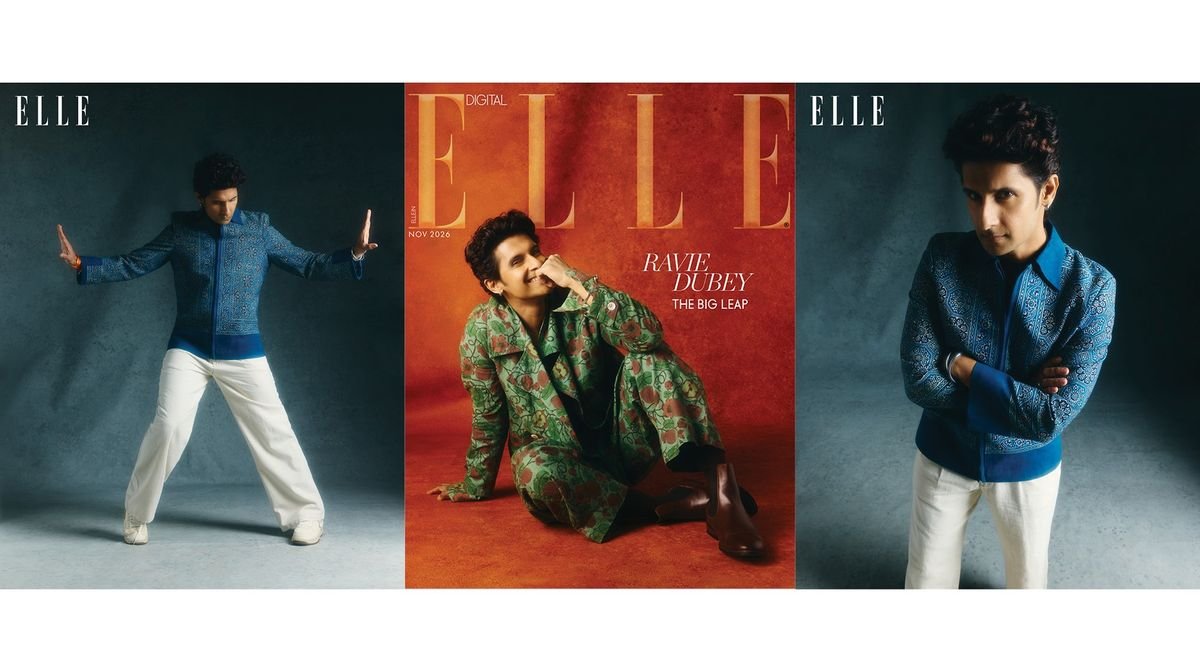
If you grew up in an era when watching cable television with your family was a weekend ritual, chances are Ravie Dubey was a familiar face. I’ve grown up watching him on Indian reality television shows like Khatron Ke Khiladi and Nach Baliye (little me was quite the fan), as well as fiction shows like Jamai Raja. I can still recall the times when my mother would scold me to switch off the television at 9 pm because it was a school night, while I was busy watching yet another one of Dubey’s shows. Back in the day, you would see him just about everywhere.
On Ravie Dubey: Mint orchard coat and trousers, both by Abhichiq; Classic gold ring by Ritika Sachdeva; Chelsea boots by The Alternate.
What made him particularly interesting, however, was that he rarely appeared in the same capacity twice. On some days, he was an anchor, while on others, he was a television star or a dancer on Nach Baliye. From modelling and acting to hosting, reality television, digital entertainment and production, Dubey’s career has been anything but linear. And just when you think you’ve seen him explore it all, he is now appearing as Lakshman in the much-anticipated Ramayana, stepping into a role that carries an entirely different kind of responsibility. If there is one thing that connects these seemingly different chapters, it is his appetite for new experiences.
The Art Of Moving On
On Ravie Dubey: Ajrak handblock jacket and pants, both by Motife; Silver coil men’s bracelet by Arvino; Cube ring by ZACH.
When I ask him how he manages to move between so many creative avenues without confining himself to one, he lets me in on a little secret. “I am only excited about something that I’m doing till the time I get an experience out of it that completely satiates me. And after that, I generally move to a different vertical entirely.”
It is a pattern he has followed throughout his career. He began with modelling but soon found himself drawn towards acting. Between 2005 and 2007, he appeared in nearly 80 commercials before consciously moving towards longer-format storytelling. Television fiction became his next big chapter, one that continued until 2017. His stint on Jamai Raja proved particularly fulfilling, offering him the opportunity to perform, learn and grow as an actor. “Jamai Raja was a show that really satiated me. I thought that I could not get a better experience. It gave me an incredible opportunity to perform and an incredible opportunity to learn. It kept me on the front foot throughout,” says Dubey. Yet, even at the height of his television career, he knew when it was time to move on.
February 2017 marked his last fiction outing on Indian television, and instead of looking back, he turned towards non-fiction. Shows like Rising Star offered him an entirely different kind of learning, particularly because of their live format. “Whatever could go wrong sometimes did go wrong, but despite that, you salvage the situation,” he recalls, describing it as an experience that strengthened his skills in ways scripted television hadn’t.
On Ravie Dubey: Ajrak handblock jacket and pants, both by Motife; Silver coil men’s bracelet by Arvino; Cube ring by ZACH.
Digital storytelling followed, although his interest in the space eventually led him elsewhere. Along the way, he explored unconventional formats, including Matsya Kaand, where he had the opportunity to play 11 characters. Production, meanwhile, became another creative avenue he could explore alongside his wife, Sargun Mehta. For the two of them, storytelling was no longer limited to being in front of the camera. It was also about creating worlds and putting their own voices out there. When I previously spoke to Mehta, she shared a similar vision for their production company, Dreamiyata Entertainment, and the stories they hoped to tell together.
An Engineer At Heart, A Storyteller By Choice
“Engineering was not an easy journey at all. I was definitely not cut out for it,” says Dubey. Before the cameras, scripts and production sets, there was engineering. While it wasn’t exactly a match made in heaven, he believes the experience shaped him in ways he appreciates much more today.
Today, he finds himself particularly fascinated by the intersection of science and spirituality, while his understanding of technology has also become useful in his role as a producer. With AI opening up new possibilities in storytelling, he sees his engineering background as an unexpected ally. As it turns out, even the paths that don’t quite work out can have their uses.
Portraying The Divine
On Ravie Dubey: Mint orchard coat and trousers, both by Abhichiq; Classic gold ring by Ritika Sachdeva; Chelsea boots by The Alternate.
His latest creative chapter, however, comes with a different kind of responsibility. With Ramayana, the conversation shifts from reinvention to reverence. Bringing a contemporary perspective to a story so deeply rooted in India’s cultural and spiritual consciousness requires a certain sensitivity. “The archetype is already set, and that archetype is already very inspiring,” he explains. He believes that actors must return to the scriptures, read and reread them, and understand the essence of the characters before attempting to portray them. For him, the process calls for surrender and devotion, allowing the essence of the deities to guide every movement and dialogue delivery. Technique and craft remain important, but they are not the most significant tools. “The most important tool in telling a story like this is basically surrender to the deities.”
The Discipline Behind The Scenes
Away from the demands of storytelling and production, another constant in his life is fitness. He sees it as an exercise in discipline, one that gradually spills into other aspects of life. According to him, no shortcut can replace the consistency required to stay fit. The physical benefits are only one part of the equation, with mental and spiritual fitness becoming equally important outcomes of the process.
Perhaps that’s what makes Dubey’s journey particularly interesting. Across acting, hosting, production and now one of Indian cinema’s most anticipated adaptations, he has consistently sought out experiences that challenge him to grow. There is discipline behind the reinvention, but also a genuine curiosity about what comes next.
In an industry that often rewards people for finding a successful formula and sticking to it, Dubey seems far more interested in discovering what happens when you don’t.