Artists reimagine Kanjeevaram saris in ‘Journey and Exile’ showcase at Asian Art Museum, USA

“A sari is never cut to fit one specific woman who drapes it, but is a treasured inheritance. Each sari has a story to tell. The sari—18 feet in length—is an unstitched marvel worn by women across all walks of life, from labourers to queens,” says artist and curator Vara Ramakrishnan.
She recently showcased 34 saris featuring artwork by artists and master weavers for a one-day exhibition held at the Asian Art Museum, San Francisco, USA.
The theme was Journey and Exile. “The idea behind using the sari as a medium was to highlight the value of these pieces—not just in looking at them, but in experiencing them. That is why we plan to auction these saris in May,” says the curator.

Malli: The Jasmine, designed by Lakshmi Srinath
| Photo Credit:
LaraLakshmi.Org
Chennai-based artist Lakshmi Srinath says her sari represents the Devadasi system of a bygone era. “I was given an ivory silk sari with golden checks to work on, and I dyed it with Shibori technique to resemble granite stone in a temple. The design is a deconstructed kolam, conveying a sense of incompleteness, and is strewn with jasmine flowers. On the pallu, I added my signature vermilion red dot. The curator has titled it Malli: The Jasmine,” she says.
Vara Ramakrishnan notes that while most artists were given silk saris, House of Tuhil—a Chennai-based sari store focused on reviving vintage Kanjeevaram weaves—was invited to design a thematic sari for the exhibition. With design inputs from Varsha Kumar and D. Jayakumar, the sari, Meenakshi: Goddess of Madurai, was woven by B. Srinivasan under the supervision of master weaver P. L. Banumurthi.
The sari, in maragadha pachai—a shade associated with the complexion of Goddess Meenakshi—features motifs drawn from the mythology of Madurai and the goddess herself. These include the lotus, elephant, rudraksha beads, yazhi (an architectural motif), the parakeet often depicted on the goddess’s shoulder, and various ornaments she is adorned with.

Meenakshi: Goddess of Madurai
| Photo Credit:
LaraLakshmi.Org
Artist Thejomaye Menon, an artist and art educator who specialises in abstract and figurative works across mediums, created The Matriarchs, depicting four stylised women and a child set against a golden sky, rendered in vivid, layered colours. Dressed in flowing garments of red, blue, green, and purple with floral motifs and gold accents, the figures embody spiritual depth and richness. Birds and vines intertwine with them, symbolising freedom, continuity, and feminine energy. The artist describes the work as portraying matriarchs as guardians of tradition, grace, and the cycles of life.
Art director and painter Thota Tharani’s contribution, titled Thota: Garden, is a fabric painting on a silk sari. “Thota,” meaning “garden,” explores how memory and identity travel with us across places. Tharrani created an invented script in which each form spells “Thota.” The sari evokes the imagery of a portable garden, representing how we carry our roots and memories wherever we go.
Designer Prabha Narasimhan created meticulous embroidery for four saris featured in the exhibition. These were designed by artists Kanchan Chander, Seema Kohli, Shirin Nijhawan, and Vara Ramakrishnan.
For Kanchan Chander’s sari, Prabha used thread work, aari embroidery, satin stitch, and three-dimensional lotus motifs. Seema Kohli’s sari, depicting Ardhanadhewarar along with autumn leaves, features raised thread work with French knots and extensive shading, with the border showcasing four kinds of deer rendered in fine detail.

Vara Ramakrishnan’s thematic sari, Comic Temple, with embroidery by Prabha Narasimhan
| Photo Credit:
LaraLakshmi.Org
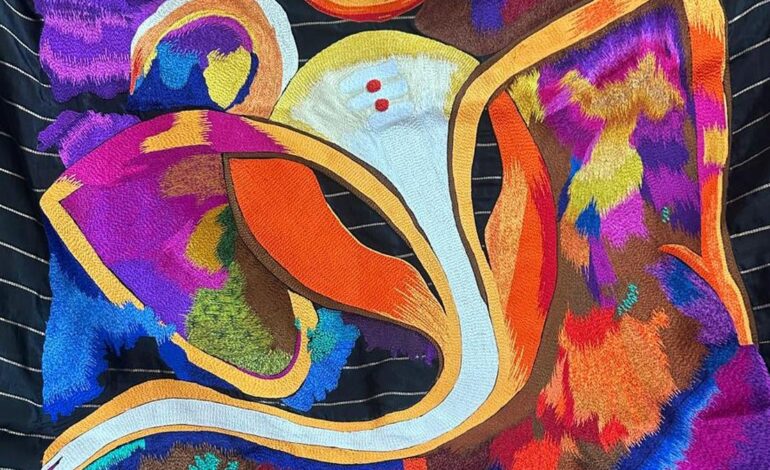
Shirin Nijhawan’s Ganesha is resplendent in a riot of colours, enhanced by varied shading techniques and French knots, reflecting Prabha’s thoughtful palette choices. Vara Ramakrishnan’s vermilion sari features extensive flat embroidery depicting a temple tower and temple car in vibrant detail. Across all four saris, Prabha’s work stands out for its richness, precision, and masterful use of colour and texture.
Mother-daughter duo Lakshmi Krishnamurthy and Kavitha Prasad both participated in Journey and Exile. A former Head of Visual Arts at Kalakshetra and a Tagore Fellow, Lakshmi Krishnamurthy brings relentless curiosity and craftsmanship to her practice. She has devoted her life to exploring, researching, and reviving pan-Indian art forms.

Memory Lane, by Lakshmi Krishnamurthy
| Photo Credit:
LaraLakshmi.Org
Her piece, Memory Lane, draws from her memories of growing up in Thanjavur, often called the granary of the South. The rich flora and fauna of her village upbringing find expression in motifs such as the lush yellow sarakkonai (Indian laburnum), vibrant gulmohar, banana and coconut palms, and playful peacocks in the background. Each motif is painted entirely freehand on ombré-dyed Kanchipuram silk, designed to resemble a parchment-like surface reminiscent of an illustrated manuscript.
Her daughter, Kavitha Prasad—an artist, architect, and educator—created a painted sari. Translating her practice onto silk required rethinking her approach: understanding how the fabric absorbs pigment and how layering behaves differently compared to paper. The result is a Kanchipuram silk sari painted with silk dyes, gutta, and acrylics—meditative in quality and rooted in close observation of the natural world.
Published – April 24, 2026 04:16 pm IST