How Tamil Nadu’s election fashion got a Gen Z makeover
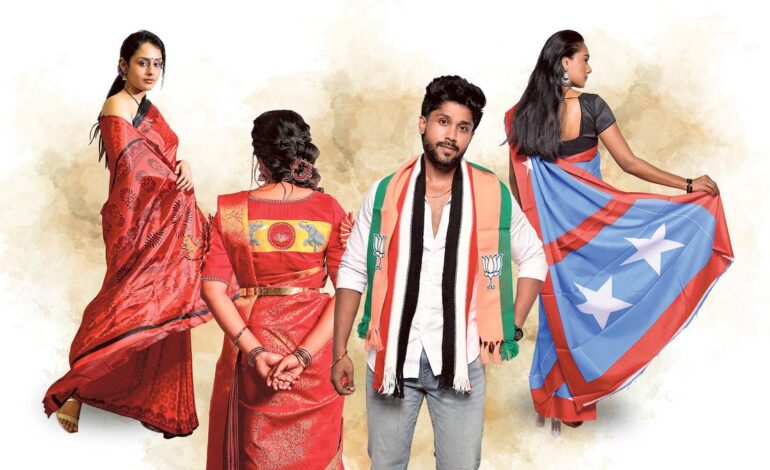

It is not often that Tamil Nadu’s voters see a sitting Chief Minister in tailored trousers while addressing the public. Nor have chudidars traditionally been part of the campaign trail. Bright, eye-catching colours have become the new political uniform, and we even have reels teaching supporters how to replicate the look of the TVK chief.
Who would have thought we would live in a world where a bridal house creates an ornate TVK blouse, complete with two squirrels rising from a fan of whistles?

Chennai: Leader of Opposition in the Tamil Nadu Assembly and AIADMK chief Edappadi K Palaniswami with BJP leader and former Telangana governor Tamilisai Soundararajan during an election roadshow at the Mylapore constituency, ahead of the state Assembly elections, in Chennai district, Wednesday, March 25, 2026.
| Photo Credit:
PTI
In 2015, The Hindu published an article titled ‘Clothing reality: TN politicians bid for new appeal’, on the transformation of the traditional Tamil dress code in politics. In it, reporter B Kolappan spoke about how leaders were trading the spotless white khadi shirt and dhoti for pants. This era saw a slow, hesitant, and tepid change in attire by a daring few.

Now, 11 years later, access to platforms like Instagram and X, along with the rise of fast fashion delivered to one’s doorstep, has brought global aesthetics into everyday wardrobes at accessible prices. Gen Z voters, in particular, are approaching the election on their terms — through AI campaigns, holograms, customised T-shirts, and theatrics staged for the perfect Instagram reel, like riding a cycle through a highway.

TVK president C. Joseph Vijay riding a bicycle at a campaign in Mahadhanapuram on Sunday.
| Photo Credit:
A. Shaikmohideen
Ahead of the 2026 Assembly Elections, wholesale and retail shopkeepers across Tamil Nadu, who trade in political party-branded shirts, mufflers, towels, dhotis and saris, say that remarkable changes have been witnessed this time around.
A quick Google search lists several hundred sellers who have stocked up on Dravida Munnetra Kazhagam (DMK) saris and shirts with the rising sun incorporated in design; colourful red and yellow Tamilaga Vettri Kazhagam (TVK) memorabilia with the whistle symbol; and the All India Anna Dravida Munnetra Kazhagam (AIADMK) and Bharatiya Janata Party (BJP) alliance’s two leaves and lotus symbol on clothes. Godown Street in Sowcarpet spills over with mufflers and towels in a variety of party colours. This, however, is routine during elections.

Countering a narrative: DMK president and Chief Minister M.K. Stalin greeting supporters at an election meeting at Paramakudi in Ramanathapuram district
| Photo Credit:
L. Balachandar
While the sales of dhotis, saris, and shirts have been greater than during the Lok Sabha election in 2024 in the State, this time we are also seeing numerous stylistic alterations including screenprinting the faces of leaders like Chief Minister MK Stalin and actor-politician Vijay, and customised logos on attire; checkered thundus (towels) like the one worn by AIADMK chief Edappadi K Palaniswami; colourful mufflers; hoodies bearing the names of political parties and constituencies; and most importantly, pants, are now steady features of the campaign mix.

Back in the day
Author and professor AR Venkatachalapathy, who wrote the book Tamil Characters: Personalities, Politics, Culture, published by Pan Macmillan India, speaks of the early aesthetic of the Dravidian movement where black and red were significant anchors of the Dravida Kazhagam (DK) party started by Periyar EV Ramasamy.
“The black symbolises the darkness and thralldom that the Dravidian people were living under. The red speaks about moving past this time. This was back in 1944. The DK was insistent about wearing these colours but when a rift between Anna and Periyar occured, he [the latter] turned up at party conferences without the black shirt. This furthered the rift,” he says.

C.N. Annadurai and Periyar
| Photo Credit:
The Hindu Archives
After DMK’s split from DK, the party subsequently moved towards white shirts and dhotis, since black was part of DK’s uniform. Anna helmed and organised a significant party-led campaign to support handloom weavers in the early 1950s when the industry was in crisis. Back then leaders and party workers wore nothing but handloom.

Academician P Ramajayam, says that with the introduction of different kinds of fabric, particularly synthetic mix, in the market has caused a deviation from the hard-line stance that the DMK once took about using handloom. “It is obviously more expensive and time consuming to wash and maintain a white-and-white outfit. Nobody today has the time for starch,” he says.
Except members of the Congress, who continue to wear khadi.

Moving on
Harikishan TV, a fifth-generation entrepreneur running Krishna Emporium at Godown Street in Sowcarpet, says that the primary material used now is polyester, especially since cotton prices have shot up. “We stock party garments through the year, but during election season, we place bulk orders in Surat where screen printing is cheaper. Designs, particularly for the pallu and the shirt pocket, are sent in advance and stocks arrive right in time for election season,” he says.
Hari adds that quality often depends on how much party workers and candidates are willing to spend. “The DMK usually asks for higher-quality saris, priced upwards of ₹200, while parties like the Desiya Murpokku Dravida Kazhagam (DMDK) and Viduthalai Chiruthaigal Katchi (VCK) are usually in the ₹160 to ₹200 range.”

Various political party flags and election campaign materials are on sale ahead of Assembly Election 2026. A scene at Parrys Corner.
| Photo Credit:
R. Ragu
Wholesaler R Suresh Kumar, who runs Niew Shankar Store on the same street, says retailers from across Tamil Nadu buy clothing to distribute in smaller towns, cities and villages. DMK, AIADMK and TVK paraphernalia have dominated sales. “The first two have consistent sales every year but the DMK checked towels, a new entrant to the market is particularly doing well,” he says. Retailers from Thoothukudi, Salem, and Vriddhachalam confirm this shift.
R Sankar of Sri Lakshanaa Sarees in Elampillai, Salem district, says his TVK and DMK saris are sold out. They highlight saris that have Vijay’s face printed across the body. “The DMK saris have Stalin and Udaiyanidhi Stalin as people prefer to see both of them together. All our saris have a synthetic tussar finish,” he says, adding that the reel they posted on Instagram with Vijay’s face went viral. The saris with the faces retail at ₹599 but saris with just the party symbol sell anywhere between ₹100 and ₹300.

Cashing in on the mania is M Madhumathi of Maya’s Bridal House in Velachery who insists that she is not a Vijay fan though everyone else around her is. “Business was slow so I designed an ornate blouse using aari work with the TVK flag on the back flanked by two squirrels [his fans are called ‘anils’ or squirrels in Tamil], rising from a pool of whistles [the party’s symbol]. The blouse costs ₹12,000 and nobody has purchased it but my reel has reached some 37 lakh views and I have gotten many inquiries since,” she says.

A squirrel emerging from a fan of whistles, the symbol for TVK.
| Photo Credit:
Special Arrangement
Long before Vijay officially announced the name of his party, M Ajay Karthick from Thoothukudi began selling shirts with a red embroidered Vijay on the shirt lapel. “We run Master Clothing and we are big fans. We screen print T-shirts and hoodies too but only for bulk orders. People often want their names and their constituency names on our T-shirts. The Thalapathy shirt first sold for ₹800 and saw tremendous demand but copies of designs have plagued us,” he sighs.
An ease
“It is all about convenience,” says DMK’s incumbent MLA from Thousand Lights constituency, Ezhilan Naganathan, who is also a senior physician. This MLA who is contesting from the same constituency this year often sporting his party colours in the inner fold of his shirt collar. “As someone who is a politician and a practising doctor, I have to step in and out of clinics. A shirt is essential for a professional look. I contacted Rafi, a tailor and designer who made some sample shirts. We settled on one where the sleeves and the collar reveal my party colours,” he says.

Thousand Lights MLA Dr. Ezhilan Naganathan during an interview with The Hindu.
| Photo Credit:
S. Shivaraj
Dr V Gokilamani, who is contesting from Avinashi, is DMK’s youngest nominee at 28, and can often be seen in black saris or salwar kameez. “It is a personal preference and is dependent on the occasion. While campaigning, I have noticed that people are warm irrespective of what I wear. I just like wearing black and red,” she says.

Dr V. Gokilamani campaigning in Avinashi.
| Photo Credit:
Special Arrangement
The same can be said of Porkodi Armstrong, wife of slain Bahujan Samaj Party (BSP) leader K Armstrong, contesting from Thiru Vi Ka Nagar constituency. She wears neutral colours and salwars in her campaign, andhas said that she seeks a broader mandate to champion the rights of Dalits and other marginalised communities.
J Balasubramaniam, Assistant Professor, Department of Journalism, Madurai Kamaraj University, says that among the first things told to young Dalit children in the 1990s was “to always ensure that everyone is highly educated and is always impeccably dressed”. It prevents any barriers to entry, he says.
He gives K. Krishnasamy of Puthiya Tamilagam (PT), who used to wear pants and Reebok and Nike shoes to the Assembly, as an example: “Cartoons were drawn in Tamil magazines commenting on his style. A leader from an oppressed community was wearing chic clothes,” he says.

Tamil Nadu Bahujan Samaj Party (BSP) chief and Thiru Vi Ka Nagar (reserved) constituency candidate Porkodi Armstrong along with former AIADMK Minister D.Jayakumar coming out after filing her nomination papers to Returning officer at Zone. 6.office, Pattalam in Chennai.
| Photo Credit:
B. Jothi Ramalingam
Balasubramaniam says he and VCK leader Thol Thirumavalavan follow revolutionary leader BR Amedkar’s style, dressing in crisp shirts, pants, blazers, and ties. He adds, “Thirumavalavan’s look has changed from the dark shirts folded above his elbow when he first began his career. Today, he sports light shirts in blue, cream and white. He has always dressed sharply though. Today the letters VCK or the party’s star symbol are often embroidered on his pocket,” he says.

Viduthalai Chiruthaigal Katchi president Thol. Thirumavalavan.
| Photo Credit:
R. Ashok
Pocket notes
Ezhilan says that he has observed several members of the party replicate this signature design, particularly on the pocket. “Everyone has their own style. The Deputy Chief Minister [Udhayanidhi Stalin] wears the symbol of the Youth Wing on his T-shirt, while TRB Rajaa [Minister for Industries] can be seen wearing the party colours on the lapel,” he says.

Udhayanidhi Stalin, DMK leader at a rally.
| Photo Credit:
Bijoy Ghosh
Durai Vaiko of Marumalarchi Dravida Munnetra Kazhagam (MDMK) flaunts the band of his party flag on the arm of his shirt, while Bharatiya Janata Party members including Tamilisai Soundararajan, L Murugan and K Annamalai, sport the lotus prominently as a scarf over their shoulders.

Senior journalist RK Radhakrishnan says that this entire exercise in personal branding began back in 2014 when Narendra Modi took a selfie outside a polling booth with the lotus that ended up going viral online. Soon, he used the party symbol in his garments and insisted that senior leadership followed suit. “This has trickled down to Tamil Nadu too,” he says.

Hindu nationalist Narendra Modi, the prime ministerial candidate for India’s main opposition Bharatiya Janata Party (BJP), takes a “selfie” with a mobile phone after casting his vote at a polling station during the seventh phase of India’s general election in the western Indian city of Ahmedabad April 30, 2014.
| Photo Credit:
Reuters
Winds of change

As Tamil Nadu heads to polls, a marked rise in new fashion trends both among candidates and party workers can be seen in customised saris, T-shirts, and party merch. The emergence of pants and salwars are a particularly distinct change.
| Photo Credit:
J. Johan Sathyadas
Eleven years since publishing his article, have B Kolappan’s observations on this functional shift towards convenient clothing in politics changed? “People might be wearing pants, jeans, and T-shirts but there is something that we are forgetting. The idea of identity. Some things — the language we speak, the food we eat — remain consistent despite changing times. The dhoti is like that. Despite the fact that pants are now being utilised, the charm of the dhoti remains. It is why politicians continue to wear it in the Assembly,” he says, adding “Outside of the State, it is central to our identity.”