
France, Spain battle wildfires as more than 2,50,000 people are forced to flee homes
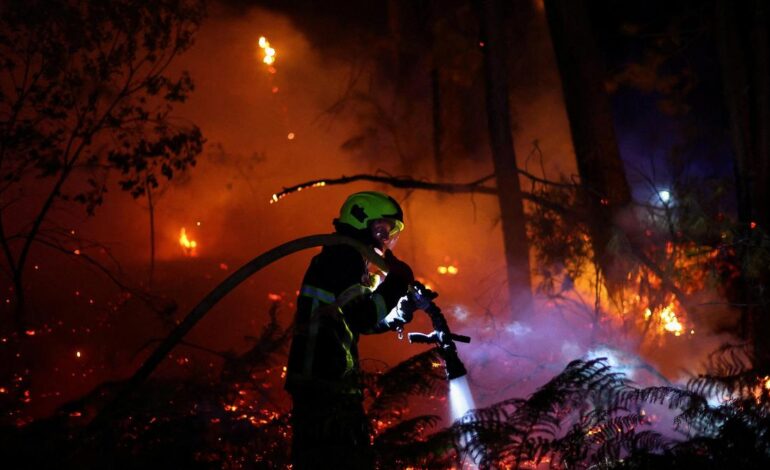

France sent a hulking military cargo plane to dump tonnes of flame retardants as it battled raging wildfires on Saturday (July 25, 2026) and slashed the final stage of the Tour de France to redeploy security personnel to the blazes that forced tens of thousands of people to flee their homes.
The latest wildfires in southern Europe this week have displaced more than 2,50,000 people, including some 70,000 people who were evacuated in central Spain. One man died in Manises, the municipality reported on its Facebook page, the first death so far in the blazes.

Flames burn during a wildfire in La Vall d’Uixo, Castellon, Spain, on July 25, 2026.Flames burn during a wildfire in La Vall d’Uixo, Castellon, Spain, on July 25, 2026.
| Photo Credit:
Reuters
In France, the giant A400M transporter swooped in low, its long plume of ochre-coloured retardant trailing over drought-hit woodlands in the southwest as fire crews on the ground fought flames that authorities feared could spread toward the wine region city of Bordeaux.
Race organisers and the Paris police department announced a truncated 21st and final stage on Sunday (July 26, 2026) for the three-week Tour, France’s most famous annual sporting event, reflecting the immense strain that two large fires in the southwest are causing for emergency services.

Tour riders will race on Sunday (July 26, 2026) inside Paris, rather than starting from Thoiry, west of the capital, on a circuit of 89 kilometres (55 miles) — down by a third from the 133-kilometre (82.5-mile) route that had been planned. Part of the race’s security detail will instead “reinforce the response efforts in the areas affected by the wildfires”, according to the statement announcing the ”exceptional measures made necessary by the situation”.
Shifting winds raise concerns for Bordeaux
With winds expected to shift in a west-to-east direction on Saturday afternoon, potentially driving flames closer to Bordeaux, fire crews and authorities were digging trenches, using retardants and taking other blaze-blocking steps, French Interior Minister Laurent Nunez said, predicting a “long and very difficult” battle.

He said the fire was about 30 kilometres (20 miles) west of the city and lost some of its intensity overnight. The prefect of the Gironde region that includes Bordeaux said the blaze grew into “a firestorm” on Friday after igniting earlier this week and cautioned that it “remains dangerous” even though firefighters were making progress.
The government mobilised soldiers to join fire crews and was rushing in 1.5 million face masks to protect against choking smoke.
Authorities ordered people between the fire and Bordeaux to evacuate, including from parts of the city’s western suburbs and other towns and villages.

French Prime Minister Sebastien Lecornu described the fires as unprecedented and said the Gironde blaze became so strong on Friday (July 24, 2026) that it had begun generating its own winds. Firefighting teams were being reinforced with the addition of hundreds of soldiers and breathing masks to filter out potentially noxious smoke particles were being rushed to those exposed, Lecornu said.
In Bordeaux, authorities took in thousands of evacuees, offering them food and shelter in an exhibition centre, and the city’s mayor said it could be equipped to welcome as many as 10,000 people if that became necessary. The city’s airport said it remained open but that its bus and tram services were suspended.
Evacuation orders were sent with special alerts to mobile phones, instructing people to leave, Gironde prefect Sophie Brocas said. She said the fire had destroyed about 140 homes in the region.
Magnitude of the wildfires caught authorities off guard
The French military’s A400M transport plane, specially converted for firefighting, was a heavyweight new tool in the battle. It joined at least 18 other water- and retardant-dropping aircraft and helicopters that Nunez said were deployed in the Gironde region, working in rotation in the smoke-filled skies.
The virulence of the French and Spanish wildfires, fuelled by high temperatures and the long-term effects of climate change, caught fire crews and authorities off guard.

Smoke rises as flames burn during a wildfire at Ares, Grionde, amongst worsening drought conditions following a heatwave and water shortages across much of France, on July 25, 2026.
| Photo Credit:
Reuters
Firefighters in Spain said the blazes spread so fast and violently that they could not be tackled head-on. In France, some people even fled by boat when flames swept through touristic towns on the Atlantic coast.
“We’ve never seen anything like this,” said Javier Organista, a resident of El Tiemblo, west of Madrid, where fire charred a famed chestnut grove. “When we saw the flames coming into our town, surrounding us, leaving us with practically no way out, all the neighbours joined together to try to stop its advance.”
Published – July 26, 2026 11:01 am IST